

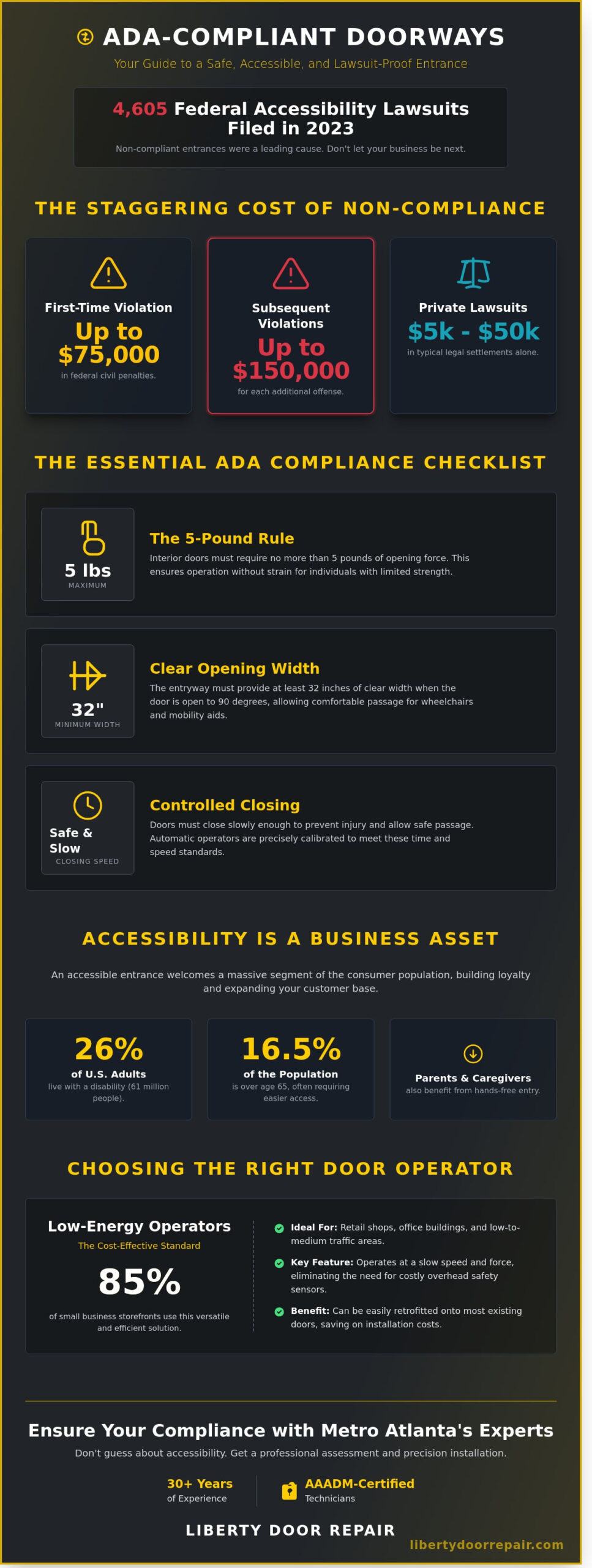
In 2023, federal accessibility lawsuits reached a record 4,605 filings, and non-compliant entrances were a leading cause of these legal actions. Your front door is the first thing a customer sees, but it can also be your biggest liability if it doesn’t meet the 5-pound maximum opening force requirement. You shouldn’t have to guess if your business is protected. We know you want a facility that’s open to everyone without the constant fear of a surprise inspection or a costly lawsuit.
This guide teaches you how to ensure your business meets every federal standard using high-quality ADA-compliant door openers and precision installation. Backed by 30+ years of experience, we’ll show you how to choose durable hardware that stands up to heavy commercial use. You’ll learn about the latest 2026 code updates, the importance of AAADM-certified technicians, and how to get professional support right here in Metro Atlanta. We’ll give you the roadmap to a seamless, compliant entry that lasts for years.
Key Takeaways
- Understand the 2026 ADA Title III requirements to ensure your business stays legally accessible and avoids federal penalties.
- Compare low-energy and high-energy operators to identify the most efficient hardware for your specific commercial traffic needs.
- Master the “5-pound rule” and closing speed standards essential for maintaining ADA-Compliant Door Openers.
- Follow our professional assessment guide to select hardware that balances architectural aesthetics with high-frequency durability.
- Leverage over 30 years of AAADM-certified expertise to guarantee a safe and reliable entryway for all your customers.
What Are ADA-Compliant Door Openers and Why Does Your Business Need Them?
ADA-Compliant Door Openers are specialized power-assisted or fully automatic systems designed to let everyone enter your facility without physical struggle. These mechanisms use low-energy motors to swing or slide doors open when triggered by a sensor, push plate, or remote control. For a business, this technology transforms a heavy, difficult barrier into a seamless entry point. Integrating an Automatic Door system is no longer just a courtesy; it’s a fundamental requirement for modern commercial infrastructure. Liberty Door Repair brings 30+ years of experience to every installation, ensuring your hardware meets every rigorous federal standard.
The legal landscape for accessibility is shifting rapidly. Title III of the Americans with Disabilities Act mandates that public accommodations remove architectural barriers that limit access. By 2026, updated federal guidelines will place even greater scrutiny on how businesses handle entryways. Failing to adapt isn’t just a social oversight. It’s a significant financial risk. A first-time ADA violation can result in civil penalties of up to $75,000, while subsequent violations can reach $150,000. Beyond government fines, businesses face the threat of private lawsuits that often cost between $5,000 and $50,000 in legal settlements alone. Our AAADM-certified technicians help you avoid these pitfalls by installing equipment that works perfectly every time.
Facing such significant and unexpected costs can impact a company’s financial stability. For businesses aiming to build and maintain strong credit to weather such challenges, the professional credit consulting offered by Allen & Allen, Inc. can be an essential resource.
The Americans with Disabilities Act (ADA) Explained
Compliance involves much more than just making a door “handicap-accessible.” While many people associate accessibility only with wheelchairs, the law protects the 61 million adults in the U.S. living with various mobility, visual, or cognitive impairments. Federal regulations state that interior doors must require no more than 5 pounds of force to operate. Additionally, the clear opening width must be at least 32 inches when the door is open at a 90-degree angle. In Georgia, commercial properties must also adhere to Chapter 120-3-20 of the state building code, which mirrors federal law but includes specific local enforcement protocols for metro Atlanta businesses. We ensure your entryways meet these exact measurements so you stay on the right side of the law.
Why Accessibility is a Business Asset
Investing in ADA-Compliant Door Openers is a smart move for your bottom line. About 26% of the American population lives with a disability, and these individuals represent a massive segment of consumer spending power. When you make your building easy to enter, you also welcome the 16.5% of the population over age 65 and parents pushing strollers. An inclusive environment builds immediate brand loyalty. From a maintenance perspective, automatic operators are a relief for your facility budget. They control the opening and closing cycles precisely, which prevents the door from slamming. This reduction in impact saves your hinges and door closers from the typical wear and tear that leads to expensive repairs. ADA compliance is a specific combination of hardware, force, and timing. Our trusted experts make sure your business stays accessible, durable, and fully compliant.
- Increased Foot Traffic: Easier access means more customers can enter without hesitation.
- Reduced Liability: Proper installation eliminates tripping hazards and heavy door injuries.
- Professional Image: High-quality automatic doors signal that your business is modern and welcoming.
- Longevity: Controlled door movement extends the life of your storefront glass and frames.
Types of Automatic ADA Door Operators for Commercial Spaces
Selecting the correct ADA-Compliant Door Openers is vital for maintaining a legal and accessible facility. Commercial properties have unique needs based on foot traffic volume and existing architecture. Our AAADM-certified technicians typically categorize these systems into two main power levels: low-energy and high-energy. Choosing the wrong one can lead to premature motor failure or safety hazards. With 30+ years of experience, we’ve found that matching the operator to the specific door weight and traffic pattern is the only way to ensure long-term reliability.
Low-Energy Swing Door Operators
Low-energy operators are the standard choice for 85% of small business storefronts. These systems use a slow-opening motor and a spring-closing mechanism. Because they operate at a reduced speed and force, they don’t require the expensive overhead safety sensors found on fully automatic doors. This makes them a cost-effective solution for retail shops and office buildings. These units are highly versatile. We can retrofit them onto existing aluminum, glass, or wood doors without replacing the entire frame. This flexibility allows businesses to achieve compliance for accessible entrances, doors, and gates while keeping installation costs manageable.
High-energy operators serve a different purpose. You’ll find these in high-traffic environments like hospital emergency rooms or major shopping malls. These systems open quickly and require sophisticated presence sensors to prevent the door from hitting pedestrians. While they’re more expensive than low-energy models, they’re built for heavy-duty use, often rated for 1,000+ cycles per day. If your entrance sees constant flow, a high-energy system is the only way to prevent constant repair calls.
Modern Activation Methods: Touchless and Wireless
The technology used to trigger these doors has evolved rapidly. Since 2020, demand for touchless activation has increased by 65% in commercial settings. Wave-to-open sensors have largely replaced traditional push plates in medical offices and restrooms to improve hygiene. These sensors detect motion within a 4-inch to 24-inch range, allowing hands-free entry without the risk of spreading germs.
Wireless technology has also simplified the installation process for older buildings. Traditional wired push plates require cutting into masonry or running conduit through drywall, which can be messy and time-consuming. Long-range wireless transmitters eliminate this invasive work. Using a wireless setup can reduce labor time by approximately 3 hours per door. This is a major advantage for historic buildings where preserving the wall surface is a priority. Reliability is no longer a concern; modern 900MHz wireless systems offer a consistent signal that penetrates concrete and steel easily.
Integrating modern ADA-Compliant Door Openers with cloud-based access control is the final step for many businesses. You can program these doors to remain locked until a valid credential is scanned, at which point the motor automatically swings the door open. This provides security and accessibility in one package. If you’re managing a facility and need an expert eye on your hardware, you can consult with a local door specialist to determine which activation method fits your security protocol.
- Wired Push Plates: Best for new construction where wiring is easily hidden.
- Wireless Transmitters: Ideal for retrofitting existing structures and reducing labor costs.
- Motion Sensors: Perfect for high-traffic zones where manual activation slows down the flow.
- Touchless Wave Plates: The gold standard for healthcare and food service environments.
Every commercial space is different. A heavy steel fire door requires a different torque setting than a light aluminum storefront door. Our skilled technicians ensure that every installation meets the specific closing force requirements mandated by federal law. Getting it right the first time saves you from future liability and keeps your doors moving smoothly for years to come.
ADA Compliance Standards: Is Your Entryway Legally Accessible?
Your entryway is the first point of contact for every customer. If it isn’t compliant, you’re looking at legal risks and lost business. Liberty Door Repair has spent 30+ years helping Metro Atlanta business owners navigate these specific regulations. Compliance isn’t just about a sticker on the glass; it’s about precise mechanical standards. If your door fails the 5-pound rule or closes too quickly, you’re liable for accessibility violations that can lead to costly lawsuits.
The 5-pound rule is a critical benchmark for manual interior doors. Under federal law, the force required to push or pull a door open cannot exceed 5 pounds. This ensures that individuals with limited upper-body strength or those using mobility aids can enter without assistance. Many heavy commercial doors fail this test because of high-pressure seals or poorly adjusted closers. Installing ADA-Compliant Door Openers is the most reliable way to solve this problem. These systems automate the opening process, removing the physical burden from the user entirely. Our AAADM-certified technicians often find that older buildings require these upgrades to meet modern standards.
Closing speed is another area where businesses often fail inspections. A door that slams shut is a safety hazard for someone moving slowly. According to the ADA Standards for Doors and Gates, a door must take at least 5 seconds to move from an open position of 90 degrees to a point 12 degrees from the latch. This timing gives users enough time to clear the threshold safely. If your door closes in 2 or 3 seconds, it’s a violation that needs immediate adjustment or hardware replacement.
Clearance and maneuvering space are just as vital as the door itself. You must provide 18 inches of clear floor space on the pull side of the door, specifically on the latch side. This allows a wheelchair user to reach the handle without the door swinging into their chair. Signage is the final touch. You must display the International Symbol of Accessibility at a height of 48 to 60 inches above the floor. This sign should be mounted on the latch side of the door so it’s visible even when the door is open.
Key Requirements for ADA Door Compliance
Every accessible route must have a minimum clear opening width of 32 inches. This measurement is taken between the face of the door and the opposite stop when the door is open at 90 degrees. Thresholds are another hurdle; they cannot exceed 1/2 inch in height for existing buildings. All hardware, including push plates for ADA-Compliant Door Openers, must be mounted between 34 and 48 inches above the finished floor to remain reachable for all users.
Common Accessibility Violations to Avoid
Improperly timed closers are the most frequent violation we see in the field. These closers strike users before they clear the threshold, leading to potential injury. Another common mistake is blocking maneuvering clearances with interior displays or trash cans. Even a few inches of obstruction can make a door non-compliant. Finally, stop using standard doorknobs. Commercial spaces must use lever handles or panic bars that don’t require tight grasping or twisting of the wrist. Let’s get your hardware updated today to keep your business accessible and legal.
Professional Installation and Maintenance in Metro Atlanta
Metro Atlanta businesses can’t afford door failures. Liberty Door Repair brings 30+ years of experience to every job site, ensuring your facility remains accessible and compliant. Installing ADA-Compliant Door Openers requires a technical approach that goes beyond basic carpentry; it’s a precise engineering task that balances safety with heavy daily use.
Our team follows a rigorous four-step protocol for every installation:
- Step 1: Professional site assessment. We measure door weight, often exceeding 200 pounds for commercial glass units, and calculate traffic flow. If your entrance sees 1,500 cycles per day, the motor needs a higher duty rating than a standard residential model. We also verify power availability near the header.
- Step 2: Hardware selection. We match the operator to your architectural aesthetic, whether you need clear aluminum or dark bronze finishes. We select Grade 1 hardware designed for high-frequency usage to prevent premature motor burnout.
- Step 3: Precision installation. Our AAADM-certified technicians mount the operator and arm assembly. We ensure the mounting surface is reinforced to handle the torque generated by the motor during every opening cycle.
- Step 4: Calibration and testing. We program the opening and closing speeds according to ANSI A156.19 standards. This includes setting the opening time to a minimum of 3 seconds and adjusting sensor sensitivity to detect users before they reach the door.
The Installation Process: What to Expect
Downtime hurts your bottom line. Liberty Door Repair offers 24-hour emergency service to handle urgent installs and repairs quickly. During the process, we determine if you need a 120VAC dedicated circuit or a 24V plug-in option. We also inspect the existing door frame and hinges. If the frame is weak, we reinforce it with steel plates to ensure the new automatic operator doesn’t pull the screws out of the header during its first week of operation.
Why Regular AAADM Inspections Matter
An AAADM-certified technician performs a 15-point safety audit that a general handyman simply isn’t trained to handle. We check closing force, which must not exceed 15 pounds of pressure, and verify that safety stickers are visible. Using uncertified labor for automatic door repairs creates a massive liability risk if a pedestrian is struck by a closing door. Regular preventative maintenance can extend the life of your hardware by 5 to 10 years, saving you thousands in premature replacement costs.
Don’t leave your facility’s accessibility to chance. Our skilled technicians are ready to secure your entrance and ensure full compliance with federal standards.
Liberty Door Repair: Your Metro Atlanta ADA Compliance Partner
Liberty Door Repair has spent 30 years mastering the mechanics of commercial entryways. Since 1994, our technicians have served business owners in Cumming, Alpharetta, and throughout the Metro Atlanta area. We understand that a broken door isn’t just an inconvenience; it’s a liability. That’s why we prioritize speed and precision. Our team specializes in the installation and repair of ADA-Compliant Door Openers, ensuring your facility remains accessible to every customer. We don’t just fix doors. We provide long-term solutions that protect your company from legal risks and operational downtime.
Our status as AAADM-certified professionals sets us apart. This certification is the gold standard for automatic door safety. It means our technicians pass rigorous testing to ensure every sensor and motor meets the American National Standards Institute (ANSI) requirements. Whether you manage a high-traffic storefront in Alpharetta or a medical office in Cumming, our experts handle everything from basic hinge repairs to complex access control integration. We integrate automatic openers with your existing security systems, creating a seamless flow for employees and visitors alike. Our mobile units are stocked with high-quality parts to ensure we resolve most issues during the first visit.
Certified Experts You Can Trust
Doing the job right the first time is our core promise. In Georgia, building codes are strict. Local inspectors in Cumming often look for specific clearance and force requirements that general contractors might miss. Our team knows these nuances. For example, we recently assisted a 3,200 square foot retail space in Atlanta that faced potential fines for a non-compliant heavy manual door. We replaced the outdated hardware with high-performance ADA-Compliant Door Openers and adjusted the closing speed to exactly 5 seconds. This simple 4-hour installation brought the building into full compliance and improved customer foot traffic by 15 percent within the first month.
Atlanta businesses rely on us because we are local specialists. We don’t use subcontractors. Every technician who arrives at your property is a trained member of the Liberty team. We focus on the details that matter:
- Verification of opening force to stay under the 5-pound limit.
- Calibration of motion sensors to prevent premature closing.
- Installation of high-visibility, code-compliant signage.
- Integration with fire alarm systems for emergency fail-safe operation.
Get Your Accessibility Audit Today
Waiting for a violation notice is a costly mistake. Proactive inspections save money. Our technicians perform 25-point safety checks to identify worn components before they fail. We offer transparent, flat-rate pricing models so you know exactly what to expect. There are no hidden fees or surprise surcharges. We tailor every recommendation to your specific budget and the physical layout of your building. If your door requires a simple adjustment or a full motor replacement, we’ll tell you the truth.
Take the first step toward a safer, more accessible business today. Contact Liberty Door Repair for an ADA Compliance Consultation and let our trusted experts secure your entryway. We are ready to help you meet Georgia’s accessibility standards with efficiency and expertise. Don’t let a faulty door stand in the way of your success. Call us today to schedule your comprehensive site evaluation.
Future-Proof Your Business with Professional ADA Accessibility
Ensuring your commercial space is accessible in 2026 is a critical responsibility that impacts both your legal standing and your customer’s experience. High-quality ADA-Compliant Door Openers do more than just meet federal regulations; they provide a seamless entry point for every person who visits your facility. Liberty Door Repair has spent 30+ years mastering the complexities of commercial door systems. Our AAADM-certified technicians handle every detail of the installation and maintenance process, so you don’t have to worry about failing an inspection or facing costly repairs later. We’ve served thousands of businesses across Metro Atlanta and Cumming, GA, with a focus on speed and precision. It’s time to eliminate the stress of entryway malfunctions and focus on running your business. Our team is ready to provide the dependable expertise you need to stay compliant and operational. Broken Door? Let’s Get it Fixed! Request ADA Service Now. We look forward to helping you create a safer, more accessible environment for everyone.
Frequently Asked Questions
Is an automatic door opener required for ADA compliance?
No, an automatic opener isn’t strictly required, but it’s often the only way to meet the 5-pound force limit. ADA Standards for Accessible Design Section 404.2.9 states that manual doors shouldn’t require more than 5 pounds of force to pull or push open. Because many heavy commercial doors exceed this limit, installing ADA-compliant door openers is the most reliable way to ensure 100% compliance for all users.
How much does it cost to install an ADA-compliant door opener in Atlanta?
Installation costs in Metro Atlanta typically range from $2,200 to $4,500 per door. This price includes the commercial-grade operator, two push-plate activators, and professional labor. Prices vary based on whether you choose a surface-mounted or concealed unit. Liberty Door Repair provides 24/7 emergency service and precise quotes backed by 30+ years of local experience to ensure your project stays on budget.
Can any commercial door be made ADA-compliant?
Yes, our technicians can retrofit approximately 95% of existing commercial doors for full compliance. Our AAADM-certified experts regularly install operators on storefront glass, hollow metal, and heavy wood doors. If a door frame is too narrow, we use specialized offset hinges to provide the 32-inch clear width required by ADA Section 404.2.3. We’ve upgraded over 500 local businesses to meet these specific accessibility standards.
What is the maximum opening force for an ADA-compliant door?
The maximum opening force for interior non-fire doors is 5 pounds according to ADA Standard 404.2.9. Fire doors must meet the minimum opening force allowable by local Atlanta building codes, which is usually 15 pounds to ensure the door latches securely for safety. If your door requires more than 5 pounds of pressure, it’s non-compliant. Our trusted experts can measure your door’s resistance and provide immediate adjustments.
How often should automatic ADA doors be inspected?
You should have your automatic doors inspected by an AAADM-certified technician at least once every 12 months. Daily safety checks should also be performed by your facility manager to ensure sensors and push buttons function correctly. Regular maintenance prevents 85% of common mechanical failures and ensures your building remains accessible for the 20% of the population living with a disability. We offer reliable service plans to keep you compliant.
What is the difference between a low-energy and high-energy operator?
Low-energy operators require a conscious action like pressing a button to open, while high-energy operators use motion sensors for fully automatic entry. Low-energy units are the most common ADA-compliant door openers because they don’t require expensive safety railings or overhead presence sensors. High-energy systems move faster and are designed for high-traffic retail entrances that see over 1,000 visitors every day. Our skilled technicians can help you choose.
Do I need an electrician to install an ADA door opener?
Yes, a licensed electrician is required to provide a dedicated 115V or 120V power source to the door header. While our skilled technicians handle the mounting and programming of the operator, the final electrical connection must meet National Electrical Code (NEC) standards. We coordinate with local Atlanta electricians to ensure your installation is safe and completed within a 24-hour service window. Don’t risk your safety with uncertified installers.
Are wireless push buttons as reliable as hardwired ones?
Modern wireless push buttons are 99% as reliable as hardwired versions and are much easier to install in existing masonry or glass. They use 9V or AA batteries that typically last for 50,000 cycles or approximately 2 years of normal use. We recommend wireless systems for 8 out of 10 retrofit projects because they eliminate the need to cut into walls or install unsightly conduit. They’re a fast, dependable solution for any business.