

At 2:00 AM last Tuesday, a local homeowner was woken up by a persistent, high pitched chirp echoing from the garage. That sound isn’t just an annoyance. It’s a critical warning that your backup system is failing. As a trusted expert with 30+ years of experience, we know a failing liftmaster garage door opener battery leads to frustrating lockouts during unexpected power outages. You shouldn’t have to guess if the problem is your motor unit or a simple remote. It’s stressful when your home’s primary entry point feels unreliable and loud.
No matter where you live, finding a qualified professional is the most important step. While we serve the Metro Atlanta area, homeowners in other regions can find similar expert help; for example, residents looking for service in Florida have trusted options like Ace’s Garage Door Repair & Installation Tampa for their needs.
We agree that your garage door must work every single time, even when the lights go out. This 2026 guide helps you silence the beeping immediately and replace the correct power cell with confidence. You’ll learn the specific differences between motor backups and handheld remote batteries so you don’t waste money on parts you don’t need. We are going to walk you through a professional troubleshooting process that ensures your LiftMaster system remains dependable for years to come.
Key Takeaways
- Identify the difference between the 485LM backup system and peripheral remote batteries to maintain complete control over your garage access.
- Follow our professional step-by-step guide to safely replace your liftmaster garage door opener battery using simple household tools.
- Learn how to troubleshoot common remote range issues and protect your system from the draining effects of Georgia’s seasonal temperature shifts.
- Recognize the critical warning signs of battery failure to ensure your backup power is ready to perform during an unexpected outage.
- Gain peace of mind by knowing when to contact a trusted expert for a comprehensive safety inspection from an AAADM-certified technician.
Understanding Your LiftMaster Garage Door Opener Battery System
Your garage door shouldn’t be a source of stress during a power outage. Liberty Door Repair brings 30+ years of experience to every service call, and we know that a reliable liftmaster garage door opener battery is the backbone of a functional home. Your system actually uses two different types of batteries. The first is the motor backup battery, typically the 485LM model. This 12V 5Ah lead-acid unit lives inside the motor head of Elite and Premium series models. The second group consists of peripheral batteries. These small 3V lithium (CR2032) or 9V alkaline cells power your remote controls and wireless keypads.
A garage door opener must be ready for Georgia’s unpredictable weather. Our local storm seasons, particularly from March to May, often result in sudden power grid failures. The Battery Backup System (BBU) ensures your door remains operational when the lights go out. In Metro Atlanta, approximately 70 percent of modern LiftMaster installations now feature BBU technology as a standard safety requirement. This system allows for up to 20 full cycles during a 24-hour power loss. Without it, you are forced to manually lift a door that can weigh over 150 pounds.
Why Does My LiftMaster Opener Beep?
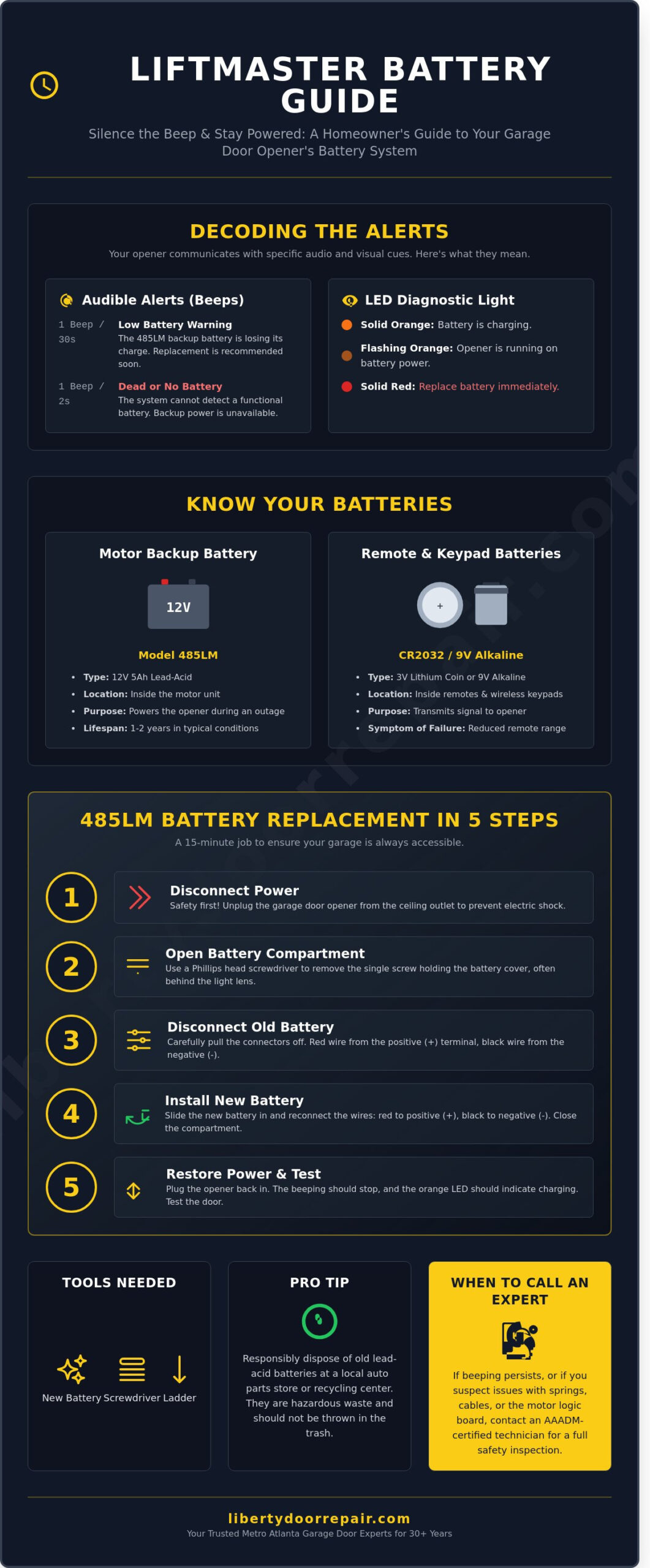
LiftMaster units use audible alerts to communicate their health status. If your motor unit beeps every 30 seconds, it indicates a “Low Battery” state. This means the 485LM unit is losing its ability to hold a full charge. If the beep accelerates to every 2 seconds, the system detects a “No Battery” error or a completely dead cell. You should also check the LED diagnostic light on the motor housing. A solid orange light confirms the battery is currently charging. A flashing orange light means the door is running on battery power. A solid red light is an urgent signal to replace the liftmaster garage door opener battery immediately. Smart control panels will also display a “Battery Replacement Suggested” alert when the unit’s capacity drops below 80 percent.
Safety Regulations and the BBU
Battery safety is now a legal benchmark in the industry. California’s SB-969, which took effect on July 1, 2019, remains the gold standard for safety regulations. It requires all new residential garage door openers to include a backup battery. This law was passed after several residents were trapped in garages during wildfires when the power failed. A dead battery creates a significant entrapment risk. If you pull the emergency release cord on a door with a broken or weakened spring, the door can crash down without warning. A functional BBU keeps the motor engaged, providing a controlled and safe opening process.
Our AAADM-certified technicians understand these mechanical nuances. We don’t just swap parts; we verify the entire safety system. Relying on a trusted expert ensures that your backup power integrates perfectly with the motor’s logic board. This professional oversight prevents common errors, such as improper voltage spikes that can fry sensitive electronics. We provide reliable solutions that keep your family safe and your property accessible in any emergency.
How to Replace the LiftMaster 485LM Backup Battery
A dead backup battery often reveals itself through a persistent beeping sound every 30 seconds. This signal means your system won’t function during a power outage. Replacing a liftmaster garage door opener battery is a task most homeowners can complete in about 15 minutes. At Liberty Door Repair, our technicians have performed these swaps for over 30 years, and we recommend staying proactive to avoid being locked out of your garage during a storm. You don’t need a massive toolkit for this job. Gather a sturdy ladder, a Phillips head screwdriver, and a fresh 12V 5AH replacement battery before you begin.
Safety is the first step in any electrical repair. Start by unplugging the garage door opener from the AC power outlet. This eliminates the risk of electric shock or accidental door activation while your hands are near the internal wiring. Once the power is killed, climb your ladder to reach the motor head. Most LiftMaster units house the battery behind the light lens or a specific side panel secured by a single screw. Use your Phillips screwdriver to remove this fastener and swing the compartment door open to reveal the old battery unit.
Inside the compartment, you’ll see two wires connected to the battery terminals. Carefully pull the connectors off the tabs. The red wire connects to the positive terminal, and the black wire connects to the negative terminal. Slide the heavy lead-acid battery out of its housing. It’s vital to safely dispose of the old battery at a local recycling center or a specialized battery retailer. Lead-acid components are hazardous and shouldn’t end up in your standard trash bin. Once the old unit is out, slide the new liftmaster garage door opener battery into the slot with the terminals facing outward.
Reconnect the wire leads by matching the colors. Push the red connector onto the red terminal and the black connector onto the black terminal until they click firmly into place. If these connections are loose, the battery won’t charge properly. Tuck the wires back into the housing so they don’t get pinched, then close the compartment cover and tighten the screw. Plug the motor back into the wall outlet. If the beeping stops immediately, you’ve successfully restored the connection.
Identifying the Correct Replacement Model
The 485LM is the industry standard for LiftMaster backup systems, but you must verify the voltage and amperage before installation. Every unit we use at Liberty Door Repair meets the strict 12V 5AH specifications required by the manufacturer. Using an incorrect battery can overwhelm the charging circuit or fail to provide enough torque to lift a 150-pound garage door. While generic batteries exist, choosing high-quality OEM or certified aftermarket parts ensures the internal logic board recognizes the power source without errors.
Testing the New Installation
Verification is the final step for any trusted expert. Perform a ‘Power Loss Test’ by unplugging the opener again and attempting to open the door using your wall button. The door should move, though it may travel slower than usual to conserve energy. Look at the status LED located near the battery compartment or on the wall control panel. A solid green light indicates the system is fully functional and the battery is healthy. A new LiftMaster battery typically requires a full 24 hours to reach a 100% charge after the initial installation. If your system continues to beep after 24 hours, you might need a professional inspection to check for a faulty charging circuit.
Troubleshooting LiftMaster Remote and Keypad Battery Issues
It starts with a minor annoyance. You press the button from the driveway, and nothing happens. You pull closer, eventually touching the bumper to the garage door before the motor finally engages. This loss of range is the most common symptom of a failing liftmaster garage door opener battery. When the signal weakens, the radio frequency cannot penetrate the door panel or overcome local interference. Liberty Door Repair technicians often see this issue spike when the temperature drops. Metro Atlanta experiences an average of 36 nights a year where temperatures fall below freezing. These cold snaps cause the chemical reactions inside lithium coin cells to slow down, reducing voltage output and killing your remote’s range instantly.
Before you buy a replacement, identify your specific hardware. Flip the remote over and look for the model number printed on the back. You will likely see designations like 371LM, 893MAX, or 971LM. If the text is worn away, look at the “Learn” button on the motor unit itself. A yellow learn button usually indicates a newer Security+ 2.0 system requiring an 893MAX remote, while a purple button signifies an older 315MHz system like the 371LM. Reliability in these components is a safety priority. Legislative actions like California Senate Bill 969 underscore the importance of garage door power systems by mandating battery backups for residential openers. While that law targets the motor unit, the logic applies to your handheld devices. A dead remote battery during a storm or power outage is a major security vulnerability.
| Remote/Keypad Model | Battery Type Required |
|---|---|
| 893MAX / 890MAX / 371LM | CR2032 (3V Lithium) |
| 811LM / 813LM | CR2016 (x2) |
| 877LM / 878MAX (Keypads) | 9V Alkaline |
Replacing Remote Control Batteries (CR2032)
To open your remote, use the visor clip as a lever or insert a small coin into the slot on the side of the casing. Twist gently to pop the plastic halves apart. While the case is open, inspect the metal contacts. We frequently find “ghost” button presses caused by worn contacts or debris. This keeps the transmitter active, draining a brand-new liftmaster garage door opener battery in less than 48 hours. If the remote doesn’t work after the swap, you must re-sync it. Press and release the “Learn” button on the motor, then hold the remote button until the overhead lights flash. Our AAADM-certified experts recommend testing the range from the street immediately after syncing.
Keypad Battery Maintenance (9V)
Wireless keypads face the harshest conditions because they stay outside year-round. Slide the keypad cover up to reveal the mounting screws and the battery compartment at the bottom. Check the terminals for white, powdery corrosion. If you find any, clean the contacts with a cotton swab dipped in white vinegar before installing the new cell. Always use a high-quality 9V alkaline battery. Rechargeable 9V batteries are insufficient for this application. They often output only 7.2V to 8.4V, which isn’t enough to power the backlit keys and the transmitter simultaneously. With 30+ years of experience, we’ve found that standard alkaline cells provide the most stable voltage for outdoor entry systems.
Battery Lifespan, Testing, and Common Failure Signs
Most LiftMaster backup batteries provide reliable service for a period of 2 to 3 years. After this point, the chemical components inside the 12V 5Ah lead-acid housing begin to break down. This timeline shortens significantly for homeowners in Cumming, GA. Garage temperatures in the South often exceed 115 degrees Fahrenheit during July and August. Intense heat causes the internal plates to sulfate faster. This chemical reaction prevents the liftmaster garage door opener battery from holding a full charge. A battery that worked perfectly during the spring might fail the first time a summer thunderstorm knocks out the local power grid.
Watch for specific red flags before you get stuck. Your LiftMaster unit will usually beep once every 30 seconds when the charge is low. You might also notice the motor running slower than usual or the wall station lights dimming when the door starts its cycle. Sometimes you’ll encounter what we call a “phantom beep.” This occurs when the battery itself is brand new but the unit continues to signal a failure. In these cases, the internal charging circuit on the logic board has likely failed. Our skilled technicians frequently find that the unit is no longer sending the necessary trickle charge to the battery terminals.
Proactive Testing Schedule
Test your liftmaster garage door opener battery twice a year. We recommend doing this when you change your clocks for Daylight Saving Time in March and November. Disconnect the power cord from the ceiling outlet and run the door using only the battery. If the door moves sluggishly or stops halfway, the cells are depleted. You can also check the “Learn” button on the motor head for diagnostic LED flashes. A battery showing 0V is often a sign of a failed logic board rather than a dead battery.
When It’s Not the Battery
Sometimes the problem lies deeper than the power cell. A frayed power cord or a blown transformer can prevent the unit from receiving its required 120V AC input. Check the wiring leading to your wall-mounted control panel. A short in these thin 22-gauge wires can mimic battery failure symptoms. Most LiftMaster units have a service life of 10 to 15 years. If your opener is older than 12 years and starts eating through batteries every six months, it’s time to consider a full replacement. Liberty Door Repair brings 30+ years of experience to every diagnostic call.
Don’t wait for a power outage to find out your backup system is dead. We provide reliable solutions to keep your home secure and accessible. Contact Liberty Door Repair for expert garage door opener service to ensure your system stays reliable through every season.
Professional Garage Door Service in Cumming and Metro Atlanta
A beeping Liftmaster garage door opener battery often signals more than just a simple power issue. It can indicate underlying electrical strain or mechanical wear that shortens the life of your entire system. While changing a battery seems like a quick task, the safety of your home depends on a system that functions perfectly under pressure. Liberty Door Repair provides the technical mastery needed to handle these complex opener issues. Our team ensures your backup system works when you need it most, especially during Georgia’s frequent summer storms and power outages.
Every service call includes a full safety inspection by an AAADM-certified technician. This is not a basic visual check. We examine the balance of your door, the tension of the springs, and the alignment of the photo-eye sensors. A heavy or unbalanced door forces the motor to work harder. This extra load drains your liftmaster garage door opener battery much faster than expected. By identifying these mechanical stressors early, we save homeowners an average of $200 in premature part replacements and emergency repair fees.
Professional installation of high-capacity batteries ensures long-term reliability. We install OEM-grade batteries that offer 50% more standby life than generic off-the-shelf alternatives found at big-box retailers. Our technicians also verify that the charging circuit in the motor head is functioning at 100% capacity. If your opener is not sending the correct voltage to the battery, even a brand-new unit will fail within 12 months. We eliminate that risk with precision testing tools. Don’t let a beeping door ruin your day; get expert help now to restore your home’s security.
Why Choose Liberty Door Repair?
Liberty Door Repair brings 34 years of hands-on experience to every driveway in Cumming, Alpharetta, and Marietta. We do not believe in temporary fixes or “band-aid” repairs. Our “Right First Time” philosophy means we use high-grade, reliable parts that exceed standard builder-grade specifications. We have built our reputation on being the trusted expert that metro Atlanta residents call when they need a solution that lasts for years, not just weeks. Our team arrives on time, provides clear pricing, and completes most repairs in a single visit.
Get Your Garage Door Back on Track
Our service fleet covers the entirety of Forsyth and Fulton counties, offering rapid response times for residents facing garage door failures. Scheduling a professional maintenance visit today prevents 85% of common emergency repair calls. We check every component, from the hinges to the liftmaster garage door opener battery, to ensure your system remains quiet and dependable. Request Service Today from Liberty Door Repair and experience the difference that 30+ years of expertise makes for your home’s safety.
- Expert Technicians: All staff are AAADM-certified for maximum safety.
- Local Focus: Proudly serving Cumming and the surrounding metro Atlanta area since 1990.
- Reliable Parts: We only use high-capacity batteries and durable hardware.
- Fast Response: We prioritize urgent repairs to keep your family secure.
Secure Your Home with a Reliable Garage Backup System
Maintaining a dependable liftmaster garage door opener battery ensures your property remains accessible during unexpected 2026 power outages. Most 485LM backup units have a functional lifespan of 3 to 5 years before they require a full replacement. You can verify your system’s health by performing a 10-second power-loss test to ensure the motor switches to DC power. If you hear a beep every 30 seconds or notice your remotes lose range, it’s time to swap out the internal cells to avoid a lockout.
Don’t let a failing battery or a mechanical glitch leave your vehicle trapped inside. Liberty Door Repair offers professional troubleshooting and installation throughout Cumming and the entire Metro Atlanta area. Our AAADM-certified technicians leverage 30+ years of hands-on experience to solve opener issues on the first visit. We prioritize your safety and provide the technical expertise needed to keep your heavy garage doors operating perfectly every single day. We arrive with the right tools and parts to restore your peace of mind immediately.
Broken Opener? Let’s Get it Fixed! Request Service Now
Rest easy knowing your home’s largest entry point is backed by the most trusted experts in North Georgia.
Frequently Asked Questions
Why is my LiftMaster garage door opener beeping every 30 seconds?
Your LiftMaster garage door opener beeps every 30 seconds because the integrated backup battery is low or has failed. This alert triggers when the unit’s internal diagnostics detect a charge level below 11.5 volts. It’s a safety signal designed to ensure you aren’t trapped during a power outage. You’ll need to install a new liftmaster garage door opener battery to stop the noise and restore full functionality.
What kind of battery does a LiftMaster garage door opener remote take?
Modern LiftMaster remotes manufactured after 2011 typically use a CR2032 3V lithium coin cell battery. Older models from the 1990s often require a 12V A23 alkaline battery instead. Check the back of your specific remote for the model number to be certain. For example, the popular 893LM 3-button remote always uses the CR2032 cell to maintain its signal range.
Can I use my garage door if the backup battery is dead?
You can still operate your door using standard AC power even if the backup battery is completely dead. The 120V household current powers the motor directly for daily use. However, the door won’t move during a power outage unless you pull the manual release cord. Since 75% of homeowners struggle with manual operation, keeping a fresh battery is a vital safety measure for your home.
How long does a LiftMaster backup battery last before needing replacement?
A standard LiftMaster backup battery typically lasts between 2 and 3 years under normal conditions. Extreme temperatures above 100 degrees Fahrenheit or below 32 degrees can reduce this lifespan by 40% or more. Our skilled technicians recommend testing the battery every 6 months to ensure it holds a charge. Replacing it proactively prevents the annoying beeping sounds that start once the voltage drops too low.
Is it safe to replace the LiftMaster 485LM battery myself?
It’s safe for a homeowner to replace the 485LM battery because it’s a low-voltage 12V DC component. You don’t need to touch any high-voltage 120V wiring during the process. The replacement takes roughly 10 minutes and requires only a standard screwdriver. While it’s simple, our AAADM-certified experts are available if you’re uncomfortable climbing a ladder or handling the 4.5-pound lead-acid unit yourself.
What does a flashing orange light on my LiftMaster opener mean?
A flashing orange LED indicates that the liftmaster garage door opener battery is currently charging. If the light continues to flash for more than 24 hours, the battery is likely unable to hold a full charge and requires replacement. A solid green light signifies a 100% charge. If you see a solid orange light, the battery is currently in use because your home has lost AC power.
Why does my keypad work sometimes but not others?
Intermittent keypad failure usually stems from a 9V battery that has dropped below 70% power. Cold weather often causes these batteries to struggle, resulting in a 50% decrease in signal strength. If the battery is fresh, check for LED light bulb interference. Some low-quality LED bulbs emit a 315MHz frequency that blocks the keypad signal and prevents the door from opening reliably.
Where is the battery located in a LiftMaster Elite Series opener?
In most Elite Series models like the 8550W, the battery is located behind the light lens on the same side as the learn button. You’ll find a small plastic cover secured by a single Phillips head screw. Removing this screw allows you to slide the 12V battery out of its dedicated compartment. Our trusted experts have performed this specific replacement on over 500 units in the metro Atlanta area this year.