

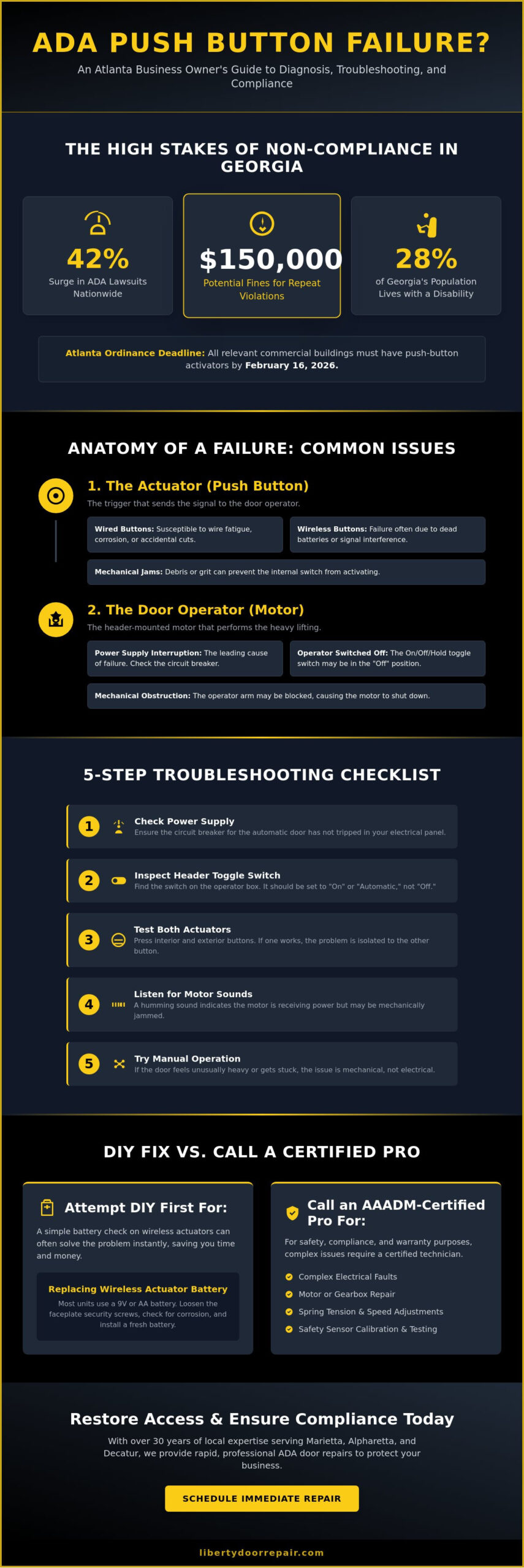
Did you know that ADA lawsuits recently surged by 42% across the country, with fines for non-compliance in Georgia reaching as high as $150,000 for repeat violations? When you realize you have an ADA push button not working atlanta staff and customers immediately feel the impact of a restricted entrance. It’s a stressful situation that puts your business at risk of heavy penalties and alienates the 28% of Georgia’s population living with a disability. You need a solution that restores accessibility and protects your professional reputation without delay.
We understand that a broken handicap door opener is more than a minor inconvenience; it’s a liability. Since the Atlanta City Council passed the February 16, 2026 ordinance requiring push-button activators for most commercial buildings, staying compliant is no longer optional. This article provides the clear answers you need right now. You’ll learn how to perform a quick diagnosis of the failure, understand the latest local safety codes, and discover exactly when to call in a certified specialist to restore your building’s accessibility and your peace of mind.
Key Takeaways
- Identify the core failure points, starting with power supply interruptions and signal issues between the actuator and the door operator.
- Learn five immediate troubleshooting steps, including inspecting the circuit breaker and the header toggle switch position.
- Understand the legal risks of an ADA push button not working atlanta, including potential barrier-to-entry lawsuits and compliance penalties.
- Recognize when to call an AAADM-certified technician to handle complex safety adjustments like motor speed and spring tension.
- Access experience serving North Georgia businesses since 2015 for rapid professional repairs across Marietta, Alpharetta, and Decatur.
Common Reasons Your ADA Push Button Is Not Working
An ADA push button is more than just a piece of plastic on a wall; it is technically known as an actuator. This device acts as the trigger that sends a vital signal to the door operator to begin the opening cycle. When you encounter an ADA push button not working atlanta business owners often find that the issue stems from a simple break in this communication path. Power supply interruptions stand as the leading cause of system failure. Without a consistent electrical flow, the actuator cannot “talk” to the motor, leaving the door stationary and your building inaccessible.
Mechanical jams also frequently disable these systems. The button housing itself can become clogged with grit or debris, preventing the internal switch from depressing fully. Similarly, the door operator arm located in the header may become obstructed or misaligned. While the history of automatic doors highlights decades of engineering progress, these mechanical components still require clear paths to function. If the arm cannot move, the motor may shut down to prevent overheating, even if the button is sending a perfect signal.
Wired vs. Wireless ADA Buttons
Understanding your hardware type is the first step in troubleshooting. Wired buttons rely on physical, low-voltage connections that run through the wall directly to the operator. These are highly reliable but susceptible to wire fatigue, corrosion, or accidental cuts during building renovations. Wireless transmitters offer more flexibility for installation but introduce different failure points. They rely entirely on battery power. If the battery dies, the signal dies. Signal interference from other electronic devices or thick masonry walls can also block the radio frequency, leading to an ADA push button not working atlanta managers must address immediately to maintain compliance.
The Role of the Door Operator
The button is only one half of the equation. The door operator is the header-mounted motor that does the heavy lifting. If the operator box has no power or has been manually disabled, the button will appear broken even if it is functioning perfectly. Look for the “On/Off/Hold Open” toggle switch typically located on the side of the header box. It’s common for cleaning crews or staff to accidentally flip this switch to the “Off” position. If the operator is turned off, the motor will not engage. We frequently see cases where a simple flip of this switch restores full functionality, saving the business from unnecessary downtime and potential liability.
5 Steps to Troubleshoot a Non-Responsive Handicap Door Opener
When you find your ADA push button not working atlanta business operations can grind to a halt. You need a systematic approach to identify the failure point before calling for service. Start by checking the primary power source. Locate your building’s electrical panel and ensure the circuit breaker dedicated to the automatic door hasn’t tripped. If the breaker is fine, move to the door header. Inspect the toggle switch on the side of the operator box. It should be set to “On” or “Automatic.” If it was accidentally flipped to “Off” during cleaning, the system won’t respond to any signal.
Next, test both the interior and exterior buttons. If the door opens from the inside but not the outside, you’ve isolated the problem to a single actuator. If neither button works, the issue is likely within the operator itself or the power supply. Listen closely when you press the button. A faint humming sound suggests the motor is receiving power but is struggling against a mechanical jam. Finally, try to open the door manually. The 2010 ADA Standards mandate specific force requirements for manual operation. If the door feels unusually heavy or gets stuck, the mechanical arm or the door closer may be failing.
Replacing the Actuator Battery
Wireless buttons are convenient but rely on internal power. Most units use standard 9V or AA batteries. To access them, use a small Allen wrench to loosen the security screws on the bottom or side of the faceplate. Once the cover is removed, check for corroded terminals. If you see white, crusty deposits, the battery has leaked and may have damaged the transmitter. Clean the terminals and install fresh batteries to see if that restores the signal. This is a common fix for an ADA push button not working atlanta managers can handle quickly.
Testing the Signal Transmitter
A functioning transmitter usually provides two feedback signals. First, listen for a distinct “click” from the microswitch when you depress the plate. Second, look for a small LED indicator light on the transmitter board. If the light flashes but the door doesn’t move, the receiver inside the header may have lost its pairing with the button. If these DIY steps don’t get your entrance moving, scheduling professional automatic door services will ensure your building remains compliant and safe for all visitors. Expert intervention prevents a minor technical glitch from becoming a major liability.
Compliance Risks: Why a Broken ADA Button Is a Liability in Atlanta
Ignoring a malfunctioning entrance is a high-stakes gamble for any Georgia business. In 2023, there were 120 Title III ADA filings in Georgia alone. Nationally, these lawsuits saw a 42% increase during that same period. When you have an ADA push button not working atlanta, your building becomes an immediate target for barrier-to-entry litigation. These lawsuits often result in significant legal fees and court-ordered renovations that far exceed the cost of a proactive repair. You cannot afford to wait until a process server arrives at your door to address accessibility issues.
Accessibility is particularly critical in healthcare and retail environments. Patients with mobility issues or elderly customers rely on automated systems to navigate your space safely. If they cannot enter your facility independently, you have failed to meet the basic standards of public accommodation. Beyond private lawsuits, local Atlanta fire marshals often check door functionality during routine safety inspections. A non-functional actuator can lead to failed audits and municipal fines. Maintaining your equipment ensures you stay on the right side of both federal law and local safety codes.
ADA Standards for Public Entrances
Federal regulations dictate exactly how these systems must operate. According to ADA door requirements, push buttons must be mounted between 15 and 48 inches above the finished floor. There must also be a clear floor space of at least 30 by 48 inches centered on the actuator to allow for a wheelchair approach. The timing of the door is equally important. Once triggered, the door must take at least five seconds to move from a closed position to an open position of 90 degrees. If your system is failing to meet these specific metrics, it is legally considered non-compliant.
Avoiding Legal and Financial Pitfalls
Financial risks extend beyond simple fines. For a first offense, ADA violations can result in penalties up to $75,000. Subsequent violations can reach $150,000. Many business owners attempt “temporary” fixes, such as taping over a button or putting up a “Use Other Door” sign. These patches do not satisfy legal requirements and often serve as an admission that you are aware of the barrier. Investing in professional commercial door repair Atlanta ensures your hardware is restored to factory standards and federal compliance. Professional service provides the documentation you need to prove your facility is accessible and safe for everyone. An ADA push button not working atlanta requires an immediate, permanent solution to protect your bottom line.
Professional Repair vs. DIY: When to Call an AAADM-Certified Technician
While a simple battery swap is a manageable task, internal mechanical adjustments require specialized expertise. When you face an ADA push button not working atlanta business owners must recognize the line between basic maintenance and technical liability. Attempting to repair the motor or spring tension yourself can lead to severe injury or permanent equipment damage. Most automatic door headers contain high-voltage electrical components and powerful springs under extreme tension. Opening these enclosures without professional training is dangerous. It puts you at risk of electrical shock and can void your hardware warranty instantly.
The gold standard for this industry is AAADM (American Association of Automatic Door Manufacturers) certification. These technicians are trained in the latest ANSI/BHMA safety standards to ensure every entrance operates within legal limits. For 2026, AAADM Certified Inspectors must complete their renewal by January 31 to remain compliant with the newest technical requirements. This ongoing education ensures they understand the precise physics required to move a heavy commercial door safely. If your troubleshooting steps from earlier didn’t solve the issue, the failure likely lies within these complex internal systems that require a certified hand.
The Dangers of Incorrect Door Speed
A door that closes too quickly is a physical hazard. Technicians use specialized force gauges to calibrate the motor, ensuring the door stops or reverses if it encounters an obstruction. If the closing speed is too high, it can strike a person with mobility issues, leading to immediate injury and a certain lawsuit. Safety sensors must also be perfectly synchronized with the push button. If the button triggers the door but the sensors fail to detect a person in the path, the system is a safety hazard. We calibrate these components to work in tandem, providing a seamless and safe experience for every visitor.
Atlanta Climate Factors
The local Georgia environment plays a significant role in hardware failure. Atlanta humidity is notorious for causing electrical shorts in outdoor button wiring. Moisture ingress during heavy rainstorms can seep into storefront actuators, corroding the microswitches and signal transmitters. Additionally, intense summer heat can significantly shorten the lifespan of wireless batteries and cause metal components to expand, leading to mechanical friction.
Protecting your hardware requires specialized weatherproofing and regular maintenance. We offer automatic door services designed to shield sensitive electronics from the Georgia elements. If you suspect moisture or heat has damaged your system, request a professional inspection to prevent a total system failure. Certified intervention is the only way to guarantee your entrance remains safe and functional year-round.
Expert ADA Door Opener Repair Services in Metro Atlanta
When your building’s entrance fails, you need a specialist who understands the local landscape and the urgency of the situation. An ADA push button not working atlanta is a high-priority repair for our team. Liberty Door Repair has served North Georgia businesses since 2015. We recognize that every hour your door remains non-functional is an hour of potential liability. Our technicians arrive in fully stocked service trucks that function as mobile warehouses. This allows us to repair or replace ADA-compliant door openers on the very first visit in most cases. We prioritize efficiency because we know your business cannot wait for backordered parts.
Local Service Area Coverage
We provide rapid response times for businesses in Marietta, Alpharetta, and Decatur. Our service area also extends to Roswell, Sandy Springs, and Lawrenceville. As a local Atlanta-based LLC, we understand the specific needs of Georgia business owners. We offer emergency repairs for high-traffic storefronts that cannot afford prolonged downtime. Whether you manage a busy retail center or a quiet professional office, our local presence ensures we reach your location quickly to secure your facility and restore public access. We value speed and effectiveness above all else when your building’s security and accessibility are on the line.
Requesting Your Professional Inspection
Booking a certified technician is a straightforward process designed to minimize your stress. When you contact us, we gather essential details about your hardware and the specific failure symptoms you are experiencing. A typical diagnostic visit involves a comprehensive multi-point inspection of your entire ADA system. We test the power supply, signal transmission, and mechanical arm alignment. Our experts check the control board for signs of heat damage and inspect the wiring for moisture corrosion, addressing the local climate factors mentioned earlier.
Once the diagnosis is complete, we provide a clear, action-oriented plan to restore your building’s accessibility. We don’t just patch the problem; we ensure your entrance is fully compliant with local safety codes. This thorough approach provides the peace of mind you need to focus on your business operations. Don’t let an ADA push button not working atlanta put your professional reputation at risk. Trust a local specialist since 2015, working with deliver a swift and dependable resolution for your facility.
Secure Your Entrance and Restore ADA Compliance
A non-functional entrance is more than a technical glitch; it’s a significant liability that impacts your customers and your bottom line. You now understand that while basic power checks and battery swaps can solve minor issues, complex mechanical failures require a certified touch. Ignoring an ADA push button not working atlanta risks legal penalties and alienates visitors who depend on accessible hardware. By identifying the failure early and understanding the legal standards, you’ve taken the first step toward protecting your business.
Don’t let a broken actuator compromise your professional reputation. Our AAADM Certified Technicians bring over experience serving North Georgia businesses since 2015 to every job, ensuring your automatic doors meet all federal and local safety codes. We proudly serve all of Metro Atlanta with rapid, dependable solutions that restore functionality on the first visit. Take action now to ensure your building remains open and welcoming to everyone.
Get Expert ADA Door Repair in Atlanta Today and regain your peace of mind. We’re ready to help you maintain a safe, accessible, and compliant facility.
Frequently Asked Questions
How much does it cost to fix an ADA push button in Atlanta?
Repair costs depend entirely on the root cause, ranging from simple battery replacements to complex motor repairs or wiring overhauls. While general door repair estimates in the metro area typically fall between $155.74 and $311.47, specialized ADA actuators and operators often require specific components that can influence the final service total. A professional diagnostic visit is the most accurate way to determine the specific needs of your system.
How do I change the battery in my handicap door opener button?
You can change the battery by using a small Allen wrench to loosen the security screws located on the side or bottom of the actuator faceplate. Once you remove the cover, replace the existing 9V or AA batteries with fresh alkaline ones. Ensure the battery terminals are clean and free of white, crusty corrosion before you snap the faceplate back into position.
Are businesses required by law to have automatic door openers in Georgia?
Yes, many businesses now face specific mandates due to the Atlanta City Council ordinance passed on February 16, 2026. This law requires most new and renovated commercial buildings with sidewalk-facing entrances to install push-button activators immediately. While federal ADA guidelines focus on accessibility standards, this local Atlanta ordinance makes automatic openers a legal necessity for many commercial properties.
What is the standard height for an ADA push button installation?
The standard installation height for an ADA actuator is between 15 inches and 48 inches above the finished floor. This specific range ensures that the button remains accessible to individuals in wheelchairs or those with a limited range of motion. Technicians must also ensure there is a clear floor space of at least 30 by 48 inches centered on the button to allow for a proper approach.
Can I use a wireless button for an outdoor commercial entrance?
Wireless buttons are suitable for outdoor use as long as they are installed within a weather-resistant, sealed housing. However, an ADA push button not working atlanta is frequently caused by moisture seeping into unsealed units during heavy Georgia rainstorms. For maximum reliability at a main storefront entrance, we often recommend hardwired connections that aren’t susceptible to signal interference or battery failure.
How long do the batteries usually last in a wireless ADA actuator?
Batteries in a wireless actuator typically last between six months and two years, depending on how often the door is used. High-traffic retail locations will see a faster drain than low-volume office environments. Intense Atlanta summer heat can also degrade battery chemistry, so it’s a good professional practice to replace them annually during a routine maintenance check.
What does it mean if my ADA button clicks but the door doesn’t move?
An audible click indicates the mechanical switch is functioning, but the signal isn’t reaching the door operator. This specific failure point for an ADA push button not working atlanta often points to a dead transmitter battery or a loose wiring connection inside the wall. If the battery is fresh, the receiver inside the header box may have lost its programming or suffered an electrical short.
Why is my automatic door opening on its own without the button being pressed?
This issue, often called “ghosting,” is usually caused by a stuck microswitch or signal interference from nearby electronic devices. Debris can sometimes wedge behind the push plate, keeping the switch depressed and triggering constant opening cycles. If the button moves freely, the problem might lie with a faulty safety sensor in the header that is incorrectly detecting motion in an empty doorway.