

Is your business just one malfunctioning sensor away from a costly “slip and trip” lawsuit? It’s a common fear for Atlanta facility managers who struggle to keep up with shifting regulations and technical requirements. You know that a failing door doesn’t just disrupt your customer flow; it creates a massive liability risk. Staying compliant with the latest ANSI/BHMA A156.10-2024 or A156.19-2026 standards shouldn’t be a guessing game. By prioritizing a regular automatic door safety inspection, you can catch mechanical failures before they become legal or financial nightmares.
We understand the pressure of maintaining a safe, accessible entrance for every visitor. This guide will show you how to protect your customers and your business with a clear breakdown of current safety standards and professional AAADM inspections. Serving North Georgia businesses since 2015, we’ve seen how proactive maintenance prevents expensive downtime and dangerous accidents. You’ll learn the critical difference between simple daily staff checks and the technical certification only an AAADM-certified expert can provide. Let’s ensure your doors meet every safety requirement and operate flawlessly every day.
Key Takeaways
- Implement a 5-minute daily safety check routine to identify obvious malfunctions before they result in customer injuries.
- Schedule a professional automatic door safety inspection annually with an AAADM-certified technician to maintain full compliance.
- Learn the specific differences between ANSI/BHMA A156.10 and A156.19 standards to ensure every entrance is correctly calibrated.
- Protect your business from “slip and trip” lawsuits by verifying that all sensors and force settings meet current safety regulations.
- Rely on a local Metro Atlanta expert Serving North Georgia businesses since 2015, to navigate Georgia building codes and specialized hardware repairs.
What is an Automatic Door Safety Inspection and Why is it Mandatory?
An automatic door safety inspection is a formal compliance audit conducted by a certified professional. It’s different from routine maintenance. While maintenance focuses on keeping the door moving, a safety inspection ensures the door stops, slows, or reverses to prevent injury. The American Association of Automatic Door Manufacturers (AAADM) sets these rigorous standards. They require technicians to verify that every sensor, motor, and safety mat functions according to current ANSI guidelines. These audits provide a technical snapshot of your entry system’s safety health.
Adopting a “set it and forget it” mindset for your storefront is a dangerous mistake. Commercial entries are complex systems with hundreds of moving parts. Over time, sensors drift and motors lose torque. Regular inspections do more than just ensure safety; they extend the lifespan of your expensive hardware. Catching a misaligned track or a worn belt early prevents the catastrophic motor failure that leads to total door downtime. Proactive checks keep your business running and your customers safe.
The Legal and Financial Risks of Neglect
For Georgia business owners, “Premises Liability” is a significant legal concern. State law requires you to maintain a safe environment for everyone who enters your property. If a door malfunctions and strikes a customer, your maintenance records become the primary evidence in a lawsuit. A documented history of every automatic door safety inspection proves you exercised due diligence. Neglecting these checks leaves you defenseless in court. One single accident can cost your business more than a decade of professional inspections.
Protecting Pedestrians in High-Traffic Atlanta Hubs
Metro Atlanta hubs like Buckhead, Midtown, and the Perimeter experience intense foot traffic. This constant volume puts immense strain on door operators in retail centers and healthcare facilities. In these environments, an automatic door safety inspection is critical for protecting vulnerable populations. Elderly patients in hospitals and disabled patrons in hotels rely on ADA-compliant sensors to stay safe. High-traffic wear and tear happens faster in Georgia’s humid climate. Sensors may become clouded or sluggish, creating a “trap” for slow-moving pedestrians. Professional audits ensure your sensors provide the wide coverage patterns required for safe, accessible entry.
The Daily Safety Check: A 5-Minute Routine for Facility Managers
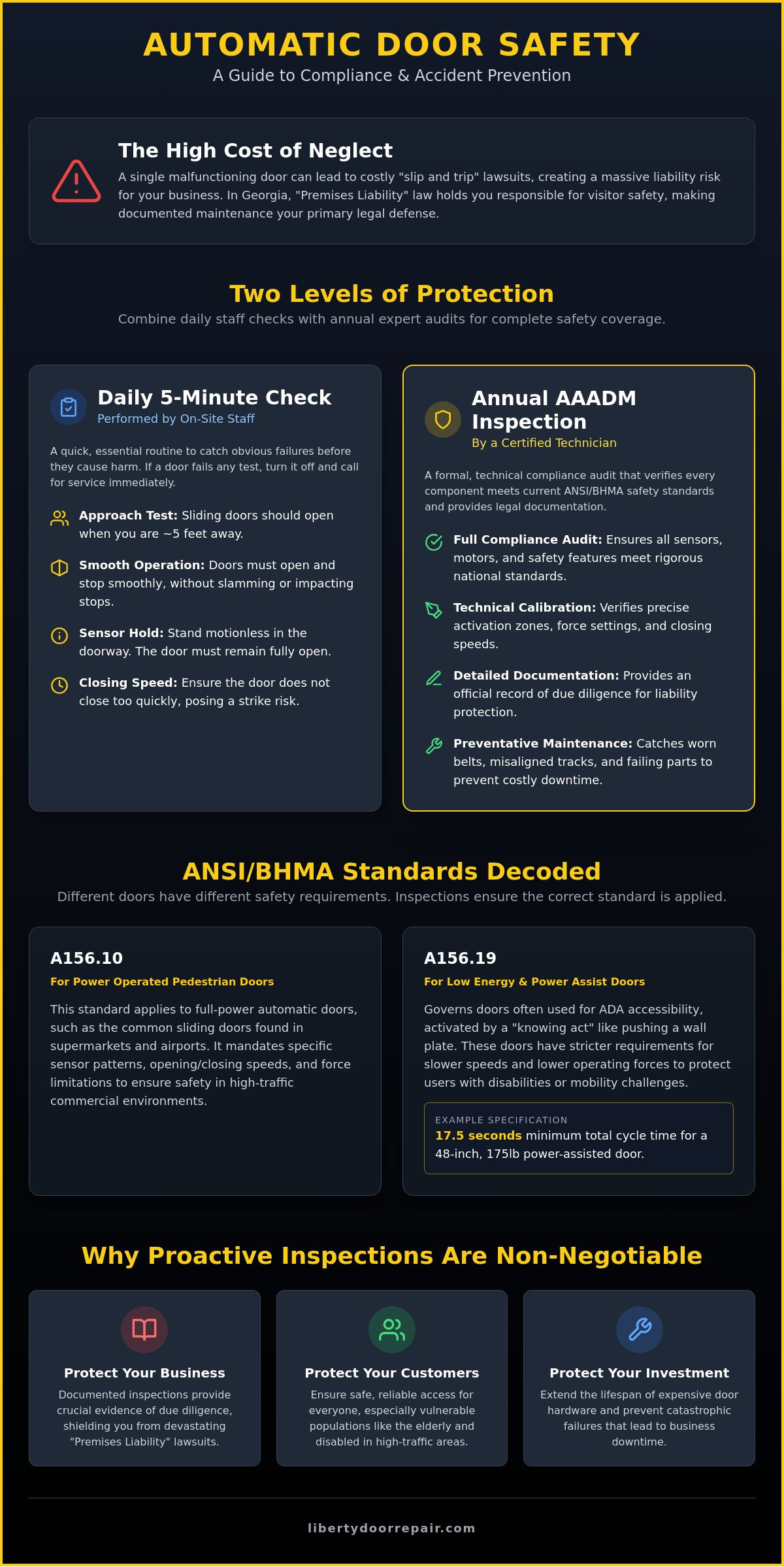
Professional audits are essential, but your staff provides the first line of defense against accidents. A daily automatic door safety inspection takes less than five minutes but can prevent a lifetime of legal trouble. Perform these checks every morning before the public enters your building. If a door fails any part of this test, turn it off immediately and secure the entrance. Operating a malfunctioning door is a direct invitation for liability. It’s better to have a door out of service than a customer in the hospital.
Start by walking toward the door at a normal pace. For sliding doors, the door should begin to open when you are roughly five feet away. It must open smoothly and stop without impacting the door stops. For swinging doors, activate the “knowing act” device, such as a push plate. The door should swing open without hesitation. Once open, stand motionless in the threshold. The door must remain open as long as you are in the path. If the door starts to close while you are standing still, the safety sensors are failing. This is a critical failure that requires immediate attention.
Pay close attention to closing speeds. The “Three-Second Rule” is a good general guide, but technical standards are more precise. For example, under ANSI/BHMA A156.19-2026, a 48-inch-wide, 175-pound power-assisted door requires a minimum total cycle time of 17.5 seconds. If your door slams shut or moves too fast, it poses a strike risk to children or elderly patrons. If you notice these timing issues, you need professional automatic door services to recalibrate the motor and control board settings.
Testing Sensors and Activation Zones
Walk through the door from both directions. The activation zone should be wide enough to detect someone approaching from an angle. Check the safety zone specifically. This is the area where the door should never close if an object is detected. You don’t need specialized tools for this; your own presence should trigger the sensors. The door should never “hunt” for position or make grinding noises during this process. Every movement must be silent and consistent to ensure pedestrian safety.
Visual and Physical Hardware Inspections
Look for physical hazards that sensors cannot detect. Check the glass for cracks or loose stops. Examine the floor tracks for debris, salt, or trash that could cause a “slip and trip” incident. Ensure that all required AAADM safety signage is clean and visible at eye level. Finally, test the emergency breakout feature. Push the door outward in the direction of egress. It should swing open manually with reasonable force. This feature is a life-safety requirement for fire codes and must never be blocked or jammed. A regular automatic door safety inspection by your staff ensures these mechanical backups are always ready.
AAADM Certified Inspections: What Happens During a Professional Audit?
While your daily checks catch obvious failures, a professional automatic door safety inspection goes much deeper. Our AAADM-certified technicians use specialized force gauges to measure the exact pound-force exerted by the door. For low-energy power-operated doors, the force required to prevent a stopped door from moving must not exceed 15 lbf according to ANSI/BHMA A156.19-2026. We don’t just look at the door; we analyze the data. If the force is too high, it’s a safety hazard. If it’s too low, the door might not close properly against wind or internal building pressure.
The audit includes a thorough inspection of internal components that are hidden from view. We examine the motor for signs of overheating and check gears for excessive wear or metal shavings. Control boards are tested for voltage stability and logical errors. Once the system passes every technical requirement, we apply the AAADM inspection sticker. This sticker isn’t just a label. It’s a dated record of compliance that serves as your primary defense during a liability audit or insurance review. It proves you’ve met the highest industry standards for pedestrian safety.
Technical Calibration and ANSI Compliance
Compliance requires precise timing and calibration. We adjust time delays to ensure doors stay open long enough for pedestrians to clear the threshold safely. This includes fine-tuning opening and closing speeds to meet the latest ANSI A156.10-2024 requirements for high-energy sliding doors. Atlanta’s frequent summer storms make battery backup systems a top priority. We test these fail-safes to ensure your doors remain operational or fail to a safe, manual state during a power outage. We also evaluate the structural integrity of pivots, hinges, and guide rails to prevent door sagging or jamming.
Environmental Factors in Metro Atlanta
Georgia’s intense humidity creates unique challenges for electronic sensors. Moisture can cause “ghosting,” where the door opens and closes without a pedestrian present. This leads to rapid hardware corrosion and wasted energy. In high-rise districts like Buckhead or Midtown, we also address “wind stack” issues. High-rise buildings often create immense air pressure that can prevent an automatic door from closing or latching correctly. Our automatic door services include specialized sensor tuning and motor adjustments to overcome these environmental pressures. We ensure your entry system remains reliable regardless of the weather or building height.
ANSI Standards Decoded: A156.10 vs. A156.19
Understanding which ANSI standard applies to your entrance is critical for passing an automatic door safety inspection. Many facility managers confuse these two categories, but the legal requirements are very different. ANSI/BHMA A156.10-2024 covers high-energy doors. These are fully automatic systems, like the sliding doors at major retail centers, that open when a sensor detects an approaching pedestrian. Because these doors move quickly and with significant force, they require sophisticated sensor arrays and specific safety zones to prevent contact with users.
ANSI/BHMA A156.19-2026 applies to low-energy power-operated doors. These are typically swinging doors that only open after a “knowing act,” such as pressing a push-plate or using a mobile app. These doors move much slower and with less force than high-energy systems. Because the user initiates the movement, the safety sensor requirements are less stringent. However, the timing and force limits are still strictly regulated. If your door opens automatically as you walk toward it, you must follow A156.10. If you have to push a button, A156.19 is your guide.
Signage is another area where these standards diverge. High-energy doors require “Caution: Automatic Door” signs visible from both sides. Low-energy doors must have signs that say “Actuate Door to Open” or “Push to Operate.” Improper signage is one of the most common reasons a business fails an automatic door safety inspection. Our technicians verify that every sticker and decal is in the correct position and meets current size requirements during every audit.
The Role of ADA in Automatic Door Safety
ADA compliance is inseparable from low-energy door safety. Push buttons must be located between 34 and 48 inches above the floor. They also need to be placed so that a person in a wheelchair has enough maneuvering clearance to stay clear of the door as it swings open. If your button is too close to the door, it creates a strike hazard for the person who just pressed it. We provide comprehensive commercial door repair Atlanta services that include full accessibility audits to ensure your “knowing act” devices are perfectly positioned.
Keeping Your Compliance Documentation Current
Documenting your safety checks is just as important as the checks themselves. You should maintain a dedicated logbook that records the date and results of every daily check and professional audit. This logbook is your first line of defense if a “slip and trip” claim is ever filed against your business. In a commercial setting, a professional AAADM audit must be performed at least once every year to maintain certification. This annual schedule ensures that your hardware hasn’t drifted out of ANSI compliance due to heavy use or environmental wear.
Don’t leave your business’s safety to chance. If you aren’t sure which standard applies to your building, contact our expert team today for a professional evaluation.
Reliable Automatic Door Safety with Liberty Door Repair
Maintaining a safe entrance is a non-negotiable part of running a successful business. At Liberty Door Repair, we provide the specialized expertise you need to stay compliant and protect your patrons. Our team consists of AAADM-certified technicians who understand every technical nuance of the current ANSI standards. Serving North Georgia businesses since 2015, we’ve handled thousands of compliance audits across the entire Metro Atlanta area. By partnering with us for your automatic door safety inspection, you gain a reliable ally in commercial compliance. We position ourselves as your local authority on Georgia building codes and specialized door hardware that keeps your business moving.
The “Liberty Advantage” is built on reliability and speed. We know that door downtime affects your customer flow and your bottom line. That’s why we prioritize swift response times and provide transparent safety reporting after every visit. You’ll receive a detailed breakdown of your door’s performance and any necessary adjustments to ensure full compliance. Our technicians stay ahead of the curve by preparing for the January 31, 2026 AAADM recertification testing and the latest ANSI updates. We value speed and effectiveness above all else because we know your business can’t afford to wait.
- AAADM-certified technicians with deep technical knowledge.
- since 2015 in commercial door safety.
- Comprehensive service area covering Marietta, Alpharetta, and Decatur.
- Direct, action-oriented solutions for urgent repair needs.
Customized Maintenance Programs for Atlanta Businesses
We don’t believe in one-size-fits-all solutions. Every facility has different traffic patterns and environmental stressors. Our proactive maintenance programs keep you ahead of compliance deadlines. We serve businesses in Roswell, Sandy Springs, and Lawrenceville with scheduled visits that prevent hardware failure. If an issue is detected during a professional audit, we provide prioritized repair services to keep your entry accessible and safe.
Get Started with a Professional Safety Audit
Booking your audit is a straightforward process. When you contact our team, we’ll schedule a visit that fits your operational needs. During the first visit, our technician will conduct a full physical and electronic evaluation of your entry system. We check everything from sensor sensitivity to motor torque and emergency breakout features. You’ll finish the day with a clear understanding of your door’s status. Schedule your automatic door safety inspection today!
Secure Your Facility and Minimize Liability
Safety is a constant commitment that requires both daily vigilance and professional expertise. You’ve seen how a 5-minute staff check can prevent immediate accidents; however; true long-term protection comes from technical compliance. Whether you operate high-energy sliding doors or low-energy ADA swingers, following the correct ANSI standards is the only way to shield your business from premises liability. Documentation is your strongest defense. Keep your logbooks updated and your hardware calibrated to avoid costly legal disputes or sudden equipment failure.
Don’t wait for a malfunction to address your building’s safety needs. A professional automatic door safety inspection ensures every sensor, motor, and safety zone meets the rigorous 2024 and 2026 standards. Our team has served North Georgia businesses since 2015 and specialized AAADM certifications to every job site in Metro Atlanta. We provide comprehensive ANSI compliance audits that keep your doors moving and your customers safe. Take the proactive step today to secure your storefront hardware and maintain flawless customer flow.
Book Your AAADM-Certified Safety Inspection Now to ensure your business remains accessible, compliant, and protected for years to come.
Frequently Asked Questions
How often should automatic doors be professionally inspected?
Professional automatic door inspections must occur at least once every 12 months. This annual interval is the industry standard for maintaining AAADM certification and ensuring your entrance remains compliant with current ANSI/BHMA regulations. If your facility handles extreme foot traffic or experiences harsh environmental conditions, you should consider more frequent audits. Regular scheduling prevents hardware drift and keeps your liability protection active throughout the year.
What is an AAADM certified inspector?
An AAADM certified inspector is a technician who has completed rigorous training and testing through the American Association of Automatic Door Manufacturers. These professionals must have at least six months of industry experience before applying. They’re required to pass annual renewal tests to stay current with the latest safety standards. Hiring a certified expert ensures that your doors are evaluated by someone with verified technical mastery and up-to-date knowledge.
Are automatic door daily safety checks required by law?
What are the most common causes of automatic door accidents?
Most accidents stem from sensor malfunctions or incorrect force and speed settings. Sensors can fail due to technical glitches or simple environmental factors like dirt and Atlanta humidity. When sensors don’t detect a pedestrian, the door may close prematurely. Additionally, if the closing force exceeds the 15 lbf limit for low-energy doors, it can cause significant injury upon impact. Regular maintenance catches these mechanical and electronic failures before they cause harm.
Can I perform my own ANSI safety inspection?
You can and should perform daily safety checks, but you can’t conduct a formal compliance audit yourself. A valid automatic door safety inspection requires specialized tools like force gauges and timing devices that most facility managers don’t own. More importantly, only an AAADM-certified technician can provide the official inspection sticker. This sticker is the recognized proof of compliance that insurance companies and legal professionals look for after an incident.
What signage is required for automatic commercial doors?
Required signage varies based on whether your door is high-energy or low-energy. Fully automatic doors require “Caution: Automatic Door” signs on both sides. Low-energy doors typically need “Actuate Door to Open” or “Push to Operate” decals. All signs must be clean, legible, and mounted at eye level. Missing or faded signage is a common compliance failure that increases your liability risk during an accident.
How long does a professional automatic door inspection take?
A standard professional inspection typically takes 30 to 60 minutes per entrance. The exact time depends on the door’s condition and the complexity of the sensor system. During this window, the technician tests every safety feature, measures closing forces, and calibrates timing cycles. If minor adjustments are needed to meet ANSI standards, the process might take slightly longer. This small time investment provides a full year of documented safety compliance.
What should I do if my automatic door hits someone?
Turn the door off immediately and secure the entrance to prevent further use. You must document the incident details and contact a certified technician for a comprehensive automatic door safety inspection. Never attempt to “reset” and restart the door yourself after a strike. The system must be professionally cleared and recalibrated to ensure the failure doesn’t happen again. Operating a known faulty door is a major legal risk.