

As of February 16, 2026, a manual entrance at your sidewalk-facing business is no longer just an inconvenience. It’s a potential legal liability under the latest Atlanta ordinances. You likely feel the pressure to upgrade but worry about ADA non-compliance penalties or choosing the wrong hardware. A professional automatic swing door operator installation is a safety-critical requirement that protects your business from liability. We understand the need for a swift, compliant solution that doesn’t disrupt your daily operations.
This guide provides the expertise you need to master technical requirements and current ADA standards. You’ll learn how to navigate the ANSI/BHMA A156.10-2024 updates and select the right touchless technology for your specific needs. We’ll outline the professional steps to ensure your entrance meets all Georgia building codes while reducing your long-term maintenance costs. Follow these expert steps to secure a fully compliant, touchless entrance for your facility.
Key Takeaways
- Understand the critical differences between low-energy and high-energy systems to select the right hardware for your facility’s traffic flow.
- Learn how to evaluate your existing door frame and choose between push or pull arm applications for a successful automatic swing door operator installation.
- Navigate the latest 2026 ADA requirements and ANSI safety standards to protect your business from costly compliance penalties.
- Follow professional mounting and assembly steps to ensure your entrance remains reliable and provides a touchless experience for all users.
- Discover why AAADM-certified expertise is essential for meeting rigorous Georgia building codes and reducing long-term maintenance costs.
What is an Automatic Swing Door Operator and Why Does Your Business Need One?
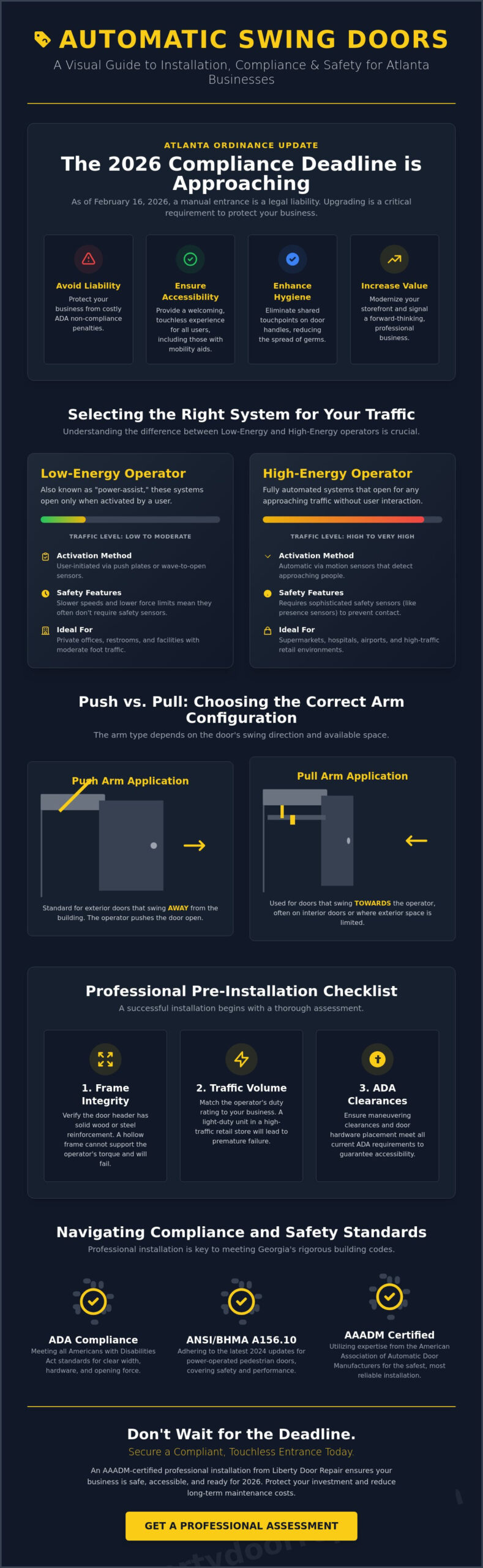
An automatic swing door operator is a motorized device that controls the opening and closing of a standard swing door. For Metro Atlanta business owners, an automatic swing door operator installation is the most effective way to modernize a storefront while ensuring universal access. These systems fall into two primary categories. Low-energy operators are designed for doors that stay closed until a user triggers a push-plate or wave sensor. High-energy operators, often found in high-traffic grocery stores, use sophisticated motion sensors to open automatically as a person approaches. To learn more about the technical distinctions between these systems, you can explore this overview of What is an Automatic Swing Door Operator? on Wikipedia.
The benefits go far beyond simple convenience. In 2026, touchless access is a baseline expectation for hygiene and professional safety. These operators eliminate the need for customers to touch door handles, which reduces the spread of germs and keeps your hardware cleaner. Beyond health, an automated entrance significantly boosts your building’s value. It transforms an aging, heavy manual door into a sleek, modern entrance that signals your business is accessible and forward-thinking. In competitive areas like Buckhead or Midtown, this professional aesthetic is a key differentiator for retail and office spaces alike.
Key Components of a Swing Door System
Modern operators are complex machines. The “brains” of the system reside in the motor and gearbox assembly, which provides the mechanical force to move the door leaf. Advanced control boards allow technicians to fine-tune adjustable parameters. We precisely calibrate the opening speed, closing force, and “backcheck,” which prevents the door from slamming against a wall or stop. You can choose between traditional physical push plates or modern wave-to-open sensors for activation. These touchless sensors are now the standard for medical offices and high-end retail environments.
The ROI of Automatic Entrances for Atlanta Retailers
Investing in your entrance pays for itself through operational savings. Georgia’s humid climate puts a massive strain on HVAC systems. Every second a door stands open, you lose treated air. Automatic operators ensure doors close immediately and seal tightly, which lowers your monthly energy bills. Furthermore, these systems protect your investment by controlling the door’s movement. Controlled opening and closing reduce the physical stress on hinges and pivots. This prevents the door from sagging and lowers your long-term automatic door service and repair costs. By removing physical barriers, you also invite more foot traffic from parents with strollers and customers with mobility aids.
Planning Your Installation: Assessing Compatibility and Requirements
A successful automatic swing door operator installation begins long before the first bolt is tightened. You must first evaluate the structural integrity of your existing door frame. Commercial operators house powerful motors that generate significant torque during every cycle. If your frame is hollow aluminum without internal reinforcement or shows signs of corrosion, the operator may pull itself off the wall within weeks. We recommend checking for solid wood or steel backing within the header to ensure a secure mount. If the frame is compromised, it must be reinforced or replaced before proceeding with automation.
Traffic volume is the next critical factor. You don’t want to install a light-duty residential operator in a high-traffic Atlanta retail environment. Light-duty units are built for occasional use, such as in private offices. Heavy-duty operators are designed for hundreds of cycles per day. Choosing the wrong grade leads to premature motor failure and increased downtime. Proper planning also involves reviewing ADA Compliance and Safety Standards to ensure your door’s maneuvering clearance remains within legal limits after the hardware is added.
Push vs. Pull: Which Arm Configuration Do You Need?
The choice between a push arm and a pull arm isn’t just about preference; it’s about door swing and available space. Push arms are the standard for exterior doors that swing away from the operator. They provide maximum leverage for heavy doors facing wind loads. Pull-side track arms are different. These are typically used for doors that swing toward the operator, often in interior corridors. The arm slides along a track mounted to the door leaf, which offers a cleaner look and requires less overhead clearance. If your header space is tight, a track arm might be your only viable option. Always measure the distance between the top of the door and the ceiling to confirm there’s enough room for the operator housing.
Electrical and Integration Pre-Checks
Reliable power is mandatory for consistent operation. Most commercial operators require a dedicated 115VAC circuit. Running an operator on a shared circuit can lead to voltage drops that cause the control board to reset or the motor to burn out. You should also consider how the door will work during a power outage. We suggest planning for battery backups to maintain accessibility when the grid fails. If your building uses access control solutions like badge readers or electric strikes, these must be integrated into the operator’s logic board. This ensures the door unlocks before the motor attempts to pull it open. Our team at libertydoorrepair.com can help you determine the exact electrical rough-in requirements for your specific site.
Professional Automatic Swing Door Operator Installation Steps
Once you’ve confirmed your frame’s integrity and electrical rough-ins, the physical automatic swing door operator installation begins. This process requires extreme precision. Even a slight misalignment in the header mounting can cause the internal gears to grind, which leads to a loud, vibrating operation and eventual motor failure. We follow a strict five-step protocol to ensure the system operates at peak efficiency from the first cycle. This isn’t a task for a general handyman. It requires specialized tools and a deep understanding of door geometry to get the arm tension and latch force exactly right.
The execution starts with mounting the operator header. We use heavy-duty fasteners tailored to your specific frame material. For aluminum storefronts, we often utilize through-bolts or internal reinforcements to prevent the header from pulling away under torque. After the header is secure, we install the arm assembly. This connects the motor to the door leaf. We then wire the activation sensors and safety presence sensors. The final stages involve programming the digital control board and conducting a comprehensive power-up test to verify the door clears all obstacles without hesitation.
Mounting and Mechanical Setup
Precision is your best defense against future repairs. We use high-accuracy levels to ensure the operator sits perfectly flat against the header. If the unit is tilted, the arm will apply uneven pressure to the door hinges. This causes the door to drag or “hunt” for its closed position. We also adjust the arm tension during this phase. You want the movement to be smooth and silent. If the arm is too tight, the motor will overheat. If it’s too loose, the door won’t latch properly against the weatherstripping, which compromises your energy efficiency.
Sensor Calibration and Safety Tuning
Programming the control board is where many DIY attempts fail. We calibrate the detection zones for microwave or infrared motion sensors to ensure they don’t trigger unnecessarily from sidewalk traffic. We also adjust the “dwell time.” This is the specific duration the door stays open. It must be long enough for slow-moving pedestrians to pass safely but short enough to prevent conditioned air from escaping. Adhering to AAADM Safety Standards is mandatory during this step. We test the “obstruction sense” settings repeatedly. If the door encounters a person or an object, it must stop or reverse immediately to prevent injury and protect your business from liability.
ADA Compliance and AAADM Safety Standards in Georgia
Compliance isn’t optional for your business. In 2026, the Americans with Disabilities Act (ADA) and local Georgia building codes require precise execution. An automatic swing door operator installation that ignores these standards is a significant liability. You must strictly adhere to ANSI A156.19 for low-energy power-operated doors. This standard dictates how fast a door can open and exactly how much force it can apply. If your door moves too quickly or hits a pedestrian with too much force, you’re at risk for lawsuits and heavy fines. We ensure every installation meets these rigorous benchmarks to protect your customers and your bottom line.
Fire marshals in Marietta and Roswell are particularly strict about life safety codes during annual inspections. DIY installations often fail because they lack the necessary integration with fire alarm systems. If a fire occurs, the door must allow for manual egress without resistance. Only a certified AAADM technician understands how to balance automation with these critical safety overrides. Having a professional sign off on the work provides a legal paper trail. This documentation proves your facility meets all current safety benchmarks and local ordinances. Don’t risk a failed inspection; trust a specialist to handle the technical details.
Required Signage and Accessibility Features
A compliant entrance needs more than just a motor. You must display specific decals to guide users safely. These include ‘Automatic Door’ and ‘In Case of Emergency’ signs placed at eye level on both sides of the glass. The mounting height for push-plate actuators is also strictly regulated. They must be installed between 34 and 48 inches above the finished floor to be accessible to all users. Additionally, you must maintain clear floor space for wheelchair maneuverability. If a trash can or display rack blocks the approach to the actuator, your entrance is no longer compliant. We help you map out these requirements to ensure total accessibility.
The AAADM Daily Safety Check
Safety doesn’t end after the initial setup. You should perform a basic safety check every morning before opening for business. Walk through the door to ensure the sensors detect you immediately and the door opens smoothly. Listen for grinding noises or sudden jerks in the door leaf. Warning signs of drift include the door closing too fast or failing to stay open for the programmed dwell time. If you notice these issues, it’s time for professional maintenance to avoid an accident. AAADM certification serves as the industry gold standard for ensuring automatic door safety and professional accountability. To ensure your facility remains within legal limits, schedule a professional audit at libertydoorrepair.com today.
Expert Automatic Door Services in Metro Atlanta
Liberty Door Repair has spent over 30 years perfecting entrance solutions for businesses across Georgia. When you choose us for your automatic swing door operator installation, you aren’t just getting a piece of hardware. You’re securing a partnership with a team that has served Atlanta, Alpharetta, and Sandy Springs since the 1990s. We understand the specific challenges of the local market. This includes the high-traffic demands of Buckhead retail and the specialized accessibility needs of medical facilities in Johns Creek. Our local presence ensures we can reach your facility quickly when you need expert attention.
Our team provides comprehensive support throughout the entire lifecycle of your entrance. This includes everything from a new automatic swing door operator installation to complex commercial door repair. Every automatic door service we perform is handled by AAADM-certified technicians. This certification is critical for your business. It ensures your facility meets all current safety codes and legal requirements. We don’t just fix doors; we ensure they stay compliant, safe, and operational for the long term.
Why Liberty Door Repair is the Trusted Choice
Our reputation is built on reliability and technical mastery. We maintain a strict commitment to 100% ADA compliance for every client we serve. This dedication protects your business from liability. It also ensures every customer can enter your building with ease. We understand that door issues create urgent problems. A malfunctioning entrance can halt your business operations or create safety hazards for your staff. That’s why we prioritize fast response times for both new installations and urgent repairs. Our technicians possess deep knowledge of local Georgia fire and life safety codes, so your project will pass inspection the first time.
Get Started with a Professional Assessment
Every facility has different requirements based on traffic flow, door weight, and existing hardware. Our team begins by conducting a thorough evaluation of your specific needs. We look at your structural frame, electrical availability, and user demographics. Following this assessment, we provide transparent quoting for both hardware and labor. You won’t have to worry about hidden fees or unsupported claims. We give you the facts you need to make an informed decision for your property. Contact Liberty Door Repair for a professional consultation today to secure your entrance for 2026 and beyond.
Secure Your Facility with Professional Automation
Professional execution is the only way to guarantee your entrance remains compliant and safe for every visitor. You’ve learned how critical structural integrity and precise sensor calibration are for a long-lasting system. Skipping professional steps often leads to premature motor wear or failed fire marshal inspections in local Georgia districts. An expert automatic swing door operator installation provides the reliability and legal protection your business needs to thrive in 2026. Don’t leave your facility’s accessibility to chance when modern code requirements are stricter than ever.
Trust our AAADM certified technicians to handle the complex technical details of your next project. With over 30 years of Metro Atlanta experience, we’re the A+ rated commercial specialist you can depend on for excellence and speed. We handle everything from the initial structural assessment to the final safety sign-off. Secure Your ADA-Compliant Installation Today and ensure your storefront is accessible to everyone. Your business deserves a modern, touchless entrance that operates perfectly every single time. We look forward to helping you modernize your facility.
Frequently Asked Questions
Do I need a new door to install an automatic swing operator?
You don’t usually need a new door for an automatic swing door operator installation. Most existing commercial doors can be retrofitted with a motorized header if the frame is structurally sound. We inspect your door’s hinges and header reinforcement to ensure it can handle the torque of an automatic system without sagging or pulling away from the wall.
What is the difference between low-energy and high-energy operators?
Low-energy operators move the door slowly and require a deliberate trigger, such as a push plate or wave sensor. These are the standard for ADA compliance in most office and retail settings. High-energy operators use sophisticated motion sensors to open automatically as someone approaches. They move faster and require more complex safety sensors to prevent contact with pedestrians.
How long does it take to install an automatic door opener for a business?
A professional installation typically takes between four and eight hours per door leaf. This timeframe includes mounting the heavy-duty header, connecting the arm assembly, and wiring the activation sensors. The final portion of the day is dedicated to precise calibration and AAADM safety testing to ensure the door operates exactly as required by law.
Are automatic swing doors required by the ADA in Atlanta?
While the ADA itself doesn’t strictly mandate automatic doors, they are often the only way to meet maneuvering clearance and opening force standards. However, Atlanta’s February 2026 ordinance now requires most new and renovated buildings with sidewalk-facing entrances to have accessible push-button activators. This makes automation a practical necessity for many local business owners to remain compliant with city codes.
What happens to an automatic door during a power outage?
The door will revert to manual operation or rely on an integrated battery backup system. Life safety codes require that any automatic door can be pushed open manually for emergency egress. If your facility requires continuous accessibility, we recommend installing a battery backup to keep the motor functional during short-term power failures.
How often should automatic door operators be serviced for safety?
You should schedule a professional inspection at least once per year to maintain safety and compliance. Regular service prevents minor issues, like sensor drift or hinge wear, from turning into expensive motor failures. We also recommend that your staff performs a basic daily safety check to ensure the sensors are detecting traffic correctly every morning.
Can automatic door operators be integrated with my building’s security system?
Yes, modern operators integrate seamlessly with most professional access control solutions. We can connect the operator to your badge readers, electric strikes, or keypad systems. This ensures the door remains locked to unauthorized users but opens automatically for those with the correct credentials, protecting your property without sacrificing accessibility.