

A single fire code violation in 2026 can cost your Atlanta business thousands in fines and immediate “fix-it” orders. You’ve likely felt the frustration of a sticking push bar or a door that refuses to latch properly after a busy shift. These aren’t just minor annoyances. They’re significant security gaps that put your staff and customers at risk. When you need expert commercial panic bar repair atlanta, you need a team that understands the latest NFPA 101 requirements. Liberty Door Repair has served North Georgia businesses since 2015, ensuring your exit devices are quiet, secure, and fully operational.
This guide provides everything you need to know about maintaining your life safety hardware under the new 2024 International Building Code standards. You’ll learn how to identify common mechanical failures, troubleshoot latching issues, and ensure your hardware meets the specific 34 to 48 inch mounting height requirements mandated by the ADA. We’ll also walk through the differences between fire-rated and standard exit devices so you can pass your next inspection with total confidence. From basic maintenance to professional part replacement, we’re here to help you secure your facility and protect your bottom line.
Key Takeaways
- Understand why exit devices are classified as life-safety hardware and how they differ from standard locks to protect your occupants.
- Identify the common causes of “stuck bar” syndrome and latch misalignment to prevent immediate security risks at your facility.
- Ensure your business remains compliant with 2026 NFPA 101 codes and ADA standards by prioritizing professional commercial panic bar repair atlanta.
- Learn the cost-benefit factors of repairing internal springs versus full unit replacement to save on long-term maintenance expenses.
- Discover why working with AAADM-certified technicians is essential for maintaining complex fire-rated door systems and avoiding heavy code violation fines.
What is a Commercial Panic Bar and Why is it Critical?
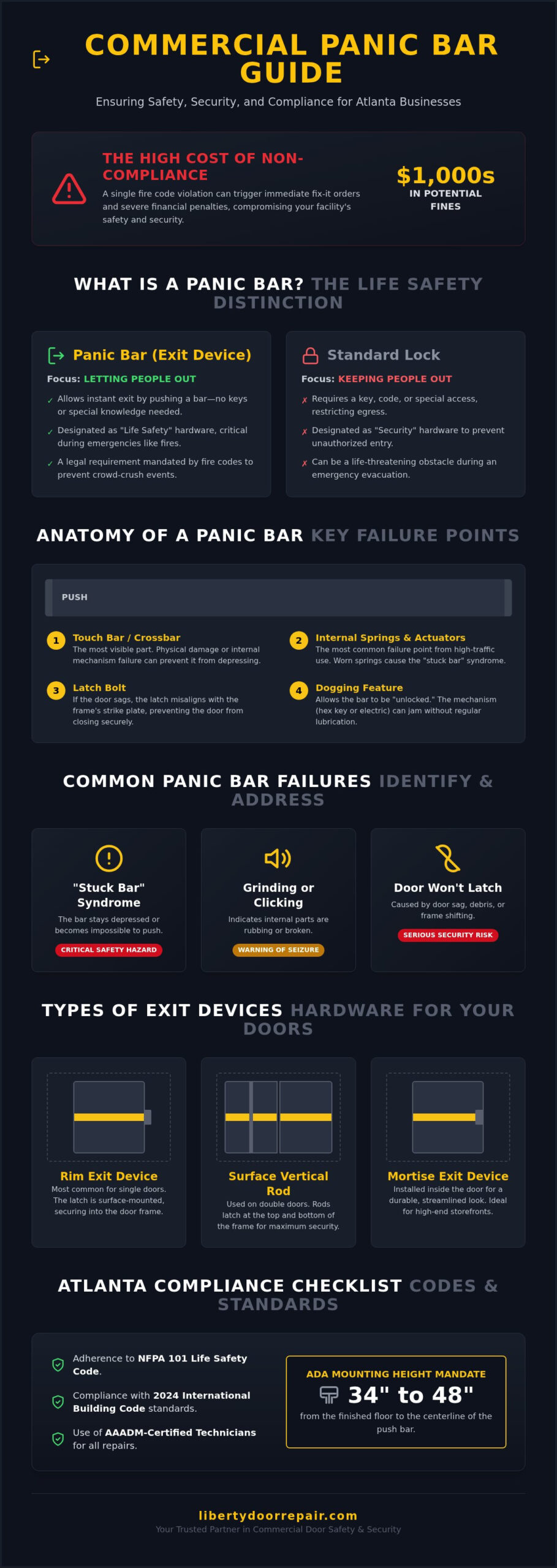
A commercial panic bar, officially known as an exit device, is a spring-loaded metal bar installed horizontally across the interior of an out-swinging door. Its design allows anyone to exit a building instantly by simply pushing against the bar. You don’t need keys, specialized knowledge, or even free hands to operate it. This is why it carries a “Life Safety” designation. While a standard lock focuses on keeping people out, a panic bar focuses on letting people out safely during a crisis. For business owners seeking commercial panic bar repair atlanta, understanding this distinction is the first step in maintaining a safe facility.
The history of these devices is rooted in preventing “crush” events. In early 20th-century disasters, crowds rushing toward exits were often trapped because doors opened inward or were locked from the outside. Modern fire codes in Georgia now mandate these devices to ensure that even in a dark, smoke-filled room, a simple push provides an escape. Beyond safety, functional exit hardware is a legal requirement. In the Metro Atlanta area, failing to maintain these devices can lead to failed fire inspections, heavy fines, and the potential loss of your business insurance coverage if a claim arises from a hardware failure.
The Different Types of Exit Devices in Atlanta Businesses
Choosing the right hardware depends on your door type and security needs. We frequently encounter three primary styles during commercial panic bar repair atlanta service calls:
- Rim Exit Devices: These are the most common choice for single doors. The mechanism is surface-mounted on the interior, latching into a strike plate on the door frame.
- Surface Vertical Rods: Typically found on double doors, these devices use metal rods that extend to the top and bottom of the door. They provide two points of contact for maximum security.
- Mortise Exit Devices: These units are installed within a pocket cut into the door itself. They are extremely durable and offer a streamlined appearance for high-end storefronts.
Anatomy of a Panic Bar: What Can Go Wrong?
A panic bar consists of several moving parts that endure constant stress. The touch bar or crossbar mechanism is the most visible part, but the internal springs often fail first after years of high-traffic use. If the door sags even slightly, the latch bolt will no longer align with the strike plate. This prevents the door from latching securely, leaving your business vulnerable. Finally, dogging features allow you to “lock” the bar in the open position during business hours. Whether you use a mechanical hex key or an electrical system, these components require regular lubrication and adjustment to prevent jamming.
Common Panic Bar Failures and Professional Troubleshooting
Panic bars are mechanical workhorses. They endure thousands of cycles every year. In a busy Metro Atlanta retail environment, these devices eventually show signs of wear. Identifying a failure early prevents emergency lockouts and fire code violations. If your hardware feels spongy or requires excessive force, you need professional commercial panic bar repair atlanta before an inspector arrives. Mechanical failures rarely fix themselves; they only get worse with time.
The “Stuck Bar” syndrome is a critical safety failure. This occurs when the internal springs or actuators seize. The bar stays depressed or becomes impossible to push. This isn’t just a nuisance. It’s a life-safety hazard. You should also listen to your hardware. Grinding or clicking sounds indicate that metal components are rubbing together. This usually means the internal lubrication has dried out or a part has snapped. Worn springs are the most common culprit in high-traffic storefronts. If ignored, these small noises lead to a total mechanical seizure.
When the Bar Won’t Latch: Security Risks
A door that won’t latch is an open invitation to intruders. Often, the issue is simple debris. Small rocks, dirt, or trash can wedge into the strike plate or the floor threshold. However, door sagging is a more serious cause. Over time, heavy commercial doors wear down their hinges. This causes the latch bolt to miss the strike plate entirely. Rim devices often fail at the strike plate, while vertical rods frequently suffer from rod misalignment. If the top or bottom latch doesn’t retract fully, the door will drag or jam.
Georgia’s climate also plays a role in hardware performance. Rapid temperature shifts cause metal doors and frames to expand and contract. A door that latches perfectly in the cool morning might stick during a humid Atlanta afternoon. Adjusting the strike plate or the door closer can often solve these alignment issues. For a permanent fix, Liberty Door Repair can realign your entire door system to ensure it latches every time.
The “Dogging” Mechanism is Broken
The dogging mechanism allows you to keep the bar depressed so the door remains unlocked for customers. If this breaks, the bar may stay stuck in the open position. This creates a massive security risk after hours. If you can’t “undog” the device, your door won’t lock when you leave for the night. Standard hex-key dogging uses a simple wrench, while cylinder dogging uses a keyed lock for better security. Regardless of the type, a broken dogging assembly requires specialized tools to fix. If your hardware is failing to reset, contact a specialist for commercial panic bar repair atlanta to secure your building tonight.
Repair vs. Replacement: Making the Right Financial Choice
Deciding between a quick fix and a full system overhaul is a critical financial decision for any facility manager. High-quality exit devices are categorized by grades. Grade 1 hardware is the gold standard, designed to withstand over one million cycles. Grade 2 hardware is intended for medium-traffic areas and typically lasts about half as long. If your building uses Grade 2 devices in a high-traffic entrance, you will likely face frequent commercial panic bar repair atlanta calls. In these cases, upgrading to Grade 1 hardware is often the more cost-effective long-term move.
The age of your hardware also dictates your strategy. Most commercial exit devices have a functional lifespan of 10 to 15 years. Once a device passes this window, internal metal fatigue makes individual part repairs less reliable. However, for newer systems, utilizing specialized door parts & replacements can extend the life of the unit by several years. Replacing a single broken actuator or a worn spring pack is significantly cheaper than purchasing a brand-new chassis and exterior trim.
When Repair is the Best Option
Repair is the logical choice when the structural integrity of the device remains intact. Many issues stem from simple mechanical loosening. Over time, the vibrations from thousands of door closures back out the mounting screws. This leads to minor alignment issues that a technician can solve in minutes. You should also opt for repair if the failure is limited to modular components. Latch bolts, end caps, and strike plates are easily swapped out. Regular lubrication and cleaning of the internal slide tracks can often restore a “sticky” bar to like-new performance without the need for a full replacement.
When Total Replacement is Mandatory
Structural damage to the main chassis or the touch bar itself cannot be safely repaired. If the bar is bent or the internal housing is cracked, the device is no longer reliable for life-safety egress. Replacement is also mandatory when your current hardware fails to meet the 2026 ADA or fire code standards. Older models may lack the required 32-inch clear opening width or the proper mounting height. Finally, obsolescence is a major factor. If you own a discontinued model, finding compatible commercial panic bar repair atlanta parts becomes impossible. At that point, installing a modern, supported device is the only way to ensure 100% code compliance.
Atlanta Business Compliance: Fire Codes and ADA Standards
Compliance in Metro Atlanta isn’t a suggestion. It’s a life-safety mandate. The 2024 edition of the NFPA 101 Life Safety Code went into effect on May 27, 2025. Every commercial project submitted for a permit after this date must strictly adhere to these updated standards. One of the most dangerous mistakes a business owner can make is “securing” an exit door with a chain or deadbolt during business hours. In Georgia, this is a major felony violation. If a panic bar is failing, you cannot simply lock the door shut. You must seek professional commercial panic bar repair atlanta to restore the device to its legal, functional state.
ADA requirements also dictate how these devices operate. Hardware must be operable with one hand. It shouldn’t require tight grasping, pinching, or twisting of the wrist. If your push bar is so stiff that it requires significant body weight to activate, it’s non-compliant. Professional commercial panic bar repair atlanta ensures your hardware meets these specific force requirements. Additionally, you must distinguish between fire-rated and non-fire-rated hardware. Standard panic bars cannot be used on fire-rated doors. Using the wrong hardware compromises the door’s ability to prevent the spread of fire, leading to failed inspections and increased liability.
Preparing for a Fire Marshal Inspection
Fire Marshals in Atlanta look for immediate egress. If you use delayed-egress bars, they must release within 15 seconds of being pushed. This is known as the 15-second rule. You also need proper signage. If a door is not an exit, it must be clearly marked. If it is an exit, the hardware must be visible and unobstructed. Keep a detailed log of your maintenance. Documenting every repair and inspection shows the Marshal that you take life safety seriously. If you’re unsure if your current hardware meets these 2026 standards, contact Liberty Door Repair for a professional assessment.
ADA Accessibility and Panic Hardware
The physical placement of your hardware is strictly regulated. The actuating portion of a panic bar must be mounted between 34 and 48 inches above the finished floor. If your bar has slipped or was installed incorrectly, it violates ADA standards. Furthermore, the push pad or crossbar must extend at least half the width of the door leaf. Accessible doors must also provide a minimum clear opening of 32 inches when opened to 90 degrees. If your hardware protrudes too far into this space, it creates a bottleneck. For visually impaired occupants, high-contrast finishes on the touch bar help identify the exit path quickly during an emergency.
Why Liberty Door Repair is Atlanta’s Trusted Panic Bar Expert
Liberty Door Repair has provided commercial door repair in Atlanta since 2015. This longevity isn’t just a statistic. It’s a testament to our reliability in a demanding business market. When you schedule commercial panic bar repair atlanta with us, you aren’t hiring a general locksmith or a residential handyman. You’re getting an AAADM-certified technician who understands the mechanical and legal complexities of life-safety systems. We maintain a no-nonsense, professional approach that prioritizes your business uptime. We know a broken exit device can halt your operations or invite heavy fines, so we work with speed and precision.
Our experience allows us to handle the hardware and the door itself. Whether you have a hollow metal door or a glass storefront, we ensure the panic bar integrates perfectly with the frame. We’ve been building, since 2015, a reputation as the dependable local specialist that Metro Atlanta businesses call when they need results. We don’t just offer repairs; we provide peace of mind that your facility is secure and compliant with the latest 2026 standards.
Specialized Tools and On-Site Inventory
We don’t believe in making you wait for parts while your building remains unsecure. Our service vans are fully stocked mobile workshops. We carry an extensive on-site inventory of major brands like Von Duprin, Detex, and Sargent. This allows us to complete most commercial panic bar repair atlanta jobs in a single visit. Standard handymen often lack the specialized equipment needed for these systems. We use precision alignment tools specifically designed for commercial door frames and heavy-duty hardware. These tools ensure your panic bar operates smoothly and meets the strict ADA force requirements mentioned in previous sections. This level of specialized preparedness is a standard that professional locksmiths strive for nationwide; for instance, businesses in the Denver area can rely on Ali Baba Locksmith for similar high-quality mobile support.
The Liberty Door Repair Guarantee
Safety and code compliance are the cornerstones of every job we perform. We don’t just fix the hardware; we ensure the entire door system protects your occupants and your liability. Our team is available from 7 AM to 7 PM daily to address your hardware failures. You’ll always speak directly with experienced technicians, not a disconnected call center. We serve over 20 cities across Metro Atlanta, including Marietta, Roswell, and Alpharetta. This local footprint means we understand the specific municipal requirements and fire marshal expectations in your neighborhood. We guarantee a professional, efficient experience that gets your doors back in service without the typical delays of larger national chains.
Secure Your Facility and Meet 2026 Safety Standards Today
Maintaining your exit devices isn’t just about smooth operation. It’s about protecting every person who enters your building. We’ve explored how the 2024 NFPA 101 codes and updated ADA mounting requirements make professional oversight essential for your liability protection. A small investment in commercial panic bar repair atlanta now prevents massive fire marshal fines and dangerous security failures later. Identifying issues like latch misalignment or “stuck bar” syndrome early keeps your business running without interruption. Proactive maintenance is always more cost-effective than an emergency replacement after an inspection failure.
Liberty Door Repair has served North Georgia businesses since 2015. Our AAADM-certified technicians serve the entire Metro Atlanta area with fully stocked vans and specialized precision tools. We don’t just fix hardware; we ensure your business stays compliant and your occupants stay safe. Don’t leave your building’s security or life-safety egress to chance. Contact our experts to verify your hardware’s integrity and keep your facility protected for years to come.
Get Expert Panic Bar Repair in Atlanta – Call Liberty Door Repair Today!
Frequently Asked Questions
Do panic bars require regular maintenance in high-traffic Atlanta stores?
Yes. High-traffic stores in Atlanta should have their exit devices inspected twice a year. Moving parts like the latch and internal springs wear down with constant use. Regular lubrication prevents the metal-on-metal grinding mentioned earlier. Professional maintenance ensures the door latches securely and opens with the 2026 mandated ADA force levels. This proactive approach extends the hardware’s life and prevents sudden mechanical failure during business hours.
Can I install a panic bar on any type of commercial door?
Most commercial doors accommodate exit hardware, but the specific device depends on the door material. Aluminum storefront doors typically use rim devices. Hollow metal doors often require vertical rods for double-door configurations. Wood doors need reinforced mounting points to handle the weight of heavy-duty bars. It’s essential to match the hardware to the door’s fire rating. Our technicians evaluate your specific door structure to ensure the installation is stable and code-compliant.
What is the difference between fire-rated exit hardware and standard panic bars?
Fire-rated hardware is designed to stay latched during a fire to prevent the spread of flames. Standard panic bars often have “dogging” features that allow the bar to stay depressed. Fire-rated devices cannot have mechanical dogging because the door must remain positively latched at all times. Using non-fire-rated hardware on a fire door is a major safety violation. Always check for the UL label on your device to confirm its rating.
Why is my panic bar making a loud slamming noise when it closes?
This usually indicates a failure in the door closer rather than the panic bar itself. The hydraulic fluid in the closer might be leaking, or the valves need adjustment. If the door slams, it puts excessive stress on the panic bar’s latch and strike plate. This eventually leads to the misalignment issues discussed in section two. Adjusting the backcheck and latching speed can quiet the door and protect your hardware from structural damage.
Is it legal to put a padlock on a door with a panic bar after hours?
No, it is generally illegal to use secondary locking devices like padlocks or chains on required exit doors. Fire codes mandate that exit hardware must be operable from the inside with a single motion at all times the building is occupied. Even if you only lock it when you think the building is empty, you risk significant legal liability. If you need more security, consider upgrading to an alarmed exit device or an access control system.
How much does it cost to repair a commercial panic bar in Atlanta?
Repair costs vary based on the specific mechanical failure and the parts required. Minor adjustments or strike plate realignments are less expensive than replacing internal actuators or spring packs. Factors like the hardware grade and the type of device also influence the final price. For an accurate quote, you should have a technician inspect the unit. Investing in commercial panic bar repair atlanta is always cheaper than paying fire marshal fines for non-compliance.
What should I do if my exit device fails a fire inspection?
You must address the specific violations listed in the inspector’s report immediately. Common failures include improper mounting height, excessive opening force, or secondary locks. Contact a specialist for commercial panic bar repair atlanta to bring the hardware back into compliance. Once the repairs are finished, keep the documentation for your records. The fire marshal will typically schedule a follow-up visit to verify that the life-safety hazards have been corrected.
Does Liberty Door Repair service all of Metro Atlanta, including Alpharetta and Marietta?
Yes, Liberty Door Repair serves over 20 cities throughout the Metro Atlanta area. Our technicians regularly travel to businesses in Marietta, Alpharetta, Roswell, and Decatur. We understand the specific local building codes and fire marshal expectations in these different municipalities. Whether you’re in a retail space in Buckhead or a warehouse in Gwinnett, we provide the same professional, no-nonsense service to ensure your commercial doors remain secure and fully operational.