

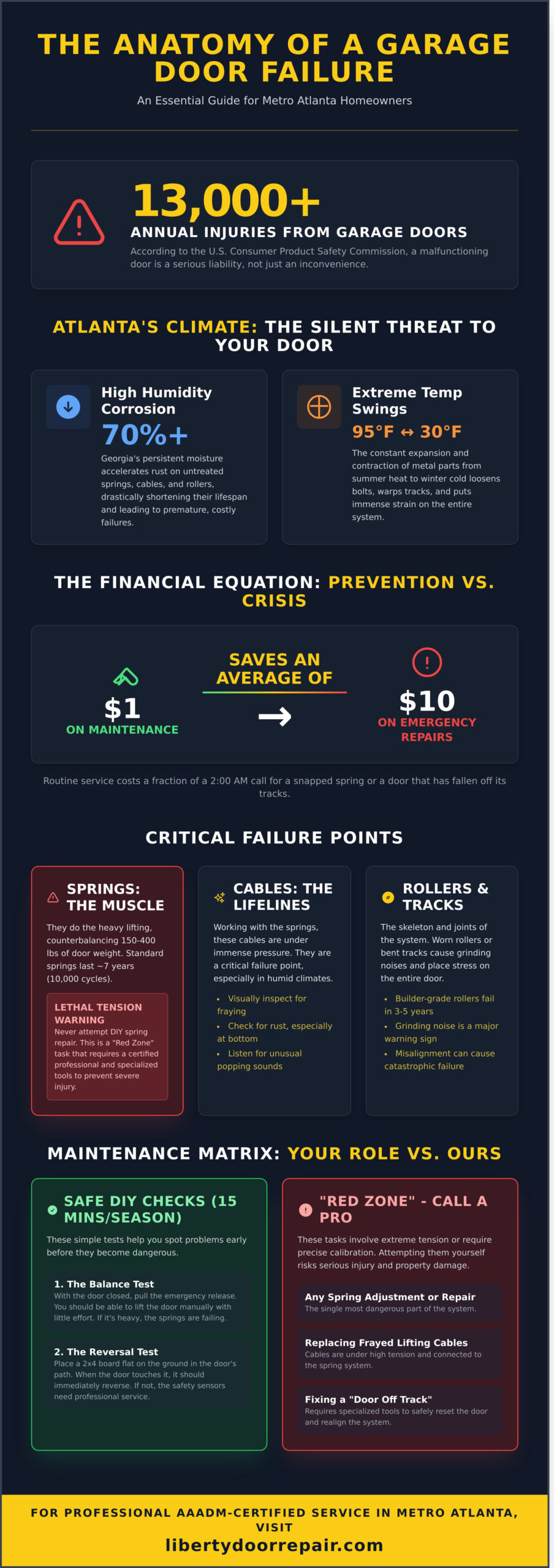
According to the U.S. Consumer Product Safety Commission, over 13,000 people are injured by garage doors each year, turning a daily convenience into a sudden liability. It’s easy to ignore the squeaks and rattles until it’s too late. That groaning sound isn’t just an annoyance waking the family; it’s a warning sign. In Metro Atlanta’s humid climate, unseen rust and wood swelling can accelerate wear, leading directly to sudden, costly failures that trap your car or worse.
We recommend a professional garage door tune-up at least once per year. Georgia’s high humidity and seasonal temperature swings can accelerate wear on metal parts like springs and rollers. An annual inspection by a certified technician catches problems before they become costly emergencies. Scheduling yearly professional service is the most reliable way to ensure your door operates safely. Finding trusted garage door maintenance near me is a critical step for any homeowner, and seeing the standards of a reputable, veteran-owned business like the Visalia Garage Door Repair and Installations Company can serve as a great example of what to look for in a local provider.
Finding a trusted expert for garage door maintenance near me isn’t a luxury; it’s a critical step for your family’s safety and peace of mind. This guide provides a clear, expert-led framework, backed by over 30 years of local experience, to help you extend the life of your door and avoid those expensive emergency calls. You’ll discover the essential maintenance tasks you can handle, identify the critical warning signs that demand a skilled technician, and finally get your door running quietly and smoothly for 2026 and beyond.
Key Takeaways
- Learn why Georgia’s high humidity is a major threat to your door’s springs and rollers, leading to premature rust and costly failure.
- Distinguish between safe, 15-minute DIY checks and high-risk “Red Zone” repairs that require a certified and insured professional.
- Perform two critical safety checks-the Balance Test and the Reversal Test-using our simple, step-by-step seasonal checklist.
- Discover what separates a general handyman from a trusted expert when you search for “garage door maintenance near me,” including the importance of AAADM certification.
Why Routine Garage Door Maintenance is Non-Negotiable in Metro Atlanta
Your garage door is more than an entryway. It’s the largest moving object in your home, a critical security barrier, and a major component of your property’s curb appeal. Routine maintenance is not just about silencing a squeaky roller; it’s a proactive safety and performance audit designed to protect your family and your investment. Here in Metro Atlanta, our unique climate makes this service an absolute necessity, not a luxury.
Georgia’s climate wages a constant war on your door’s components. With average humidity levels often exceeding 70%, the air itself works to corrode untreated metal parts. This moisture leads directly to premature rust on high-tension torsion springs and steel rollers, weakening them long before their expected lifespan is up. Compounding this is North Georgia’s ‘temperature swing’ effect. Metal parts that bake in 95-degree July heat contract sharply during a 30-degree January night. This constant expansion and contraction loosens critical bolts, warps tracks, and puts immense strain on the entire system. Understanding the Anatomy of a Garage Door reveals just how many of these interconnected parts are vulnerable to our local weather.
The financial return on investment is undeniable. Industry data shows that for every $1 spent on preventative maintenance, homeowners save an average of $10 on future emergency repairs. A scheduled service call from a trusted expert costs a fraction of a 2:00 AM emergency call for a snapped spring or a door that has fallen completely off its track. Searching for professional garage door maintenance near me is a strategic financial decision for any Atlanta homeowner looking to avoid a sudden, four-figure repair bill.
The Cost of Neglect: Beyond the Noise
That grinding sound you hear is a warning. An ignored noisy roller often indicates a misaligned track, placing uneven stress on the entire system until it fails catastrophically. This can lead to a “door off track” disaster, trapping your vehicle and causing significant property damage. Frayed lifting cables in a high-use residential garage are a ticking time bomb, ready to snap under hundreds of pounds of pressure. Preventative maintenance is the primary defense against catastrophic spring failure, as mandated by 2026 residential safety standards.
Safety First: The Liability of a Failing Door
A poorly maintained garage door is a security risk. A door that doesn’t close flush with the ground becomes an easy entry point for intruders. More critically, failing auto-reverse safety sensors pose a direct threat to your family and pets. The U.S. Consumer Product Safety Commission documents dozens of serious injuries each year from malfunctioning doors. It’s why our skilled technicians see a surge in service calls from Cumming and Alpharetta homeowners prioritizing maintenance before the spring storm season begins in March.
The Anatomy of a High-Performance Garage Door: Critical Components
Your garage door is the largest and heaviest moving object in your home. It’s not just a single panel; it’s a complex system of interconnected parts working under extreme tension to lift and lower hundreds of pounds, day after day. Understanding these critical components is the first step toward effective maintenance and preventing catastrophic failures. From the high-tension springs to the humble weather seal, each part has a vital role to play in the door’s safety and performance.
Springs and Cables: The Muscle of the System
The springs, not the opener, do the heavy lifting. Whether you have a torsion spring (a large spring on a metal bar above the door) or extension springs (two smaller springs running along the horizontal tracks), their job is to counterbalance the door’s weight, which can range from 150 to 400 pounds. Standard springs are rated for 10,000 cycles; one cycle is a full open and close. If you use your door four times a day, that’s a lifespan of about seven years. Regular professional balancing can prevent premature wear. The cables work with the springs, and signs of fatigue are a major red flag. Visually inspect your cables for any thinning, rusting, or fraying, especially near the bottom brackets where moisture collects.
Warning: Garage door springs are under lethal tension. Attempting a DIY spring repair or adjustment without proper training and specialized tools is extremely dangerous. It violates established industry safety standards and can result in severe injury. This work must be left to a skilled, AAADM-certified technician.
Tracks and Rollers: Ensuring a Smooth Path
The tracks guide the door, and the rollers allow it to move. Think of them as the skeleton and joints. If you hear excessive grinding or squeaking, your rollers may be the problem. Most builder-grade doors come with basic steel rollers that lack ball bearings and wear out in 3-5 years. An upgrade to sealed 13-ball-bearing nylon rollers provides dramatically quieter and smoother operation. A bent track is a more serious issue. Look for visible gaps between the track and the rollers or listen for a scraping sound. A misaligned track forces your opener’s motor to work harder, which can shorten its lifespan by up to 50% and lead to a costly burnout. When looking for professional garage door maintenance near me, ensure the service includes a track alignment check.
A common mistake is lubricating the inside of the tracks. Never apply grease or oil to the track itself. This only attracts dirt, dust, and debris, creating a thick sludge that will jam the rollers. Instead, simply wipe the inside of the track clean with a damp cloth. Lubricant should only be applied to the moving parts: the hinges, roller stems (not the wheel), and bearings.
Finally, inspect the weather seal at the bottom of your door. This flexible vinyl or rubber strip is your first line of defense against the elements. A cracked, brittle, or flattened seal allows drafts, water, and pests into your garage. Replacing it can improve your home’s energy efficiency and keep your garage clean and dry. If you’re unsure about the condition of these components, our trusted experts can perform a full system safety inspection to identify and address any potential issues.
DIY Maintenance vs. Professional Service: The Decision Matrix
Understanding the difference between a simple task and a dangerous repair is critical. Your garage door is the largest moving object in your home, with components under extreme tension. A 16-foot double-car garage door can weigh over 400 pounds. The torsion springs that lift this weight are wound with enough force to cause severe injury. This isn’t about saving a few dollars; it’s about managing risk and ensuring your family’s safety. Making the wrong call can have serious consequences.
What You Can Safely Do Yourself
These are the safe, 15-minute tasks any homeowner can perform once every three months to keep their door running smoothly. Think of this as basic upkeep, not a repair. A 7/16-inch wrench and a can of silicone-based lubricant are all you need. These simple actions prevent noise and reduce minor wear caused by daily vibrations, extending the life of your system’s components.
- Tighten Hardware: Vibration from opening and closing the door loosens nuts and bolts over time. Check and tighten all roller brackets and the bolts that hold the rails to the frame.
- Test Photo-Eye Sensors: Clear any dust or cobwebs from the sensor lenses with a soft cloth. To test them, start closing the door and wave an object (like a broom handle) in front of one of the sensors. The door should immediately reverse.
- Lubricate Moving Parts: Apply a high-quality, silicone-based lubricant to the door’s hinges, rollers, and springs. Do not lubricate the door tracks; this will attract dirt and cause the rollers to slip instead of turn.
When to Call a Trusted Expert
Certain symptoms are immediate red flags that signal a problem requiring a skilled technician. These issues involve the parts of the door under the most tension or the complex electronics of the opener. Attempting to fix these yourself without proper tools and training is extremely dangerous. Don’t hesitate. A professional service call is the only safe solution for these problems.
- A Heavy Door: Disengage the opener and try to lift the door by hand. It should feel lightweight (around 8-10 pounds) and stay open around waist-height. If it feels heavy or slams shut, the springs are failing and can no longer support the door’s weight.
- A Broken Spring: If you hear a loud bang from the garage, it was likely a torsion spring breaking. You will see a visible 1/8-inch gap or more in the spring coil above your door. The door is now unsafe to operate.
- Opener Malfunctions: Any issue with the opener’s motor, gears, or circuit board requires a diagnosis from an expert. Tinkering with these components can lead to electrical shock or permanent damage to the unit.
You can diagnose many issues with a simple visual and audio test. Look for frayed, rusty, or thinning lift cables at the bottom corners of your door. These are a critical failure point. Listen for grinding, scraping, or popping noises as the door operates. These sounds indicate metal-on-metal contact from worn-out rollers or parts under immense strain. A professional tune-up, the kind you get when you search for garage door maintenance near me, includes over 20 specific safety and performance checks that go far beyond a simple visual scan. Our technicians measure spring tension, check drum and cable integrity, test the opener’s force settings, and diagnose wear on parts a homeowner would miss, preventing a catastrophic failure before it happens.
Your Seasonal Garage Door Maintenance Checklist for Cumming, GA
Your garage door is the largest moving part of your home. In Cumming, GA, it faces intense summer humidity and chilly winter drafts. A consistent maintenance routine doesn’t just prevent inconvenient breakdowns; it ensures your family’s safety and protects your home’s energy efficiency. This five-step checklist is your guide to proactive care. For tasks that seem complex or involve high-tension components like springs, searching for professional garage door maintenance near me is the safest solution.
Spring and Fall: The Best Times for Service
Twice a year is the ideal schedule for a thorough inspection. Spring maintenance prepares your system for the heavy, humid air of a Georgia summer, which can strain opener motors and cause wooden doors to swell. A fall check ensures your door seals tightly against winter cold. A properly sealed and insulated garage door can reduce your attached home’s energy loss by up to 15%, keeping your utility bills down when temperatures drop.
Follow these five critical steps to assess your garage door’s health:
- Step 1: The Monthly Balance Test. Your door’s springs do the heavy lifting, not the opener. To check them, first pull the red emergency release cord to disconnect the opener. Then, manually lift the door to about waist height. It should stay in place. If it slams down or shoots up, the springs are unbalanced and under dangerous tension. This requires immediate professional service.
- Step 2: The Reversal Test. This is a non-negotiable safety check. Place a standard 2×4 piece of wood flat on the ground in the door’s path. When you close the door, it should immediately reverse direction upon contact with the wood. If it doesn’t, the safety reversal system is failing. This is a serious hazard that needs an expert technician to recalibrate or repair the system according to UL 325 federal safety standards.
- Step 3: Lubrication of Moving Parts. Noise is often the first sign of trouble. Use a silicone or white lithium grease spray, never a penetrating oil like WD-40, on all moving metal parts. This includes the hinges, rollers, and springs. Proper lubrication reduces friction and extends the life of your hardware, preventing premature wear from the constant movement.
- Step 4: Weatherstripping Inspection. The vinyl or rubber seal at the bottom of your door is a critical barrier. Inspect it for cracks, brittleness, or gaps. In Georgia, a damaged seal is an open invitation for moisture, debris, and pests like spiders and roaches to enter your garage. Replacing worn weatherstripping is a simple fix that makes a significant difference.
- Step 5: Visual Hardware Check. Take a moment to look over the entire system. Check for loose bolts or brackets, especially where the tracks are mounted to the wall. Look for signs of rust on the tracks or fraying on the lift cables. Do not attempt to adjust or tighten the high-tension cables or springs yourself.
Identifying Local Warning Signs
The North Georgia climate creates unique challenges. The high humidity from May to September can cause wood doors to swell and stick. Condensation can form on metal tracks, leading to oxidation and rust that impedes smooth operation. Heavy spring pollen and falling autumn leaves can also build up in the tracks, blocking the photo-eye sensors and preventing your door from closing properly. Regular cleaning of these components is essential.
While these DIY checks are effective, they can’t replace the trained eye of a professional. If you uncover issues or simply want the peace of mind that comes with an expert evaluation, it’s time to call for service. Don’t wait for a small problem to become a major repair. When you need reliable garage door maintenance near me, our skilled technicians are ready to help. You can request a complete safety and maintenance inspection from our trusted experts today.
Professional Garage Door Maintenance by Liberty Door Repair
While a DIY checklist is a great start, certain tasks demand the precision and safety of a trained professional. When you need a trusted expert for your home, Liberty Door Repair is the definitive answer. With over 30 years of dedicated service to the Metro Atlanta market, we’ve built our reputation on reliable solutions and unmatched expertise. Our skilled technicians understand the specific challenges local homes face, from humidity affecting wooden doors to the wear and tear from daily use.
What truly sets us apart is the Liberty Difference. Every technician on our team is AAADM-certified (American Association of Automatic Door Manufacturers). This is the gold standard in the industry, a qualification typically reserved for complex commercial door systems. We bring that same level of precision, safety protocol, and in-depth knowledge to every residential garage door we service. Your home deserves nothing less than commercial-grade expertise.
To ensure your door operates at peak performance, we offer a comprehensive 21-point safety and performance tune-up. This isn’t a quick look-over; it’s a detailed diagnostic and preventative service designed to catch problems before they become costly emergencies. Our inspection covers every critical component of your system, including:
- Testing the door’s balance and spring tension for smooth operation.
- Lubricating all moving parts, including rollers, hinges, and bearings, to reduce noise and friction.
- Inspecting cables and pulleys for any signs of fraying or wear.
- Aligning and cleaning photo-eye safety sensors to guarantee responsiveness.
- Checking all bolts and hardware, tightening them to factory specifications.
If you’re searching for professional garage door maintenance near me, our local teams are ready to respond. We provide fast, reliable service across the region, from the neighborhoods of Cumming and Alpharetta to Marietta and beyond. We are your local experts, not a faceless national chain.
Why Experience Matters in Door Repair
Our 30+ years of commercial experience directly benefits your home. We understand which parts fail and why, so we only use high-quality components designed for longevity. Our commitment is to ‘fix it right the first time,’ saving you time and money. When you call us, you speak directly with local dispatch who can connect you with a technician, not a generic call center. It’s efficient, personal, and professional service.
Ready for a Quieter, Safer Door?
Our maintenance packages are designed with transparent pricing to give you complete peace of mind. A well-maintained door is safer, quieter, and far less likely to fail unexpectedly. We offer convenient scheduling, including same-day service in areas like Cumming, to fit your busy life. Stop dealing with a noisy, unreliable garage door. Let our trusted experts restore its performance and safety today.
Broken Door? Let’s Get it Fixed! Request Service Now
Protect Your Investment: Schedule Expert Maintenance Today
Your garage door is more than an entryway; it’s a critical system protecting your home and family in Metro Atlanta. This guide has detailed why routine care is non-negotiable for safety and how professional service addresses complex components that DIY checks can’t. When you search for garage door maintenance near me, you aren’t just looking for a quick fix. You’re seeking a reliable partner to ensure your door operates flawlessly for years to come.
Liberty Door Repair is that trusted expert. With over 30 years of local Atlanta experience, our team provides solutions backed by a proven track record. Our AAADM-Certified Technicians deliver a level of skill and safety that has earned us consistent 5-star local service reviews from your neighbors. Don’t wait for a squeak to become a snap or a wobble to become a breakdown. Let our professionals perform a comprehensive inspection.
Take proactive control of your home’s safety and security. Request Your 21-Point Garage Door Tune-Up Today and ensure your largest moving part is in expert hands.
Frequently Asked Questions About Garage Door Maintenance
How often should I have my garage door serviced in Georgia?
We recommend a professional garage door tune-up at least once per year. Georgia’s high humidity and seasonal temperature swings can accelerate wear on metal parts like springs and rollers. An annual inspection by a certified technician catches problems before they become costly emergencies. Scheduling yearly professional service is the most reliable way to ensure your door operates safely. Finding trusted garage door maintenance near me is a critical step for any homeowner.
What is the best lubricant to use on my garage door rollers?
Use a silicone-based spray or a white lithium grease specifically designed for garage doors. These lubricants reduce friction on moving metal parts without attracting dust and debris. Do not use standard WD-40, as it’s a solvent that can strip away existing grease and attract grime, causing more problems over time. Apply the lubricant directly to the rollers, hinges, and bearings, but be sure to keep it off the tracks themselves.
Why is my garage door making a loud grinding noise?
A loud grinding noise almost always signals a serious mechanical problem. The sound is often caused by worn-out rollers scraping against the metal track or a stripped gear inside the garage door opener. This isn’t a noise you should ignore. Continuing to operate the door can lead to severe damage to the tracks or the opener motor itself. Contact a professional technician immediately to diagnose and fix the issue safely.
Can I replace a garage door spring myself?
No, you should never attempt to replace a garage door spring yourself. Torsion springs are under thousands of pounds of extreme tension and require specialized tools and knowledge to handle safely. A mistake can cause the spring to snap violently, resulting in severe injury or even death. This repair is one of the most dangerous in home maintenance and must be left to a trained, certified garage door expert.
How much does a professional garage door tune-up cost in Cumming?
A comprehensive garage door tune-up in the Cumming, GA area typically costs between $99 and $149. This service should include a full safety inspection, lubrication of all moving parts, tightening of bolts and hardware, and balancing the door. This preventative maintenance investment is small compared to the average cost of an emergency repair, which can easily exceed $300, making it a smart financial decision for homeowners.
Is it normal for my garage door to slow down in the winter?
Yes, it’s common for a garage door to operate more slowly in cold weather. Low temperatures, often below 32°F, can cause the lubricant on the tracks and rollers to thicken, creating more resistance. The metal components can also contract slightly. While minor sluggishness is normal, if the door struggles significantly, stops mid-travel, or makes unusual noises, it may signal a more serious issue with the springs or opener motor that needs professional attention.
What should I do if my garage door safety sensors are blinking?
A blinking light on your safety sensors means the infrared beam is broken or misaligned. First, check for any obstructions in the sensors’ path, like a box, tool, or debris. The sensors are located about 6 inches from the floor on either side of the door. Next, wipe the lenses with a clean, soft cloth. If they still blink, they may be misaligned. Try gently adjusting them until both sensor lights are solid, confirming the connection is restored.
How long do garage door springs typically last before they break?
Standard garage door torsion springs are rated for 10,000 cycles. One cycle is a single open and close action. For the average household using the door 3-4 times daily, this translates to a lifespan of approximately 7 to 9 years. If your door is over 7 years old and you hear a loud bang from the garage, a broken spring is the most likely cause. High-cycle springs, rated for 25,000 cycles or more, are also available for a longer-lasting solution.