

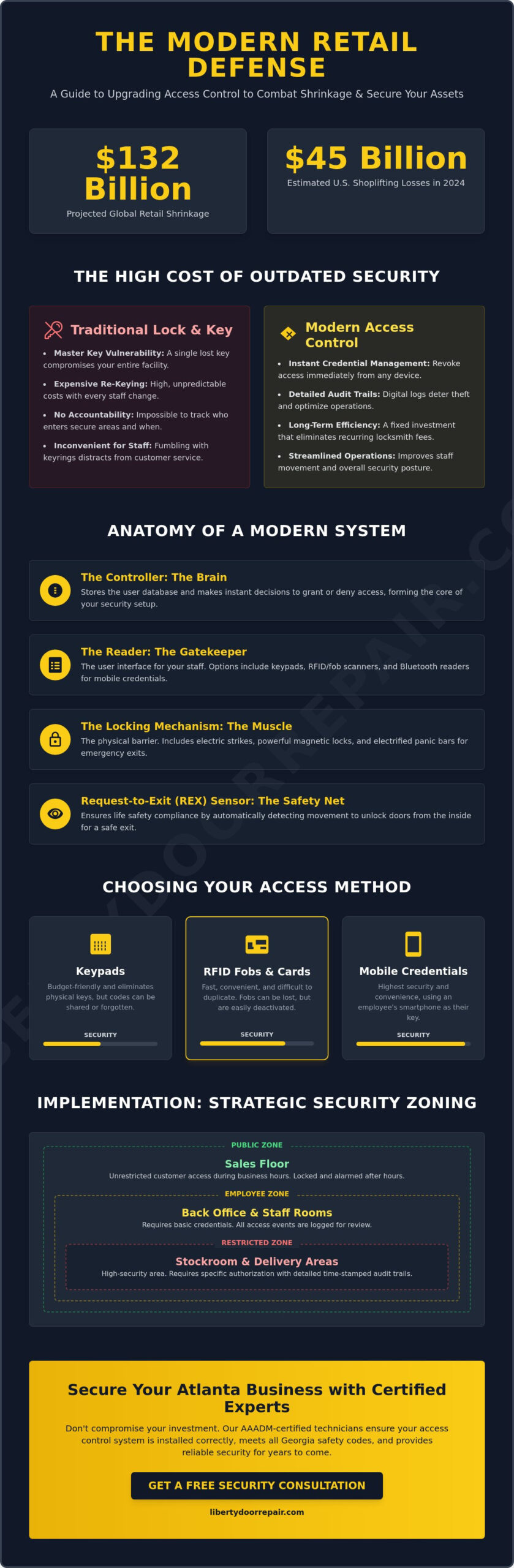
Retail shrinkage is projected to reach $132 billion globally, and U.S. retailers lost an estimated $45 billion to shoplifting in 2024 alone. For an Atlanta business owner, these aren’t just figures on a spreadsheet. They represent lost profit and growing safety concerns for your staff. You need to protect your inventory, but you can’t afford to make your shop feel like a fortress or deal with the headache of re-keying locks every time an employee leaves.
Investing in a modern access control system for retail store management is the best way to balance high-tech security with a seamless customer experience. This 2026 guide will show you how to secure your premises while maintaining full ADA accessibility and smooth traffic flow. We’ll cover the transition to mobile credentials, Georgia building code requirements, and how to choose a keyless system that provides the tracking data you need to stop internal and external theft.
Key Takeaways
- Eliminate the cost and hassle of frequent re-keying by transitioning to a digital system designed for high employee turnover.
- Identify the best access control system for retail store layouts to secure high-value inventory without disrupting customer traffic.
- Evaluate the effectiveness of keypads, RFID fobs, and mobile credentials based on your specific security and budget requirements.
- Implement a tiered security strategy that separates public-facing entrances from restricted stockrooms and delivery zones.
- Avoid long-term hardware issues by relying on AAADM-certified technicians for professional installation and maintenance.
Why Your Retail Store Needs a Modern Access Control System
Retail security is a constant battle against shrinking margins and evolving threats. Global retail shrinkage hit $132 billion in 2024; a staggering figure that highlights the vulnerability of physical inventory. For shop owners in Metro Atlanta, the risk isn’t just about lost product. It’s about protecting staff during late-night shifts in busy shopping centers and ensuring that only authorized personnel enter restricted areas. A traditional lock and key cannot meet these demands. An access control system for retail store operations replaces physical vulnerability with digital precision.
Eliminating the ‘Master Key’ Risk
Traditional keys are a liability in the retail sector. If an assistant manager loses a master key, your entire facility is compromised. You face thousands of dollars in locksmith fees to re-key every cylinder in the building. Digital credentials eliminate this panic. When an employee leaves your company, you can revoke their permissions instantly through a central management interface. The cost of re-keying is an unpredictable penalty for business growth, whereas the cost of digital management is a fixed investment in long-term operational efficiency.
Audit Trails and Loss Prevention
Accountability is the strongest deterrent against internal theft. Modern Access Control technology provides detailed audit logs that show exactly who entered the stockroom and when. If inventory goes missing during a specific shift, you have a digital paper trail to cross-reference with your surveillance footage. This data does more than just catch thieves; it helps you optimize operations. By reviewing access frequency, you can identify high-traffic times in your delivery zones and adjust staff schedules to ensure adequate coverage. Integrating these logs with your existing retail surveillance creates a unified defense that protects your bottom line 7 AM–7 PM daily.
Essential Components of a Retail Access Control System
A reliable access control system for retail store operations is more than just a digital lock. It’s a network of hardware designed to withstand hundreds of cycles every day. These components must work in perfect synchronization to ensure security while maintaining a professional appearance. If one part of the chain fails, your entire security perimeter is compromised. Understanding these four pillars is the first step toward a secure storefront.
- The Controller: This is the ‘brain’ of your security setup. It stores your database of authorized users and makes the split-second decision to unlock a door when a credential is presented.
- The Credential Reader: This is the interface your staff uses. Options include PIN keypads, RFID scanners for fobs, or Bluetooth-enabled readers that allow employees to use their smartphones.
- The Locking Mechanism: This provides the physical force. Common retail choices include electric strikes, magnetic locks, and electrified panic bars for emergency exits.
- The Request-to-Exit (REX) Sensor: Safety is paramount. These sensors detect when someone is approaching the door from the inside and release the lock automatically for a safe exit.
Integrating these tools allows you to Improve Security Measures across your entire floor plan. When hardware is installed correctly, it remains nearly invisible to your customers while providing total control for your management team.
Choosing the Right Locking Hardware
Glass storefronts require specific hardware. Electric strikes are a popular choice because they allow the door to remain latched but unlocked during business hours. Magnetic locks provide immense holding force but require a constant power source to stay locked. Any electronic lock installation must be coordinated with professional fire door services to ensure compliance with Georgia life safety codes. Standard hinges often fail under the weight of electrified hardware. You should install heavy-duty pivots to support the additional load and protect your door frame from warping over time.
Cloud-Based vs. On-Premise Management
Cloud-based systems are the modern standard for Atlanta retailers with multiple locations. These platforms allow you to manage permissions for three different stores from a single smartphone app. You can grant temporary access to a delivery driver or revoke a former manager’s credentials in seconds. On-premise systems are less common but remain a viable choice for high-security boutiques that prefer local data storage. These systems don’t rely on an internet connection to function, but they lack the remote flexibility of the cloud. Reliable connectivity is a requirement for same-day service, available 7 AM–7 PM daily retail operation. If your hardware is misaligned, even the best software won’t keep your shop secure. Consider a professional evaluation of your door’s physical health before upgrading your electronics.
Comparing Access Methods: Keypads, Mobile, and RFID for Stores
Choosing the right credential type is a critical decision for your security posture. You must consider staff turnover, ease of use, and the specific value of the goods you protect. A robust access control system for retail store environments should offer flexibility without compromising safety. Different zones in your shop may require different methods to stay secure.
- Keypads: These are the most cost-effective solution. They eliminate physical keys entirely, but codes are frequently shared among staff, which weakens your security perimeter.
- RFID Cards and Fobs: These are durable and easy to distribute. However, fobs are easily lost or stolen, requiring immediate deactivation to prevent unauthorized entry.
- Mobile Access: This method uses encrypted Bluetooth or NFC technology on a smartphone. It is highly secure because it’s tied to a specific device and usually requires biometric phone unlocking.
- Biometrics: Fingerprint or facial recognition provides the highest level of security. Use these for restricted zones like jewelry cases or high-end electronics stockrooms.
The goal is to find a solution that fits your team’s workflow. If your staff can’t use the system efficiently, they will eventually find ways to bypass it, such as propping doors open. This creates a massive security gap that invites theft.
Pros and Cons of Keyless Entry
Speed is essential in retail. Your staff often has their hands full with heavy shipments or inventory. Mobile access allows for “hands-free” entry, which is a major advantage over fobs or PINs. You also need to consider the durability of your hardware. Atlanta’s high-traffic environments and local humidity can wear down cheap readers quickly. While RFID cards are inexpensive to replace, mobile credentials offer superior encryption and cannot be physically shared as easily. It’s also important to remember that not every employee will have a compatible or charged smartphone, so a hybrid system is often the most reliable choice.
Multi-Factor Authentication (MFA) for High-Security Zones
Some areas of your shop require more than a single tap. High-value retail environments often implement Unified Access Control & Security Solutions to protect cash rooms. Combining a PIN with an RFID card ensures that a stolen fob alone isn’t enough to gain entry. For luxury retailers, biometric scanners add an elite layer of protection for high-ticket items. Professional access control solutions ensure these layers don’t slow down authorized operations. Your team needs to move fast. Your security must be able to keep up.
Implementation Strategy: Securing High-Traffic and Restricted Zones
Effective retail security requires a tiered implementation strategy. You cannot treat your front entrance the same way you treat a cash room. A well-designed access control system for retail store environments creates clear boundaries between public, semi-private, and restricted zones. This structure prevents unauthorized wandering while ensuring your team can work efficiently. By dividing your property into specific tiers, you minimize risk without hindering the customer experience.
Tier 1 focuses on the storefront. This is your most active entry point. It must remain inviting to customers during business hours but lock down tight at night. Tier 2 secures the stockroom. This area is the primary target for inventory shrinkage. Restricting access here to specific staff and delivery personnel is essential for loss prevention, especially for specialized retailers like HomeWise Appliances that handle large, high-value inventory. Tier 3 covers the manager’s office. This zone houses your cash, sensitive records, and server racks. It requires the highest level of restriction; often involving multi-factor authentication to ensure total privacy.
Storefront ADA and Fire Code Compliance
Safety regulations in Metro Atlanta are strict. Your storefront must comply with the Georgia State Accessibility Code. Professional automatic door services ensure your entrance stays accessible for all customers while integrating perfectly with your electronic locks. You must also understand the difference between ‘fail-safe’ and ‘fail-secure’ hardware. Fail-safe locks release when power is lost; this is often required for fire exits to ensure safe egress. Fail-secure locks stay locked during power failures to protect high-value goods. Panic bars are another non-negotiable component. They allow immediate exit during emergencies, regardless of the electronic system’s status. If your hardware is outdated, schedule a commercial door compliance inspection today to avoid heavy fines.
Managing Staff and Vendor Access
Retail operations often involve third-party vendors. You can use ‘time-fenced’ credentials to allow delivery drivers access only during specific morning windows. This prevents them from entering your facility after hours without supervision. For businesses in Brookhaven or Decatur, managing seasonal holiday staff is another common challenge. Digital systems allow you to issue temporary credentials that expire automatically after the busy season ends. You also need a plan for emergency overrides. First responders must be able to gain entry quickly if an alarm is triggered. Modern systems allow for master codes or physical overrides that keep your business safe while allowing for necessary intervention.
Professional Installation and Maintenance in Metro Atlanta
An access control system for retail store use is only as effective as the physical door it manages. Many business owners make the mistake of treating security as a software-only problem. They buy a kit online and attempt a DIY installation. This approach almost always backfires. Improperly installed hardware leads to immediate commercial door repair atlanta needs. If a latch doesn’t line up perfectly with the strike plate, the system won’t lock correctly. You’re left with a false sense of security while your inventory remains vulnerable.
Liberty Door Repair has served North Georgia businesses since 2015. Our technicians are AAADM-certified experts who understand the complex mechanics of commercial entryways. We serve the entire Metro area, from the luxury boutiques in Alpharetta to the high-traffic shopping centers in Marietta. We don’t just “install” a reader. We verify that your entire door assembly is structurally sound and capable of supporting advanced security technology. Our preventative maintenance plans keep your hardware aligned, preventing small issues from turning into total system failures.
The Importance of Proper Door Alignment
A sagging door is the silent killer of electronic locks. Even a slight drop in a hinge puts massive pressure on an expensive electric strike or magnetic lock. This friction leads to burnt-out motors and hardware failure. Before we mount any electronics, we perform a total audit of your door parts & replacements, specifically checking the health of your hinges, pivots, and closers. Atlanta’s humidity is another critical factor. Metal and wood components expand and contract as the seasons change. Without professional alignment, your lock might function perfectly in January but stick or fail to catch in July. We ensure your system is calibrated for year-round reliability.
Local Support for Urgent Security Issues
When your front door refuses to lock at closing time, you can’t afford to wait for a national manufacturer’s technician to travel from out of state. That delay is a massive liability for your business and your staff. We offer rapid, local support for urgent security problems throughout the Metro Atlanta area. Our commitment is to keep your retail store safely open and fully secure. Don’t leave your bottom line to chance with a DIY kit or a distant service provider. Secure your retail store with a professional access control consultation from Liberty Door Repair today.
Future-Proof Your Retail Security Today
A secure storefront is the foundation of a profitable retail business. Transitioning to a modern access control system for retail store operations allows you to stop inventory shrinkage and manage staff turnover with digital precision. By combining tiered security zones with ADA-compliant hardware, you create a professional environment that protects your high-value stock while welcoming every customer. These systems provide the audit logs and remote management tools necessary to thrive in the competitive Atlanta market.
Expertise matters when your livelihood is on the line. Liberty Door Repair is a local, family-owned business Serving North Georgia businesses since 2015,. Our AAADM certified technicians serve all of Metro Atlanta; providing the specialized knowledge required to keep your electronic locks and physical door hardware in perfect alignment. Don’t leave your shop’s safety to chance or a DIY kit.
Get a Free Access Control Quote for Your Atlanta Store
Invest in a system that grows with your business and provides the peace of mind you deserve.
Frequently Asked Questions
Can I add access control to my existing glass storefront doors?
Yes, you can retro-fit most existing glass storefront doors with high-tech security. This process typically involves installing electric strikes or magnetic locks that integrate with your current frame. Our technicians ensure the physical alignment is perfect so the glass remains secure and the electronic components function without friction.
What happens to the door locks if my store loses power?
Your locks will behave according to their specific configuration, either fail-safe or fail-secure. Most professional systems include a battery backup to maintain security during short outages. In a total power failure, fire code requirements ensure that staff and customers can always exit the building safely through manual overrides or panic hardware.
Is a cloud-based access control system secure against hackers?
Modern cloud systems use high-level end-to-end encryption and multi-factor authentication to protect your data. These systems are often more secure than traditional keys because you can patch software vulnerabilities remotely. They eliminate the risk of someone finding a lost physical key and gaining unauthorized entry to your facility.
How much does a retail access control system cost to install in Atlanta?
Total installation costs depend on the number of entry points, the type of hardware selected, and your specific building requirements. Factors such as local permitting fees in Metro Atlanta and the complexity of your existing door frames also influence the final investment. We provide detailed evaluations to determine the most cost-effective solution for your specific storefront layout.
Do I need to replace my panic bars to use electronic access?
You don’t always need to replace your existing panic hardware. Many high-quality panic bars can be electrified or paired with an electric strike to work with a new system. We inspect your current devices to see if they meet modern safety standards before recommending a full replacement or a simple electronic upgrade.
How many employees can I manage on a single access control system?
Modern digital platforms are highly scalable and can manage an unlimited number of users. You can easily add or revoke access for hundreds of employees across multiple Atlanta locations from a single dashboard. This makes an access control system for retail store management ideal for businesses with high seasonal turnover.
What is the difference between fail-safe and fail-secure locks for retail?
Fail-safe locks automatically unlock when power is cut to ensure people can exit during an emergency. Fail-secure locks stay locked during a power failure to protect your inventory from outside threats. Local fire marshals typically require fail-safe configurations on primary exit doors to meet life safety regulations.
How does an access control system help with ADA compliance?
Access control systems integrate with automatic door operators to provide touchless entry for individuals with disabilities. This setup ensures your store meets ADA requirements by allowing doors to open via a credential reader or wave sensor. It eliminates the need for customers to manually grasp or twist heavy door hardware to enter your shop.