

Last Tuesday, a warehouse manager in Marietta got the news no business owner wants: a failed fire marshal inspection. The violation? A single fire door with a faulty latch, leading to a potential fine and a 30-day notice to correct the issue. This wasn’t a case of neglect, just a small oversight with major consequences.
That feeling of uncertainty over NFPA 80 and local Life Safety Codes is a major source of stress for Metro Atlanta business owners. You know compliance is critical for protecting your employees and assets, but the details can be overwhelming, and the liability of getting it wrong is severe. It’s a problem that demands a reliable, expert solution.
This guide is your answer. We’ll show you exactly how to stay compliant and pass your next inspection with trusted local fire door services. You’ll learn the key requirements for your facility, how to spot common failures before they become violations, and what to look for in a certified partner for inspections and repairs.
Key Takeaways
- Learn the critical components of a fire door inspection, from verifying the fire-rated label to testing the self-closing mechanism for full compliance.
- Discover the most common fire door failures, like improper gaps and alignment issues, and understand the expert solutions required to fix them.
- Understand how professional fire door services ensure your business meets NFPA 80 standards and local Metro Atlanta fire code requirements.
- See why choosing an AAADM-certified technician over a general handyman is critical for the specialized work of fire door repair and maintenance.
What Are Fire Door Services and Why Does Your Business Need Them?
Fire doors are not just heavy-duty doors; they are engineered life-safety systems designed to save lives. Specialized fire door services ensure every component of these critical barriers operates exactly as intended during an emergency. The primary role of a fire door is compartmentalization. It creates a physical barrier that contains smoke and flames, preventing a fire from spreading rapidly through your building. This containment provides occupants with the crucial time needed to evacuate safely. If you’re asking, what is a fire door?, understand it’s a complete, tested assembly including the door, frame, and hardware that must work in perfect unison.
A general contractor or handyman cannot provide the expertise required for these systems. A standard repair might fix a sticking door, but it won’t verify its compliance or fire-resistance rating. Fire door assemblies have precise tolerances and functional requirements that demand certified knowledge. Is the gap around the door within the 1/8-inch limit? Does the door close and latch automatically from any open position? Only a trained technician can answer these questions and perform code-compliant repairs.
Ignoring these requirements carries severe legal and financial consequences. A single non-compliant fire door can invalidate your building’s safety certificate. As of 2024, fines from the Occupational Safety and Health Administration (OSHA) for a serious safety violation can exceed $16,000. Looking ahead to 2026, building owners should anticipate even stricter enforcement from local fire marshals. In the event of a fire, a failed door assembly can lead to immense liability, denied insurance claims, and tragic loss of life.
The Core of Compliance: Understanding NFPA 80
The National Fire Protection Association’s NFPA 80 is the legal standard governing the installation and maintenance of fire doors. This isn’t a set of suggestions; it’s a mandate. NFPA 80 requires that all fire door assemblies be tested and inspected annually by a qualified and certified technician. The 2022 and upcoming 2025 updates to the standard continue to refine these requirements, placing greater emphasis on meticulous documentation and verification of all components, from hinges to latching hardware.
Passive Fire Protection vs. Active Systems
Passive fire protection is the physical barriers that prevent fire spread without human intervention. Your building’s active systems, like sprinklers and fire alarms, are designed to react to a fire. Your passive systems, like fire-rated walls and doors, are designed to contain it. A fire door must perform two non-negotiable functions: it needs “controlled closing” to shut automatically and “positive latching” to remain securely locked against the pressure of a fire. Professional fire door services ensure this silent, life-saving equipment is always ready.
Essential Components of a Fire Door Inspection
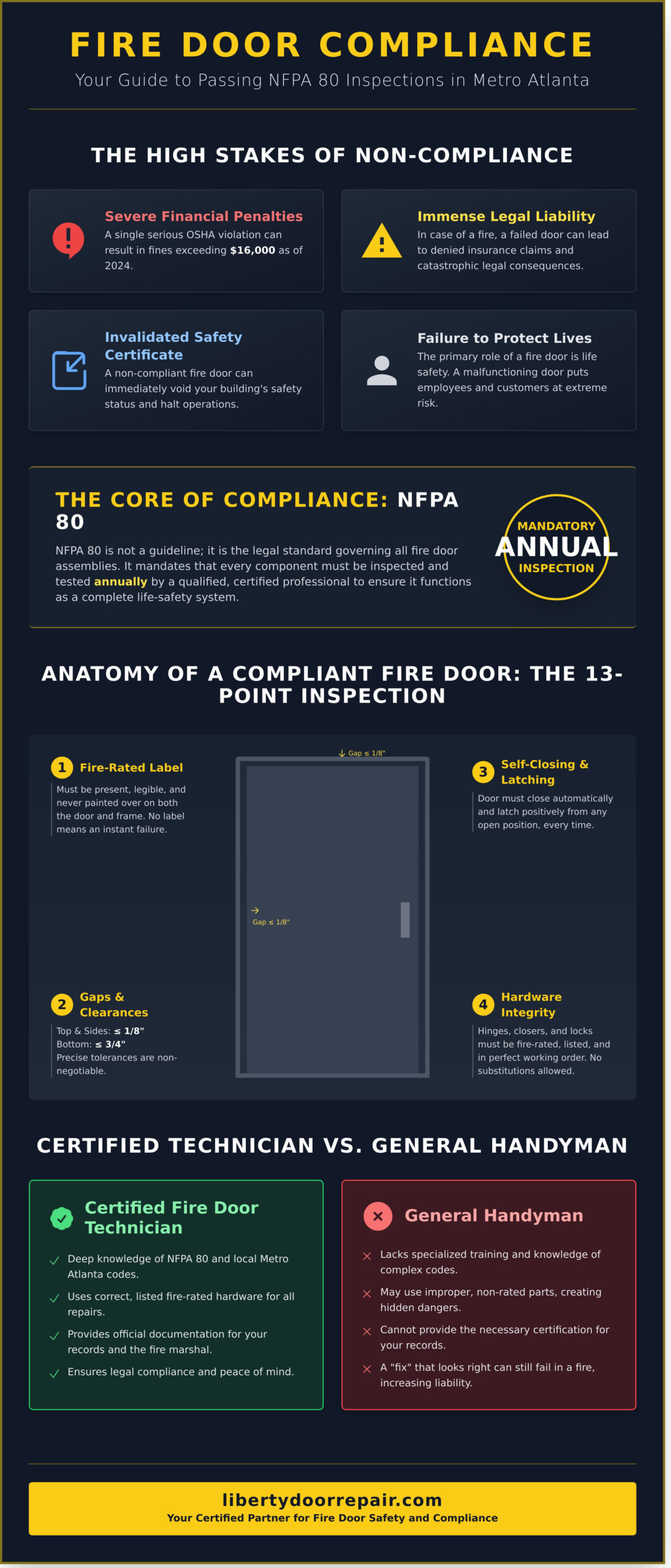
A fire door inspection is not a simple visual check. It’s a detailed, life-saving procedure dictated by the National Fire Protection Association (NFPA) Standard 80. A single point of failure can render your entire fire door assembly useless, exposing your property and occupants to extreme risk. Our skilled technicians follow a meticulous 13-point inspection process to verify that every component performs exactly as designed during an emergency.
A professional inspection confirms the operational status of four critical areas:
- The Fire-Rated Label: The first and most important check is for the label. This small tag on the door and frame certifies its fire-resistance rating (e.g., 60-minute, 90-minute). If this label is missing, painted over, or illegible, the assembly is instantly non-compliant. Its rating cannot be assumed.
- Self-Closing and Latching: A fire door must close automatically and latch securely from any open position. We test this function repeatedly to ensure it latches positively every time. A door that closes too slowly or fails to latch creates a direct path for fire and smoke.
- Door and Frame Clearances: Gaps allow smoke and flames to pass through. NFPA 80 enforces strict tolerances: for most steel doors, the clearance between the door and the frame cannot exceed 1/8 inch. The gap at the bottom of the door is limited to 3/4 inch. These precise measurements are non-negotiable for containment.
- Hardware Integrity: Every piece of hardware, from hinges and pivots to closers and panic bars, must be fire-rated and listed for use on a fire door. A standard, non-rated hinge will warp and fail in high heat, causing the door to fall from its frame.
Hardware: The Difference Between Life and Liability
Fire door hardware is engineered for extreme conditions. A fire-rated closer must be adjusted to shut the door in no less than 3 seconds from a 90-degree angle, preventing injury while ensuring a secure seal. In high-traffic areas, intumescent seals expand when heated to block gaps, while smoke gaskets prevent deadly smoke from spreading. Panic devices must be specifically labeled as “Fire Exit Hardware” to guarantee immediate egress without compromising the door’s fire rating.
The Inspection Report: Your Legal Shield
A professional report is your official record of due diligence for the Fire Marshal. It must document each door’s location, its condition, and a clear list of any deficiencies found. Compliance isn’t just about local fire codes; it also means meeting federal standards like the OSHA fire door regulations for workplace exit routes. Our expert fire door services include providing detailed digital reports, giving you an accessible compliance history for your safety files and simplifying audits. If you have questions about your building’s status, our certified technicians can perform a full NFPA 80 inspection to identify and correct any issues.
Common Fire Door Failures & Expert Repair Solutions
A fire door is a critical life-safety device, but it’s only effective if it functions perfectly. Even minor issues can lead to catastrophic failure during an emergency. Annual fire door inspections reveal that over 75% of facilities have at least one non-compliant fire door assembly, often due to a few common, correctable problems. Identifying and fixing these issues is the core of professional fire door services.
The single most common point of failure is improper door alignment, which creates unacceptable gaps around the door’s perimeter. A fire door’s job is to create a seal against fire, heat, and toxic smoke. When gaps between the door and the frame exceed 1/8 of an inch, or the clearance at the bottom of the door is greater than 3/4 of an inch, that seal is broken. Smoke can pour through these openings in seconds, incapacitating occupants long before the fire arrives.
Gap Management and Shimming
Our skilled technicians correct these dangerous gaps through precise hardware adjustments and the use of fire-rated shims. Unlike a piece of cardboard or wood, which burns away almost instantly, these specialized materials are designed to withstand extreme heat and maintain the door’s structural integrity. Using non-rated materials for a “quick fix” is a serious code violation that completely voids the door’s fire rating.
Closing and Latching Issues
A fire door must close and latch on its own, every time. A door propped open with a wedge or a faulty closer that fails to pull the door shut offers zero protection. A fire door that does not latch is effectively useless during a fire event. Our experts troubleshoot these systems by servicing hydraulic closers, adjusting spring hinge tension, and realigning vertical rod panic devices to ensure smooth, reliable, and compliant operation.
Physical damage and non-compliant hardware also pose significant risks. A dented hollow metal frame can prevent the door from seating properly, while a warped fire-rated wood door can create massive gaps. Any modification, repair, or hardware replacement must be done with extreme care to maintain the assembly’s certification. This includes replacing damaged parts with components that are specifically tested and UL-listed for that door’s rating.
You can’t guess when it comes to compliance. All repairs and hardware replacements must strictly adhere to the guidelines outlined in the NFPA 80 standards to ensure the assembly maintains its fire-resistance rating. Our trusted technicians are trained to identify and resolve these common failures, restoring the safety and compliance of your building. Don’t let a small issue become a major liability. If you suspect a problem, you need immediate, expert fire door services.
Navigating Local Fire Codes in Metro Atlanta
Ensuring your commercial property is compliant isn’t as simple as following one set of rules. Georgia adopts statewide fire safety standards based on the National Fire Protection Association (NFPA), but the final authority rests with your local Authority Having Jurisdiction (AHJ). This means the fire marshal in Cobb County may have different enforcement priorities than the one in Forsyth County. A fire door assembly that passes inspection in one city could be flagged for a violation just a few miles away.
This patchwork of local ordinances creates serious challenges for facility managers. For example, while the state follows NFPA 80 for annual fire door inspections, the City of Marietta’s fire code enforcement for its historic downtown district often requires more frequent checks on older hardware. Similarly, businesses in Alpharetta’s high-tech corridor along Windward Parkway face intense scrutiny on egress pathways in high-occupancy office buildings. Understanding these local quirks is not a suggestion; it’s a requirement for avoiding fines and ensuring occupant safety. Hiring a company that only knows the state code is a risk.
With over 30 years of experience in the region, our technicians understand the specific expectations of each Metro Atlanta AHJ. We know which inspectors prioritize door labels versus hardware functionality, and we prepare your facility accordingly. This local expertise is the difference between a passed inspection and a costly, time-consuming re-inspection process.
Looking ahead, preparation is critical. By Q4 2026, most Metro Atlanta jurisdictions are projected to fully adopt and enforce the 2024 International Fire Code (IFC). This update places a greater emphasis on documented annual inspections and the operational integrity of all fire door components. Getting your facility compliant now prevents last-minute emergencies and budget overruns. Our professional fire door services are designed to bring your building up to current and future standards.
Serving Cumming and the Metro Atlanta Area
Our deep roots in North Georgia mean we are not just a service provider; we are your local partner. We guarantee fast response times for businesses along Cumming Hwy and throughout the Metro area. Our trusted experts have spent decades building professional relationships with local inspectors, allowing us to coordinate directly with them to ensure your permit or certification passes the first time, every time.
Industry-Specific Fire Safety
Different businesses have different fire safety needs. A one-size-fits-all approach leads to compliance failures. We provide specialized solutions tailored to your industry’s unique regulatory demands.
- Healthcare Facilities: Hospitals in Atlanta’s “Pill Hill” medical district must comply with both NFPA 101 and stringent Joint Commission standards. We install and maintain fire-rated doors for operating suites and patient rooms that meet these complex requirements.
- Educational Buildings: For the 90,000+ students in Gwinnett County Public Schools, safe egress is paramount. We ensure every door in a school, daycare, or university has compliant panic hardware and clear pathways for swift evacuation.
- Retail and Hospitality: Storefronts at destinations like Avalon in Alpharetta must balance a modern aesthetic with life safety. We specialize in fire-rated glass doors and concealed exit devices that secure your property without compromising its design.
Don’t let a failed inspection disrupt your business. Ensure your facility is prepared for its next audit. Contact our certified technicians today for a complete fire door compliance assessment.
Of course, safety compliance is just one part of running a successful hospitality business. The kitchen is another critical area where professional-grade equipment is essential for performance and safety. For those in the food service sector, you can check out Southern Select Equipment for high-volume commercial ovens and other restaurant hardware.
Why Trust Liberty Door Repair for Your Fire Door Safety
Your building’s fire doors are not just doors; they are engineered life safety systems. Choosing a provider for their maintenance and repair is a critical decision that directly impacts occupant safety and legal compliance. At Liberty Door Repair, we bring over 30 years of specialized experience in commercial door systems to every job, ensuring your Metro Atlanta facility is protected, secure, and fully up to code.
Our technicians aren’t generalists. They are highly skilled, AAADM-certified professionals who understand the intricate requirements of NFPA 80 and local fire codes. A general handyman might fix a sticking door, but our experts know that the wrong screw, an oversized gap, or a miscalibrated closer can completely void a door’s fire rating. This level of specific knowledge is non-negotiable when lives are on the line. With three decades of dedicated work, we have provided expert fire door services to hundreds of businesses, from hospitals and schools to warehouses and retail storefronts.
We eliminate the hassle and delays common with other providers. Our process is built for efficiency and immediate results because we know that a deficient fire door is an urgent problem. We don’t just identify issues; we solve them, often in a single visit. Our turnkey solution includes:
- Comprehensive On-Site Inspection: A thorough audit of all fire-rated doors, frames, and hardware components to identify any non-compliant elements.
- Detailed Deficiency Reporting: You receive a clear, easy-to-understand report outlining any code violations, complete with photographic evidence and recommended actions.
- Immediate, On-the-Spot Repair: Our service vehicles are fully stocked with the most common fire-rated hardware, allowing us to perform most repairs and replacements right away.
The Liberty Difference: Professionalism and Urgency
Our “Broken Door? Let’s Get it Fixed!” philosophy drives our rapid response to every service call. We understand that a non-compliant door is a serious liability that can’t wait. That’s why we provide transparent, upfront quotes for all repairs and hardware replacements. This honesty and our 30-year track record of reliability are why property managers across Atlanta trust us to keep their buildings safe and operational without surprises.
Schedule Your Fire Door Service Today
Don’t wait for a fire marshal to issue a costly citation. Proactive maintenance is the most effective way to ensure safety, avoid fines, and manage your facility’s budget. A small investment in our professional fire door services now prevents catastrophic failures and expensive violations later. Protect your property, your assets, and the people inside. Contact our team to schedule a comprehensive fire door audit and get a detailed plan to bring your facility into full compliance. Request Expert Fire Door Service Now.
Don’t Wait for an Incident: Secure Your Fire Doors Now
Your building’s fire doors are a critical life-safety system, and ensuring they are fully operational isn’t just a suggestion-it’s a legal requirement. Navigating Metro Atlanta’s fire codes and strict NFPA 80 standards is essential for protecting your people, property, and business from devastating liability. A small, overlooked issue can lead to a major compliance failure when it matters most.
For over 30 years, Liberty Door Repair has been the trusted expert for commercial properties needing reliable fire door services. Our AAADM-Certified technicians don’t just find problems; they provide expert, lasting repairs. We deliver comprehensive NFPA 80 compliance reports that give you the documentation you need to operate with confidence. You can trust our local experience to get the job done right.
Don’t leave your safety to chance. Take proactive steps to ensure your facility is protected and compliant.
Request Your Metro Atlanta Fire Door Inspection Today and gain the peace of mind that comes with proven safety.
Frequently Asked Questions
How often do fire doors need to be inspected in Georgia?
Fire doors in Georgia must be inspected and tested annually. This requirement follows the National Fire Protection Association’s standard, NFPA 80, which is enforced by local and state fire marshals. The standard requires a documented inspection for every fire door assembly at least once every 12 months to verify that the door, frame, and all hardware components are functioning correctly. Maintaining a written record of these annual inspections is mandatory for compliance.
Can any locksmith or handyman perform fire door repairs?
No, a general handyman or locksmith should not perform fire door repairs unless they are specifically certified to do so. Fire door assemblies are critical life-safety systems, and all work must comply with strict NFPA 80 standards. Using incorrect parts or improper repair techniques can void the door’s UL certification and create a serious safety hazard. It’s essential to hire a qualified technician who understands the specific requirements for fire-rated components to ensure safety and code compliance.
What happens if my fire door fails its annual inspection?
If your fire door fails its annual inspection, the identified deficiencies must be repaired without delay. An inspector will provide a detailed report listing all non-compliant issues, from excessive gaps to inoperable hardware. According to NFPA 80, these problems must be corrected immediately to restore the assembly’s protective rating. Failing to do so can result in fines from the fire marshal and increases your building’s liability. You will need professional fire door services to perform the necessary repairs correctly.
Are all commercial doors required to be fire-rated?
No, not all commercial doors are required to be fire-rated. Their placement is dictated by the building’s fire and life safety plan, which is governed by the International Building Code (IBC) and local codes. Fire doors are specifically mandated for openings in fire-rated walls, such as those enclosing stairwells, separating different building sections, or dividing corridors. These doors are designed to compartmentalize a building and stop the spread of fire, allowing occupants time to evacuate safely.
What are the maximum allowable gaps for a fire door?
The maximum allowable gap for a fire door is 1/8 of an inch between the door and the frame on the sides and top. If you have a pair of doors, the gap between the meeting edges also cannot exceed 1/8 of an inch. The clearance at the bottom of the door is allowed to be larger, with a maximum gap of 3/4 of an inch from the top of the threshold. These precise measurements are defined by NFPA 80 and are critical for preventing smoke and flames from passing through.
Can I paint my fire door without voiding the certification?
Yes, you can paint a fire door, but you must follow specific rules to maintain its certification. The most important rule is that the certification label, typically found on the hinge edge of the door, must not be removed or painted over. This label must remain legible. Additionally, the paint should not be so thick that it prevents the door from closing and latching properly. As long as these NFPA 80 guidelines are followed, field painting is permissible.
How do I know if my fire door label is still valid?
A fire door label is considered valid as long as it is legible and has not been removed or painted over. This label is a critical part of the assembly, providing information from the manufacturer about its fire-resistance rating (e.g., 60-minute, 90-minute). It’s typically located on the hinge edge of the door. If this label is missing, damaged, or unreadable, the door is no longer considered compliant and will fail an inspection by the Authority Having Jurisdiction (AHJ).
What is the average cost of a fire door inspection in Atlanta?
The average cost for a commercial fire door inspection in Atlanta typically ranges from $25 to $55 per door assembly. The final price depends on several factors, primarily the total number of doors being inspected; facilities with over 50 doors often receive a lower per-door rate. The complexity of the door hardware and the level of detail required for the final written report can also influence the cost. It’s best to get a direct quote from a certified inspection provider.
5 Responses