

A single day of downtime due to a malfunctioning automatic door can cost an average retail business up to $3,000 in lost revenue. It’s a frustrating reality for Georgia business owners who rely on seamless entry to keep traffic moving. When your entrance fails, you aren’t just losing customers; you’re watching your conditioned air escape and risking serious liability concerns regarding ADA compliance. Finding a dependable automatic sliding door service GA is the only way to protect your bottom line and ensure your facility remains accessible to everyone.
You deserve a commercial entrance that works as hard as you do. This 2026 guide provides the essential knowledge you need to maintain, troubleshoot, and select the best repair services for your specific needs. We’ll explore the latest 2026 Georgia building code requirements and the importance of AAADM-certified expertise. You’ll discover how professional maintenance restores door function swiftly while improving energy efficiency and safety compliance across your entire building. From understanding new mandates to choosing a specialist with 30 years of experience, we have you covered.
Key Takeaways
- Learn why AAADM-certified technicians are vital for maintaining ANSI safety standards and protecting your facility from liability.
- Identify how Georgia’s high humidity affects electronic sensors and discover the benefits of a specialized automatic sliding door service GA.
- Use the “50% Rule” to make informed financial decisions when choosing between hardware repairs and a full system replacement.
- Master a simple daily maintenance checklist that prevents debris buildup in tracks and extends the life of your door’s motor.
- See why 30 years of local expertise in Metro Atlanta provides a more reliable solution than generic national service providers.
What is Professional Automatic Sliding Door Service in GA?
Professional automatic sliding door service GA goes beyond simple hardware fixes. It involves the comprehensive maintenance and technical calibration of sensor-actuated commercial entrances. Since the history of automatic doors began, these systems have evolved into complex machines combining high-voltage motors with delicate infrared sensors. For Georgia businesses, these doors are essential for maintaining accessibility in high-traffic retail environments and healthcare facilities. While a standard handyman might fix a hinge, a specialist ensures the entire logic board communicates correctly with the safety beams.
Calibration is where professional service separates itself from general maintenance. A basic repair might get a door moving again, but specialized calibration tunes the timing and sensitivity of the sensors. In the humid Georgia environment, sensors can become misaligned or overly sensitive due to moisture or dust buildup. A professional technician uses specialized tools to map the detection zone, ensuring the door opens exactly when needed and stays open long enough for safe passage. This level of detail is why businesses in Marietta and Alpharetta rely on specialized experts rather than general contractors.
The Core Components of Your Sliding Door System
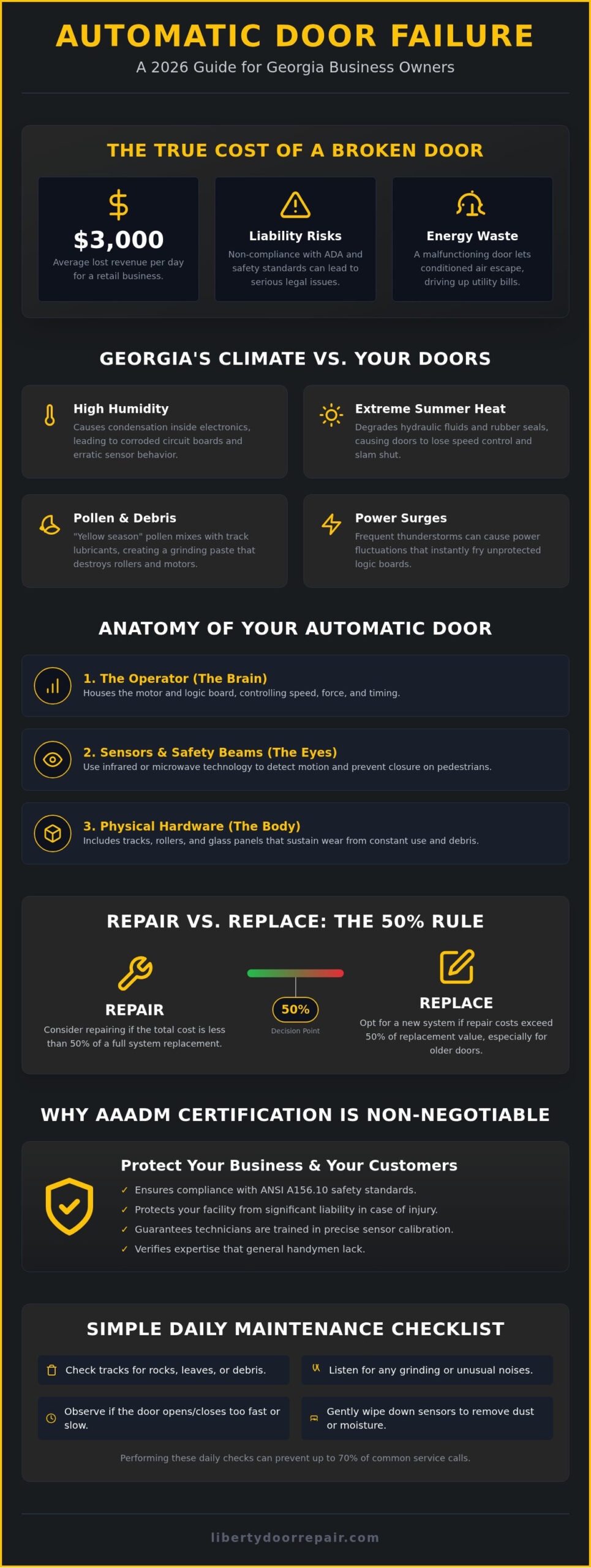
A reliable sliding door relies on three distinct layers of technology working in harmony. If one fails, the entire entrance becomes a liability. Understanding these parts helps you identify when you need an automatic sliding door service GA expert.
- The Operator: This is the “brain” of the system. It houses the motor and the logic board that controls opening speeds, closing force, and hold-open times.
- Sensors and Safety Beams: These use microwave or active infrared technology to detect movement. They prevent the door from closing on pedestrians, which is critical for meeting safety standards.
- Physical Hardware: This includes the tracks, rollers, and heavy-duty glass. In Georgia’s climate, these components sustain significant wear from constant use and environmental debris.
Why Certification Matters for Georgia Businesses
Choosing a service provider without proper credentials is a massive risk. AAADM-certified technicians undergo rigorous training to understand specific safety protocols. They don’t just fix the door; they perform a multi-point safety inspection to ensure compliance with the latest ANSI A156.10 standards. This certification is a proof point of specialized expertise that general repair companies simply don’t possess.
Legal implications are real for any public-facing business. If a non-compliant door causes an injury, the business owner faces significant liability. Certified experts calibrate the sensors to precise field widths and ensure the closing force doesn’t exceed regulated limits. This technical precision protects your customers and your company’s reputation. With 30 years of experience, Liberty Door Repair focuses on these exact standards to keep Metro Atlanta businesses running safely.
Common Automatic Sliding Door Issues in the Georgia Climate
Georgia’s climate is notoriously harsh on commercial hardware. While residents focus on the heat, business owners must worry about how high humidity levels create condensation inside sensitive electronic housings. This moisture leads to corroded circuit boards and erratic behavior in door operators. When these systems fail, you need a specialized automatic sliding door service GA to diagnose the environmental cause rather than just swapping parts. Professional technicians understand that Georgia’s “yellow season” brings heavy pollen that mixes with track lubricants, creating a thick grinding paste that destroys rollers.
Extreme summer heat also impacts hydraulic fluids and seal integrity. In Atlanta, temperatures inside a door’s header can easily exceed 120 degrees during July and August. This heat thins out fluids and degrades rubber seals over time. When seals fail, the door may lose its ability to control closing speed. This often leads to the door slamming, which violates ADA accessibility standards for doors and creates a safety hazard for your customers. Additionally, Atlanta’s frequent afternoon thunderstorms bring power fluctuations. These surges can fry a logic board instantly if your system lacks proper surge protection.
Sensor Malfunctions and Ghosting
Sensor ghosting is a common frustration for facility managers in Georgia. This happens when doors cycle open and closed without a pedestrian present. High humidity often triggers intermittent sensor failure by fogging internal lenses or causing electrical shorts. Georgia’s bright storefront light conditions also require precise calibration. Shifting shadows or reflections from the pavement can trick infrared sensors into thinking someone is approaching. A technician must tune these sensors to account for the specific light and moisture levels at your entrance.
Mechanical Wear in High-Traffic Hubs
Mechanical wear accelerates in high-traffic Georgia hubs like Marietta and Alpharetta. Worn rollers are the primary culprit for system failure. If you hear a grinding noise, it’s likely the rollers are failing. Ignoring this leads to the door “dragging,” which forces the motor to work at maximum capacity. This eventually causes motor burnout and a much higher repair bill. Checking belt tension is also vital because loose belts lead to jerky movements. Regular inspections ensure your rollers and belts stay in peak condition despite the grit and heat.
Repair vs. Replacement: Making the Right Financial Decision
For facility managers considering a transition to more robust or custom-designed systems, you can learn more about Swift Slide to see how precision manufacturing can enhance the longevity and performance of sliding door hardware.
Evaluating the financial impact of a broken entrance is vital for any Georgia facility manager. You must weigh the immediate cost of a fix against the long-term reliability of a new system. Most industry experts use the “50% Rule” to guide this decision. If the cost of a single repair exceeds 50% of the price of a new installation, replacement is almost always the smarter investment. An automatic sliding door service GA specialist can provide an itemized quote to help you run these numbers accurately and avoid sinking capital into a failing asset.
System age is the next major factor. Most commercial automatic doors have a service life of 10 to 15 years. Beyond this point, hardware is often “past its prime” and parts frequently become obsolete. If your logic board or motor fails on a 12-year-old system, finding compatible replacements may be impossible or prohibitively expensive. In these cases, sticking with an old system leads to frequent breakdowns and repeated service calls that bleed your maintenance budget dry. Modern systems installed by technicians following the standards of the American Association of Automatic Door Manufacturers (AAADM) offer far better reliability.
Energy efficiency in 2026 has reached new heights. Modern door operators use significantly less power and feature tighter seals than models from a decade ago. Upgrading can reduce monthly utility bills by up to 15% in high-traffic retail environments because the doors close faster and seal more effectively against the Georgia humidity. These gains often pay for the new system over several years of reduced overhead.
When to Choose Professional Repair
Repair is the right path when the core structure of the door remains sound. If your issues are limited to sensor misalignment or minor mechanical obstructions in the track, a quick service call is sufficient. Our technicians can swap out individual components like motors or control boards on relatively modern systems to restore full function. Learn more about professional automatic door services for quick fixes that extend the life of your current investment without the need for a total overhaul.
When Full Replacement is Necessary
Replacement becomes mandatory when your existing entrance fails to meet current safety or accessibility codes. The 2026 Georgia Building Code mandates automatic doors at accessible public entrances for many high-occupancy buildings. Transitioning to a new system allows you to install high-performance glass for better HVAC retention and ensures you meet all ADA requirements. Check out this guide to commercial door replacement for long-term planning that protects your business from liability and improves customer experience. A localized automatic sliding door service GA expert can ensure your new installation perfectly matches your building’s traffic patterns.
Maintenance Checklist for Georgia Facility Managers
Proactive maintenance isn’t just about convenience; it’s about protecting your business from liability and high repair costs. Reliable entrance operation starts with a daily mindset. You don’t need to be a technician to spot early warning signs of system failure. By performing a simple walk-through each morning, you can identify issues before they lead to the revenue loss or energy waste discussed earlier. If you notice grinding sounds or inconsistent speeds, it’s time to call for a professional automatic sliding door service GA to prevent a total breakdown.
Cleaning protocols must be handled with care to avoid damaging sensitive electronics. Use a soft brush or vacuum to remove grit and Georgia red clay from the tracks daily. Never spray liquid cleaners directly into the header or onto the sensors. Moisture is the enemy of your door’s logic board. Additionally, monitor your door’s opening and closing speeds. Doors that move too fast or slam shut often violate safety codes and put pedestrians at risk. Finally, test the emergency “breakout” function weekly. The door panels should swing outward under manual pressure to ensure a clear exit path during a fire or power failure.
Daily and Weekly Monitoring Tasks
Incorporate these quick checks into your facility management routine to maintain a safe environment:
- Clear the Threshold: Ensure no mats, debris, or rocks are obstructing the door’s path or creating tripping hazards.
- Inspect Safety Signage: Verify that “Automatic Door” and “In Case of Emergency” decals are visible at eye level and haven’t peeled off.
- Angle Testing: Walk toward the door from the side, not just the center. The sensors should detect your presence from all reasonable approach angles.
Scheduled Professional Inspections
Semi-annual inspections are the industry standard for high-traffic commercial doors. While daily checks are helpful, only an AAADM-certified technician has the tools to measure closing force and sensor detection patterns precisely. Scheduling a professional automatic sliding door service GA ensures these technical details meet current ANSI standards. During a preventative visit, a specialist will lubricate moving parts, check belt tension, and update the control board’s firmware. Always document these inspections in a dedicated logbook. This record is vital for satisfying insurance requirements and proving compliance to the local fire marshal. Contact the experts at Liberty Door Repair to schedule your semi-annual safety inspection today.
Expert Automatic Sliding Door Service in Metro Atlanta
Liberty Door Repair has maintained a consistent presence in Metro Atlanta for over 30 years. This longevity is a marker of stability in an industry where companies often disappear. We specialize in high-stakes commercial environments where door failure isn’t an option. Our technicians are AAADM-certified. They possess the specialized training required to handle complex logic boards and sensor arrays. Choosing a local automatic sliding door service GA provider ensures you receive expert care from people who live and work in your community. We understand the specific demands that high-traffic Georgia businesses face every day.
National call centers often prioritize volume over quality. They route your urgent requests to third-party subcontractors who may lack specific expertise in automatic systems. We don’t do that. Our team handles every step of the process. This direct approach leads to more accurate diagnostics and faster repairs. Whether you need a simple sensor adjustment or a full system overhaul, we provide the technical mastery required. Our services cover everything from automatic sliders to commercial door repair in Atlanta. We focus on restoring your entrance to peak performance with minimal disruption to your daily operations.
Our Local Service Areas in Georgia
Our service area covers the entire Metro region with a focus on rapid response. We provide dedicated support for businesses in the following areas:
- Kennesaw and Marietta: Serving the busy retail and educational corridors.
- Decatur and Sandy Springs: Providing specialized solutions for healthcare and office complexes.
- Suwanee and Johns Creek: Offering rapid dispatch to these high-growth business hubs.
- Alpharetta and Roswell: Maintaining high-performance entrances for tech and commercial centers.
Local knowledge is critical in Georgia. Different municipalities have unique building codes and fire marshal requirements. We understand these specific regulations. This expertise ensures your installation or repair meets every local standard without the risk of fines or failed inspections.
Why Choose Liberty Door Repair?
We service all major brands and models. You’re never limited by the hardware you currently have installed. Our technicians carry the parts and tools needed to fix diverse systems on the first visit. We take a no-nonsense approach to commercial door reliability. We prioritize effectiveness and safety over everything else. We know that a broken door is a liability and a drain on your revenue. We deliver results that keep your business accessible and secure. Contact Liberty Door Repair today for expert automatic sliding door service.
Secure Your Entrance with Professional Georgia Expertise
Georgia’s high humidity and heavy foot traffic demand more than just basic maintenance. You’ve learned how specialized calibration protects your logic boards from moisture and why the “50% Rule” is vital for managing your maintenance budget effectively. Proper care ensures your facility remains ADA-compliant and energy-efficient throughout the 2026 season. Don’t let a malfunctioning entrance disrupt your customer flow or increase your liability. A proactive approach to your door hardware saves money and prevents the stress of unexpected downtime. Your facility’s accessibility is too important to leave to chance.
When you need a reliable automatic sliding door service GA, trust the specialists who understand Metro Atlanta’s specific building codes. Liberty Door Repair brings 30+ years of industry experience and AAADM-certified technicians to every service call. As an A+ rated local business, we prioritize the speed and technical mastery your commercial property requires. Get Expert Automatic Door Service from Liberty Door Repair today. We are ready to restore your door’s function and keep your business moving forward. Your business deserves a secure, high-performance entrance that never lets you down.
Frequently Asked Questions
How often should commercial automatic doors be serviced in Georgia?
Commercial automatic doors in Georgia should receive professional service at least twice per year. High traffic locations or those exposed to heavy pollen and humidity often benefit from quarterly inspections. These visits ensure that tracks remain clear of debris and that electronic sensors aren’t affected by moisture buildup. Regular maintenance prevents the revenue loss associated with door downtime. Scheduling a specialized automatic sliding door service GA ensures your system stays reliable year-round regardless of environmental shifts.
What are the ADA requirements for automatic sliding doors in 2026?
The 2026 Georgia building code requires automatic doors at accessible entrances for specific high-occupancy buildings. This applies to assembly occupancies with a load of 300 or more, and business or mercantile spaces with a load of 500 or more. Doors must comply with ICC A117.1 and ANSI/BHMA safety standards. These mandates ensure that public spaces remain accessible to everyone while maintaining strict safety protocols for power-operated door systems. Consulting a specialist helps you navigate these specific state amendments.
Can any electrician fix an automatic sliding door?
A door that closes halfway and then reopens is likely detecting an obstruction or experiencing high mechanical resistance. The logic board interprets resistance from dirty tracks or worn rollers as a person in the way, triggering a safety reversal. Check the track for debris or rocks. If the path is clear, the sensors may need professional recalibration. This ghosting behavior is a common sign that your door operator needs a technical inspection to avoid motor burnout.
What is the “breakout” feature on a sliding door and why is it important?
The breakout feature is a critical safety mechanism that allows sliding door panels to swing outward like a traditional door during an emergency. This function ensures a clear path for egress if the power fails or a fire occurs. It’s a mandatory requirement for fire safety compliance in commercial buildings. Facility managers should test this function weekly by applying manual pressure to the panels to ensure they swing open without catching or sticking in the track.
How much does a typical automatic door service call cost in Atlanta?
The cost of a service call in Atlanta depends on the complexity of the repair and the specific parts required for your system. Minor sensor adjustments or track cleanings are generally less expensive than replacing major components like motors or logic boards. Since every facility has different traffic patterns and hardware brands, it’s best to request a technical assessment. Professional technicians provide itemized quotes based on the current condition of your automatic door hardware and safety requirements.
Are automatic sliding doors more energy-efficient than manual doors?
Automatic sliding doors are significantly more energy-efficient than manual doors because they never stay open longer than necessary. Manual doors are often left propped open or fail to close completely, allowing conditioned air to escape. Modern 2026 models feature high-performance glass and tighter weather seals that reduce HVAC strain. This improved efficiency can lower monthly utility bills by as much as 15% for high-traffic retail businesses in the Metro Atlanta area by maintaining a consistent building envelope.
What should I do if my automatic door loses power during a storm?
If your automatic door loses power during a storm, it should be designed to fail-safe or operate on a battery backup. Most systems allow you to slide the doors manually or use the breakout feature for emergency exit. Once power is restored, the system usually performs a learn cycle to find its open and close positions. If the door remains unresponsive or moves with jerky motions after power returns, a surge may have affected the logic board.