

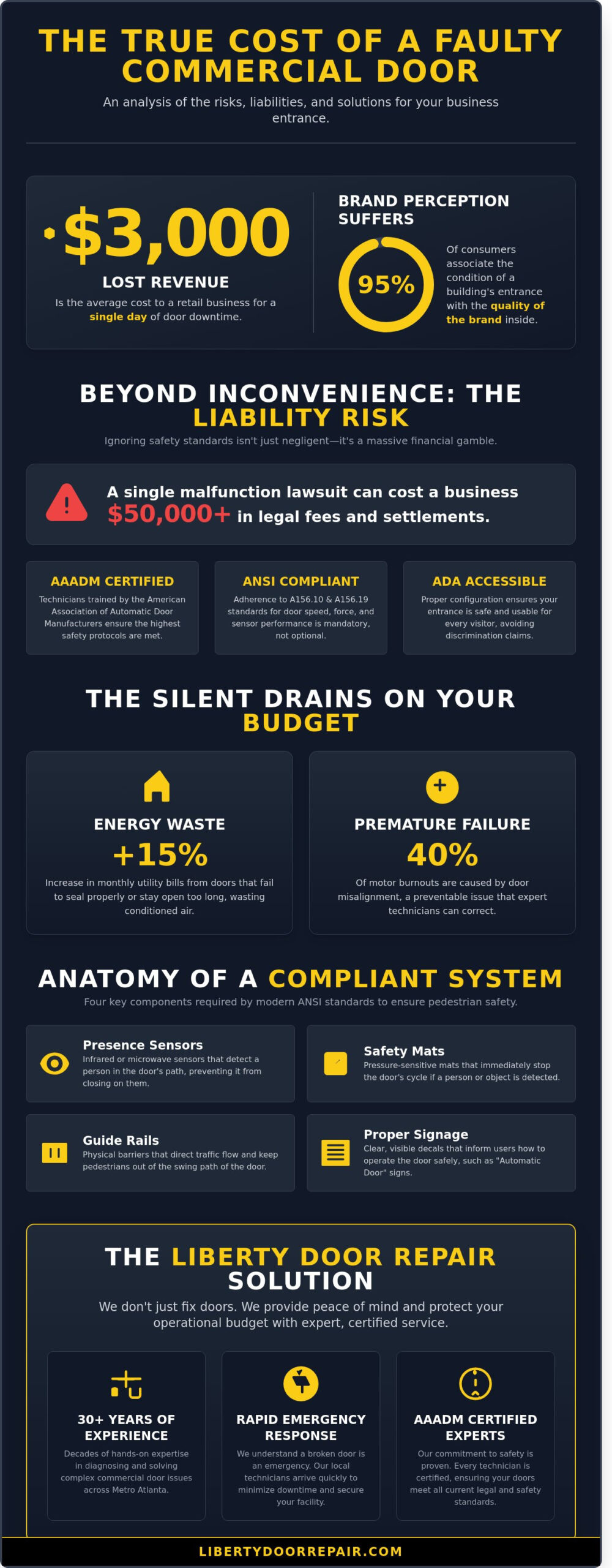
A malfunctioning entrance isn’t just an inconvenience; it’s a liability that costs the average retail business up to $3,000 in lost revenue during a single day of downtime. When your sensors fail or your sliding panels jam, your entire operation grinds to a halt. You need reliable automatic door services that prioritize speed and safety without draining your maintenance budget. We understand that a broken door is an emergency that demands an immediate response from a trusted expert.
It’s frustrating to juggle complex ANSI regulations while worrying about potential injury lawsuits. This article provides the strategies you need to master commercial door systems, from maintaining AAADM safety compliance to implementing cost-effective repair plans. You’ll learn how to ensure 100% ADA compliance and how Liberty Door Repair uses 30+ years of experience to solve your entrance issues. We’ll show you exactly how to find a local, AAADM-certified expert in Metro Atlanta who can arrive quickly to minimize your business downtime and get your doors moving again.
Key Takeaways
- Learn how AAADM safety standards and ANSI regulations keep your facility compliant and safe for every visitor.
- Identify the “tipping point” where repair costs exceed value to make the most cost-effective decision for your entrance.
- Master a proactive 5-step daily safety check to ensure constant ADA compliance and long-term system reliability.
- Discover why expert automatic door services are the key to balancing high-traffic accessibility with professional safety standards.
- Leverage over 30 years of industry experience to choose the right AAADM-certified technicians for your complex commercial needs.
Understanding Automatic Door Services for Modern Commercial Facilities
Automatic door services involve more than just fixing a squeaky hinge. This specialized field covers the precise calibration of motion sensors, the maintenance of high-torque motors, and the programming of complex safety controls. For a business, these doors represent the first point of contact with a customer. Research indicates that 95% of consumers associate the condition of a building’s entrance with the quality of the brand inside. While the history of automatic doors reaches back to ancient steam-powered inventions, today’s commercial units are high-tech assets requiring expert care.
General handymen don’t have the training to handle these sophisticated systems safely. Liberty Door Repair brings 30+ years of experience to every job site. We focus on AAADM-regulated standards because safety is non-negotiable. An improperly tuned sensor can lead to “ghosting” or, worse, physical injury to a pedestrian. Our AAADM-certified technicians ensure every door complies with ANSI A156.10 or A156.19 standards. This level of expertise protects your business from liability and keeps your facility running smoothly.
Your doors impact your bottom line directly through energy costs. A door that stays open three seconds too long or fails to seal properly wastes conditioned air. This inefficiency can increase monthly utility bills by 15% in high-traffic retail environments. Professional automatic door services ensure your weather seals are tight and your opening cycles are optimized for your specific traffic patterns. We don’t just fix doors; we protect your operational budget.
The Anatomy of a Commercial Automatic Door
Every system relies on three core components: the header, the operator, and the sensors. The header houses the mechanical guts above the opening. The operator is the engine that drives the movement. You’ll typically find two types of operators in commercial settings. Electromechanical systems use electric motors and gear trains for quiet, efficient movement. Hydraulic systems use fluid pressure and are often preferred for heavy-duty industrial gates. Hardware choice is equally vital. We install heavy-duty pivots and continuous hinges to prevent door sag. This is critical because door misalignment is the leading cause of motor burnout in 40% of our service calls.
Why “Automatic” Does Not Always Mean “Accessible”
Not all automatic doors meet ADA requirements by default. Full-power doors open quickly for high-volume traffic and require extensive safety matting or presence sensors. Low-energy operators, often called ADA swingers, require a push-plate or a specific wave-sensor to activate. These must be tuned so they don’t exceed 15 pounds of force to stop. In a post-pandemic market, 80% of shoppers prefer touchless entry options. Converting your manual doors to wave-to-open systems improves hygiene and accessibility simultaneously. We ensure your timing and force settings meet federal mandates while providing a seamless experience for every visitor.
Of course, true accessibility extends beyond the front door. For facilities with multiple floors, ensuring safe movement between levels is another crucial aspect of ADA compliance and visitor safety. For businesses considering these broader modifications, organizations like Indiana Home Safety & Mobility offer specialized aging-in-place and mobility solutions.
Types of Automatic Door Systems and AAADM Safety Standards
Liberty Door Repair brings 30+ years of experience to every job, following the strict guidelines set by the American Association of Automatic Door Manufacturers (AAADM). These rules aren’t just suggestions. They’re mandatory for safety and operation. Our AAADM-certified technicians ensure your facility stays compliant with ANSI A156.10 and A156.19. These standards govern everything from how fast a door opens to how much force it uses during its cycle. Ignoring these rules creates massive legal liabilities. A single malfunction can lead to a lawsuit that costs a business $50,000 or more in legal fees and settlements. Professional automatic door services ensure your entrance meets these rigorous benchmarks every day.
This focus on safety and liability is crucial for any business owner, extending beyond just doorways. For example, properties with swimming pools or water features face unique risks, and in the unfortunate event of an incident, families may need to consult with specialized legal teams such as Drowning Accident Lawyers to navigate the complexities of premises liability law.
Since the 2017 update to ANSI standards, requirements for sensors and timing have become even more precise. We focus on four main safety components during every inspection to keep you in compliance. Proper ADA Compliance and Longevity starts with choosing the right system for your specific traffic volume and maintaining these features:
- Presence Sensors: These infrared or microwave sensors detect a person standing in the door’s path to prevent it from closing prematurely.
- Safety Mats: These are pressure-sensitive zones that stop the door cycle if a pedestrian steps on them.
- Guide Rails: Physical barriers direct traffic and keep pedestrians away from the door’s swing path, preventing side-impact accidents.
- Signage: Correct decals must be visible to warn users of the door’s movement, a detail often missed by general contractors.
Automatic Sliding and Folding Doors
Grocery stores and retail hubs in Metro Atlanta often see 1,500+ daily cycles. Automatic sliding doors are the standard for these high-traffic storefronts because they handle heavy use without rapid mechanical wear. For narrow entryways in Metro Atlanta boutiques, telescoping sliders provide a 30% wider opening than traditional sliders by using multiple panels that stack. These systems require monthly track cleaning. Debris in the track accounts for 40% of motor failures we see in the field. Routine automatic door services can prevent these expensive motor burnouts by keeping the path clear.
Automatic Swinging Doors and ICU Entrances
Converting a manual entrance to an automatic one is a common request for local office buildings. We use overhead operators to make this transition seamless and cost-effective. In healthcare settings, the requirements get even tougher. Hospital ICU doors must meet specific smoke-leakage ratings to comply with fire codes. These doors also feature emergency breakout capabilities. This allows the door to be pushed open manually during a power outage or fire. About 85% of hospital facilities we service require these specialized breakout tests annually to remain certified for patient safety.
Keeping your system running safely doesn’t have to be a headache. Scheduling regular maintenance with trusted door repair experts can catch small sensor issues before they become expensive safety violations. Our team checks every component to ensure your doors swing, slide, or fold exactly as the law requires.
Automatic Door Repair vs. Replacement: A Cost-Benefit Analysis
Deciding between a quick fix and a total system overhaul is a high-stakes calculation for any facility manager. Most commercial operators have a functional lifespan of 10 to 15 years. When your system hits the 12-year mark, the cost of individual components often rivals the price of a complete upgrade. We recommend the 50% rule; if a single repair exceeds 50% of the cost of a new operator, replacement is the smarter investment. Modern automatic door services focus on long-term ROI rather than just patching a failing motor.
Intermittent failures and “ghosting” sensors are more than just minor annoyances. When a door opens for no reason, it wastes roughly $12 to $20 in conditioned air per day. Over a single summer month, that’s $600 literally flying out the door. Maintaining AAADM Safety Standards ensures your sensors only trigger when necessary, protecting your budget and your customers. Our trusted experts use 30+ years of experience to identify these hidden costs before they drain your maintenance fund.
When to Choose Professional Repair
Most daily issues don’t require a forklift and a new header. Simple mechanical failures are often the culprit. If your door is “slamming” during the close cycle or “hesitating” before it opens, the problem is likely a fluid leak in the closer or a loose drive belt. Addressing these early prevents the motor from working overtime and burning out prematurely. Common professional fixes include:
- Sensor Realignment: Correcting the infrared field to prevent false triggers.
- Belt Tensioning: Eliminating the “slipping” sound that occurs during high-traffic periods.
- Pivot Replacement: Swapping out worn bottom pivots to stop the door from dragging on the floor.
The savings of a timely repair are substantial. On May 14, 2023, a retail shop in Cumming, GA was quoted $4,200 for a full storefront replacement after their sliding door stalled. Our technicians arrived and found a simple alignment issue combined with a worn $85 pivot. We completed the repair for $515. The owner saved $3,685 and avoided three days of construction downtime. This is why a diagnostic visit from a skilled technician is the first step in any service plan.
Signs Your System Requires Full Replacement
Repair isn’t always the safest or most cost-effective path. Obsolescence is the primary driver for full replacement. If your operator was manufactured by a brand that went out of business in 2015, finding a control board is nearly impossible. You’ll end up paying 300% markups for used parts with no warranty. Don’t throw good money after bad technology. Consider a full replacement if you notice these three red flags:
- Structural Frame Damage: If the door frame is sagging or the glass storefront is misaligned, a new motor won’t fix the underlying physics.
- Frequent Breakdown Cycles: If you’ve called for automatic door services more than three times in a six-month period, the system is unreliable.
- Safety Compliance Gaps: Older systems often lack the presence-sensing technology required by modern liability insurance providers.
Upgrading to current technology provides 20% better energy efficiency and integrates with modern building security systems. It’s a proactive move that eliminates the “emergency” calls that always seem to happen on Friday afternoons. We provide reliable solutions that keep your business moving without the stress of constant mechanical failure.
Proactive Maintenance: Ensuring ADA Compliance and Longevity
Neglecting your entrance leads to liability. Liberty Door Repair brings 30+ years of experience to every inspection to ensure your facility stays safe. Proactive care stops 70% of mechanical failures before they happen. Don’t wait for a component to snap. A door that fails to open or close correctly is a direct threat to your customers and your reputation. Our AAADM-certified technicians follow strict ANSI A156.10 standards for power-operated pedestrian doors. This level of precision prevents expensive 2 a.m. emergency repairs that often cost triple the standard rate.
Reliable automatic door services depend on consistency. We recommend scheduling semi-annual professional inspections to maintain peak performance. During these visits, technicians calibrate the timing of opening and closing cycles. They also check the force of the door’s movement. Since the 2017 update to safety codes, the requirements for sensor sensitivity have become more stringent. Regular professional tuning ensures you remain compliant with federal law while extending the lifespan of your motor by up to 40%.
Dust and grime are silent killers for electronic components. Dirt buildup in the tracks or on sensor lenses causes 60% of intermittent sensor interference. When sensors “ghost” or fail to detect a person, the risk of a strike increases. Lubrication is equally vital. We use specific industrial-grade lubricants that don’t attract debris. This keeps the pivots and arms moving smoothly without grinding down the metal. Proper cleaning and lubrication routines turn a five-year motor into a fifteen-year motor.
The Daily Safety Check Checklist
You don’t need a toolbox to perform a basic safety sweep. Start by walking toward the door at a normal pace; it should begin opening when you’re 43 inches away. Check the “breakout” feature by applying pressure to the door in the direction of egress. It must swing outward easily for emergency exits. Verify that the closing speed is slow enough to avoid striking a person. Finally, clear any debris from the floor tracks and ensure threshold plates aren’t loose. These five steps take less than three minutes but prevent 90% of common accidents.
Pre-Call Troubleshooting: What to Check First
Before you call for automatic door services, perform a quick diagnostic. Check the power supply and ensure the “on/off/hold-open” switch is in the correct position. Often, a staff member accidentally flips this switch during cleaning. Look for physical obstructions like pebbles or trash in the floor tracks. If the door has a digital controller, try a hard reset by cycling the power off for 30 seconds. If the error persists after these checks, it’s time to bring in the trusted experts to handle the internal electronics.
Stop small issues from becoming major liabilities. Contact our AAADM-certified team to schedule your professional automatic door service today.
Why Liberty Door Repair is Atlanta’s Trusted Automatic Door Expert
Liberty Door Repair has spent over 34 years establishing itself as the premier choice for the Metro Atlanta business community. We understand that a malfunctioning entrance isn’t just an inconvenience; it’s a liability and a barrier to your revenue. Our team has managed thousands of commercial entries since 1990, providing the specialized automatic door services required to keep high-traffic storefronts safe and operational. We don’t believe in temporary patches. We focus on long-term structural integrity and mechanical precision.
The Liberty difference starts with our technicians. Every person we send to your job site is AAADM-certified. This certification from the American Association of Automatic Door Manufacturers isn’t a suggestion; it’s our standard. These experts undergo rigorous training to understand the complex interplay between motion sensors, control boxes, and hydraulic systems. While a general handyman might miss a faulty safety sensor or an incorrectly timed closing cycle, our specialists catch these details to prevent accidents before they happen. We protect your business from the legal and physical risks of a non-compliant door.
We know that hardware failures don’t happen on a convenient schedule. That’s why we maintain a fleet of fully stocked service vehicles ready for immediate dispatch. We provide rapid response times for businesses in Cumming, Alpharetta, and Marietta. If your storefront glass shatters at 2:00 PM or your warehouse fire door fails to latch during a Friday afternoon rush, we’re on the way. Our goal is to arrive within a two-hour window for urgent calls. We arrive with the tools and parts necessary to secure your perimeter and restore access immediately.
Our expertise extends far beyond simple sliding doors. We provide comprehensive solutions for a wide range of commercial entry needs, including:
- Fire Door Systems: We ensure your fire-rated assemblies meet the NFPA 80 standards for annual inspections and repairs.
- Access Control Integration: Our team syncs your automatic doors with card readers, fobs, and keypad systems for enhanced security.
- Glass and Frame Repair: We handle emergency board-ups and permanent glass replacement for cracked or shattered storefront panels.
- Commercial Hardware: We install and service heavy-duty pivots, Grade 1 exit devices, and high-security locks.
Local Expertise for Georgia Businesses
Operating in Fulton and Forsyth counties requires a deep understanding of local building codes. We stay updated on the 2010 ADA Standards for Accessible Design to ensure your business remains compliant with federal and local laws. Our commitment to fixing it right the first time means we analyze the root cause of the failure, such as building settlement or improper original installation. We use high-quality parts from leading manufacturers like Horton and Stanley. This ensures your automatic door services result in a system that handles Georgia’s humidity and high-cycle usage without failing.
Request Your Automatic Door Service Today
Our dispatch process is designed for speed and clarity. When you call, we collect specific details about your door type and the nature of the failure. This allows our technician to arrive prepared with the correct components. We believe in transparent pricing, so you’ll receive a clear estimate before any work begins. Every service call includes a 20-point safety inspection to verify that every sensor and motor is functioning within safe parameters. Don’t let a broken entrance slow down your operations. Broken Door? Let’s Get it Fixed! Request Service Now.
Secure Your Facility with Reliable Entrance Solutions
Your commercial facility depends on seamless access and unwavering safety every single day. Professional automatic door services ensure your entryways meet strict AAADM safety standards while staying in line with current ADA and ANSI requirements. Proactive maintenance prevents the high costs of emergency replacements. It also extends the life of your hardware by years. Liberty Door Repair brings 30+ years of experience to every job across Metro Atlanta. Our AAADM-certified technicians handle everything from minor sensor adjustments to full-scale system installations with precision. Don’t let a malfunctioning door compromise your business’s safety or accessibility. It’s vital to partner with a trusted expert who understands the urgency of your repairs and the importance of legal compliance. We’ve spent three decades perfecting our craft to keep Georgia businesses moving safely. Our team is ready to provide the dependable expertise you need to keep your facility running without a hitch.
Request Your Automatic Door Service Call Today
We look forward to getting your doors back in perfect working order.
Frequently Asked Questions
What is an AAADM-certified technician and why does it matter?
An AAADM-certified technician is a professional who has passed rigorous training and testing by the American Association of Automatic Door Manufacturers. This certification matters because it guarantees the technician understands the ANSI A156.10 and A156.19 safety standards required to prevent pedestrian accidents. Our team relies on 30+ years of experience and this specific training to ensure your doors operate safely and legally.
How much does a typical automatic door repair cost in Atlanta?
A typical automatic door repair in Atlanta usually costs between $150 and $1,200 depending on the parts involved. Minor sensor recalibrations or guide replacements stay on the lower end of that scale, while replacing a heavy-duty motor or control board can reach $900 or more. We offer transparent estimates for all automatic door services so you can manage your maintenance budget with total confidence.
Are automatic doors required to be ADA compliant in Georgia?
Yes, all commercial automatic doors must adhere to the 2010 ADA Standards for Accessible Design to ensure your facility is accessible to everyone. These rules require a minimum 32-inch clear opening width and specific sensor coverage zones to protect individuals using wheelchairs or walkers. Failing to meet these standards can result in federal fines of up to $75,000 for a single violation, so regular compliance checks are vital.
How often should I have my commercial automatic doors serviced?
You should have your commercial automatic doors serviced at least once every 12 months to comply with AAADM safety recommendations. High-traffic environments that see more than 1,000 opening cycles per day often require quarterly inspections to prevent premature wear on the drive belts and rollers. Regular maintenance prevents 70% of common door failures and significantly extends the life of your expensive hardware.
Can you repair automatic doors from any manufacturer?
Our technicians possess the expertise to repair automatic doors from all major manufacturers including Stanley, Besam, Dormakaba, and Horton. We carry a wide inventory of universal and brand-specific parts on our service trucks, which allows us to complete 85% of our repair jobs during the very first visit. You don’t have to worry about who installed your door because we’ve worked with every system on the market over the last 30 years.
What happens if my automatic door fails during a power outage?
Most automatic doors include a battery backup system or a manual breakout feature that allows the door to be pushed open in an emergency. Safety codes require that these doors open with no more than 50 pounds of force when the power is cut to ensure a safe exit path for occupants. We test these fail-safe mechanisms during every inspection to verify that your building remains safe even when the lights go out.
Do you provide emergency automatic door services in Cumming, GA?
We provide 24/7 emergency automatic door services in Cumming and throughout the metro Atlanta area with a 2-hour average response time. Our technicians understand that a malfunctioning door is a major security risk and a liability for your business, so we prioritize urgent calls day and night. We’re the trusted experts local business owners call when they need a fast, reliable solution to a broken entrance.
How long does it take to install a new automatic door operator?
Installing a new automatic door operator typically takes between 3 and 6 hours per entrance depending on the complexity of the header and electrical requirements. Our skilled team handles the mounting, wiring, and sensor tuning in a single visit to keep your downtime to an absolute minimum. We’ve refined our installation process over 30+ years to ensure your new system is up and running before your business day ends.
10 Responses