

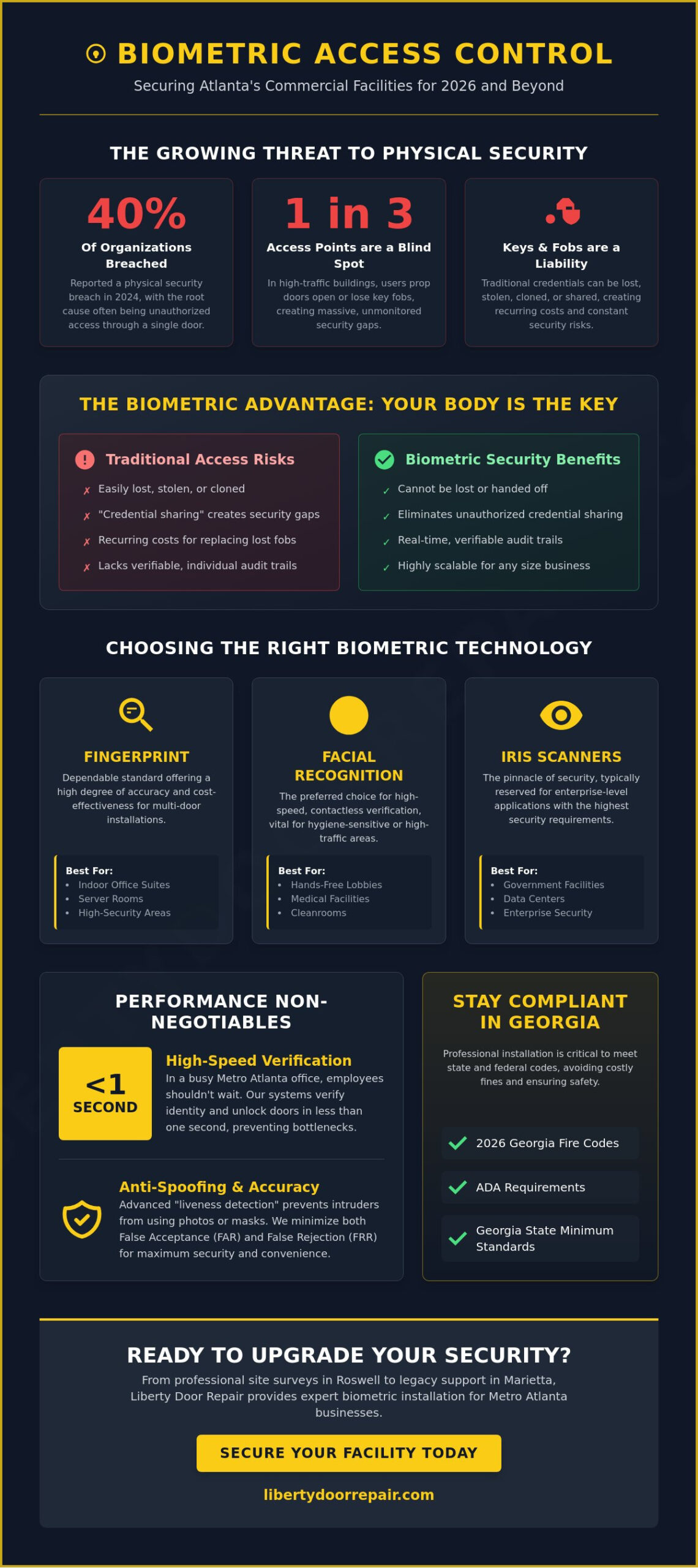
Did you know that 40% of organizations reported a physical security breach in 2024, with the root cause often being unauthorized access through a single door? In high-traffic buildings, nearly one in three access points remains a security blind spot because users prop doors open or lose their key fobs. Managing high employee turnover while trying to stay compliant with the 2026 Georgia State Minimum Standard Codes can feel like a constant struggle. You need a solution that works without the administrative headache. Upgrading to the biometric access control systems atlanta businesses trust is the most effective way to secure your facility and eliminate the inherent risks of traditional keys and fobs.
We agree that your focus should remain on your operations, not on worrying about who has a spare key. This guide helps you discover how to secure your Metro Atlanta facility with advanced biometric technology integrated into professional commercial door systems. You’ll learn about the latest touchless entry trends, the value of detailed audit trails, and how professional installation ensures you meet ADA and fire codes without voiding your door warranties. We will break down the essential hardware and software requirements you need to maintain a secure, compliant entry in 2026.
Key Takeaways
- Learn how biological traits like fingerprints and facial recognition eliminate the security risks of shared key fobs or stolen PIN codes.
- Understand the technical standards for biometric access control systems atlanta facilities require to ensure entry processing stays under one second.
- Discover how to integrate biometric readers with hardware like electric strikes and automatic door services for a seamless, hands-free experience.
- Stay compliant with the 2026 Georgia Fire Codes and ADA requirements to avoid costly fines and failed inspections during your next build-out.
- Find out how professional site surveys and legacy support in cities like Roswell and Marietta can modernize your existing security infrastructure.
What are Biometric Access Control Systems and Why Atlanta Businesses Need Them?
Biometric technology identifies individuals based on unique biological markers. These include fingerprints, facial patterns, or iris scans. This hardware integrates directly into your commercial door infrastructure to ensure only authorized personnel enter your building. Understanding What are Access Control Systems? helps business owners realize that biometrics represent the highest tier of security available today. Implementing biometric access control systems atlanta businesses trust eliminates the risk of “credential sharing.” This is a common problem where employees swap fobs or share PIN codes, which creates massive security gaps. When a credential isn’t tied to a physical object, it can’t be handed off to an unauthorized person.
Atlanta commercial hubs require precise oversight and accountability. Biometric systems provide real-time audit trails that show exactly who entered a room and when. If a security event occurs, you have a verifiable digital record that can’t be easily forged. These solutions are highly scalable. Whether you’re managing a single office in Decatur or a sprawling corporate campus in Alpharetta, the system grows with your headcount. You don’t have to worry about the logistics of managing thousands of physical keys.
The Shift from Fobs to Biometric Credentials
Physical fobs are a growing security liability in 2026. They’re easily lost, stolen, or cloned. Research from Acre Security shows that 40% of organizations reported a physical security breach in 2024, often due to unauthorized door access. In high-traffic buildings, nearly one in three access points is a security blind spot because users prop doors open or lose their credentials. Replacing lost cards is a hidden, recurring cost for HR departments. Biological credentials can’t be lost. This creates a more seamless experience for your staff. They never have to dig through a bag for a badge. They simply present their fingerprint or face to gain entry.
Key Modalities: Fingerprint vs. Facial Recognition
Fingerprint scanners remain the dependable standard for many office and warehouse settings. They offer a high degree of accuracy and are cost-effective for multi-door installations. Facial recognition is the preferred choice for high-speed, contactless verification. This is vital for medical facilities or cleanrooms where hygiene is a priority. Georgia weather also plays a role in hardware selection. High humidity and extreme summer heat can affect external readers. We recommend specific hardware housing to protect sensors from moisture and temperature fluctuations.
- Fingerprint Scanners: These are best for indoor, high-security office suites and server rooms.
- Facial Recognition: This is ideal for hands-free entry in high-traffic lobbies and sterile environments.
- Iris Scanners: These are typically used for enterprise-level security in government or data centers.
Comparing Biometric Tech: Reliability, Speed, and Security Standards
Selecting the right biometric hardware requires a balance between security and convenience. Two critical metrics define system performance: the False Acceptance Rate (FAR) and the False Rejection Rate (FRR). A high FAR means an unauthorized person might gain entry, which is a major security failure. Conversely, a high FRR causes delays for your legitimate staff. Modern biometric access control systems atlanta installations aim for a “sweet spot” where both rates are minimized. This ensures your facility remains secure without creating a bottleneck at the front door.
Processing speed is another non-negotiable factor. In a busy Metro Atlanta office, staff shouldn’t wait for a scanner to think. Effective systems verify identity and unlock the door in less than one second. To maintain this speed while preventing security breaches, 2026 systems utilize advanced anti-spoofing technology. This “liveness detection” prevents intruders from using high-resolution photos or 3D masks to trick the sensors. These high-performance readers must integrate seamlessly with your existing access control solutions to provide a unified security posture across your entire property.
Contactless Biometrics: The Post-2020 Standard
Facial recognition and iris scanning have seen a massive rise in Atlanta offices. These contactless modalities offer significant hygiene benefits. They’re perfect for high-traffic retail or healthcare environments where touching a shared surface is discouraged. Modern facial recognition hardware is also more reliable in varying light conditions. Whether your lobby is flooded with bright Georgia sunshine or dimmed for evening shifts, the sensors maintain high accuracy. This reliability ensures your staff moves quickly and safely into the building at any hour.
Multi-Factor Authentication (MFA) Options
High-security areas like server rooms or cash offices often require more than just a single biological trait. Combining biometrics with mobile credentials or PIN codes creates a robust multi-factor authentication (MFA) environment. This “Biometric + PIN” approach ensures that even if a credential is compromised, the physical person must still be present. Managing visitor access is also easier with hybrid systems. You can issue temporary mobile credentials for guests without needing to enroll their biological data into your permanent database. If you’re concerned about your current setup, it’s wise to consult an expert about upgrading your entry points to meet these modern standards.
Integrating Biometrics with Commercial Door Hardware
Biometric security is only as effective as the physical hardware it controls. Many IT providers treat these systems as standalone software products, but they’re actually integrated components of your building’s physical entry points. When you install biometric access control systems atlanta businesses rely on, the reader must communicate perfectly with electric strikes or magnetic locks. If the hardware is outdated or poorly matched, the high-speed verification of the scanner is wasted. We ensure every component, from the wiring to the strike plate, is rated for the high-cycle demands of a busy commercial environment.
To achieve a truly hands-free entry experience, biometrics must work in tandem with automatic door services. This integration allows a facial recognition scanner to verify a staff member and trigger the door operator to open without a single touch. This setup is essential for ADA compliance and high-hygiene areas. Hardware stress testing is a vital part of our process. We verify the lock mechanism matches the reader’s speed to prevent “tailgating,” where an unauthorized person follows a legitimate user through a slow-closing door. Additionally, we prioritize dedicated power supplies and battery backups. If the power fails in your Atlanta facility, your biometric hub must continue to function to maintain security.
Electric Strikes and Magnetic Locks
Choosing between fail-safe and fail-secure configurations is a critical decision for your security plan. Fail-safe locks unlock when power is removed, ensuring people can exit during an emergency. Fail-secure locks stay locked when power is lost, keeping the building secure from the outside. During a storefront door installation, specifically on aluminum or glass doors, the hardware must be precisely mortised to house the electric strike. This ensures a clean look that doesn’t compromise the door’s structural integrity or its warranty.
Panic Bars and Emergency Egress
Security must never come at the expense of safety. Your biometric system must integrate with your building’s fire alarm to allow for immediate egress. We focus on maintaining the integrity of panic devices & push bars so they function correctly even when the biometric reader is active. NFPA 101 Life Safety Code requires that access-controlled egress doors unlock immediately upon activation of the fire alarm or a power failure. In high-security zones, we may implement delayed egress hardware, which provides a controlled exit while alerting security personnel to the movement.
Compliance and Installation: Atlanta Fire Codes and ADA Standards
Installing biometric access control systems atlanta businesses can legally operate requires strict adherence to the 2024 International Fire Code (IFC) and the 2024 International Building Code (IBC). These codes became the state minimum standard on January 1, 2026. If you submitted a permit application in the City of Atlanta after February 1, 2026, your facility must meet these updated requirements. Compliance isn’t optional. Failure to align with these standards results in failed inspections, heavy fines, and significant liability risks. We ensure every installation accounts for local permitting, which often includes specific Electrical and Low Voltage permits for Metro Atlanta projects.
For businesses integrating biometrics with automatic entries, using AAADM-certified technicians is a necessity. These professionals understand the complex relationship between motion sensors and biometric readers. Whether you’re upgrading a corporate office in Sandy Springs or a retail hub in Marietta, the hardware must function flawlessly under pressure. Get a professional code-compliance review to ensure your new security hardware doesn’t create a legal bottleneck for your business.
Fire Safety and Emergency Release
Georgia state law requires that all biometric locks integrate directly with your building’s fire alarm system. In the event of an emergency, the doors must release immediately to allow for a swift evacuation. Manual overrides, such as emergency pull stations or push-to-exit buttons, must be clearly visible and accessible. According to Georgia code, a fail-safe lock is a mechanism that automatically releases and unlocks the door during a power failure or fire alarm activation to ensure unobstructed egress. We prioritize these fail-safe configurations to keep your staff safe and your building within NFPA 101 Life Safety Code guidelines.
ADA Accessibility and Biometric Reach
The Georgia Accessibility Code requires that all entry hardware remains usable for individuals with disabilities. Biometric readers must be mounted at a height between 34 and 48 inches from the floor to accommodate wheelchair users. This reach requirement is strictly enforced during inspections in Metro Atlanta. When implementing facial recognition, the cameras must account for varying heights and approach angles to ensure every authorized user is recognized. Inclusive design also means providing audio and visual feedback. A green light or a specific tone confirms successful verification, which is essential for users with visual or hearing impairments. These details ensure your facility remains welcoming and compliant for everyone.
Expert Biometric Installation and Repair in Metro Atlanta
Securing a facility in 2026 requires more than just high-end hardware. It requires a partner who understands the physical demands of Metro Atlanta’s commercial landscape. We conduct professional site surveys across Atlanta, Roswell, and Johns Creek to evaluate every entry point before installation begins. Businesses often overlook the structural integrity of their doors when planning a security upgrade. With 30+ years of local experience, we ensure that your transition to advanced security is seamless. This longevity in the Georgia market allows us to predict and prevent common installation pitfalls that less experienced providers often miss.
Many businesses currently struggle with aging hardware that no longer meets modern security standards. We specialize in legacy system support. Our technicians can repair or upgrade older readers that have become unreliable over time. Sensor degradation is a significant issue; it occurs when scanners fail to recognize authorized staff due to surface wear or environmental damage. We provide customized maintenance plans to prevent sensor failure and mechanical lock issues before they cause a total lockout. If your current biometric access control systems atlanta setup is glitching or failing to read credentials, we deliver the technical expertise to restore your security immediately.
The Liberty Door Repair Advantage
Our AAADM-certified technicians are specialized in high-security commercial doors. We don’t just manage the software; we understand the mechanical physics of the entire door opening. We provide a rapid response for businesses in Marietta, Alpharetta, and Kennesaw to minimize any potential security downtime. Our service is truly comprehensive. We handle everything from the initial reader configuration to providing high-quality door parts & replacements for worn-out strikes, hinges, or closers. This ensures your door functions as a single, secure unit.
Getting Started with Your Security Upgrade
Modernizing your business entry follows a proven, structured process to ensure total reliability. We prioritize your operational needs at every step.
- Step 1: We start with a consultation to identify high-traffic versus high-security zones. This prevents over-spending on secondary doors while ensuring main entries are fully protected.
- Step 2: Our team helps you select hardware designed to survive the Atlanta climate. High humidity and heat can destroy inferior sensors; we only install weather-rated components.
- Step 3: We perform a professional installation with minimal business disruption. Our goal is to get your biometric access control systems atlanta project online quickly and correctly.
Don’t leave your facility’s safety to chance. Contact a local specialist today to secure your building with the most dependable biometric technology available in Georgia.
Secure Your Entry Points for the Future
Modernizing your facility with biometric technology is the most effective way to eliminate the security gaps of traditional keys and lost fobs. You now understand how these systems provide high-speed verification while maintaining strict compliance with the 2026 Georgia Fire and Building Codes. Choosing the right biometric access control systems atlanta requires a precise balance between advanced sensor software and heavy-duty commercial door hardware. When these components work together, your business gains a level of security that is both unshakeable and easy to manage.
Don’t let outdated security hardware leave your business vulnerable to breaches. Our team brings 30+ years of Metro Atlanta experience to every project. With AAADM-certified technicians and local support across 20+ Georgia cities, we ensure your installation is safe, compliant, and reliable. Secure Your Atlanta Business with a Professional Biometric Consultation today to upgrade your facility’s protection. Taking this step now ensures your staff stays safe and your operations remain uninterrupted. We look forward to helping you build a more secure future for your business.
Frequently Asked Questions
Are biometric access control systems legal for Atlanta businesses?
Yes, biometric systems are legal for Atlanta businesses provided they comply with the 2024 International Fire Code (IFC) and NFPA 101 Life Safety Code. These regulations require that all electronic locking hardware allows for immediate, unobstructed egress during an emergency. Professional installation ensures your biometric access control systems atlanta setup passes local fire marshal inspections without costly delays or fines.
What happens to biometric locks during a power outage?
Biometric locks rely on dedicated power supplies equipped with battery backups to remain functional during a power outage. In the event of a total power failure, the system’s fail-safe or fail-secure configuration determines if the door remains locked or unlocked. Most commercial fire codes in Georgia require main exit doors to be fail-safe, meaning they unlock automatically to ensure occupant safety.
Can facial recognition work with masks or glasses in a commercial setting?
Modern facial recognition systems in 2026 identify users even while they wear masks, glasses, or hats. These advanced readers use infrared mapping and AI-driven liveness detection to verify unique facial structures rather than just surface images. This technology ensures that high-traffic healthcare or industrial facilities in Metro Atlanta maintain speed and security without requiring staff to remove protective gear.
How much does it cost to install biometric access control in Atlanta?
The total investment for a biometric installation depends on the selected modality, the number of entry points, and existing door hardware compatibility. Factors such as whether you choose fingerprint, facial, or palm vein recognition influence the final project scope. We recommend a professional site survey to evaluate your specific infrastructure and provide a detailed plan for your facility’s security needs.
Is biometric data stored securely to comply with privacy laws?
Biometric data is stored using advanced encryption methods that convert biological traits into unique digital templates. The actual image of a fingerprint or face isn’t typically stored; instead, a mathematical representation is kept in a secure, encrypted database. This process helps businesses comply with privacy regulations by ensuring that even if a data breach occurs, the raw biological information can’t be reconstructed.
Do I need to replace my entire door to install a biometric scanner?
You don’t usually need to replace your entire door to install a biometric scanner. Most readers and electronic strikes can be retrofitted onto your existing commercial door frames. However, if the door is structurally damaged or doesn’t meet fire door standards, our technicians may recommend specific biometric access control systems atlanta hardware upgrades or door repairs to ensure the system functions reliably.
What is the difference between fail-safe and fail-secure biometric locks?
Fail-safe locks unlock when power is cut, ensuring people can exit freely during a fire or emergency. Fail-secure locks remain locked from the outside when power is lost, keeping the building secure. Choosing the right configuration depends on the door’s location and local Atlanta building codes. Most egress-side doors must be fail-safe to comply with life safety standards.
How often should biometric readers be serviced or cleaned?
Biometric readers should be cleaned weekly and professionally serviced at least once a year. Dust, oils, and Georgia’s high humidity cause sensor degradation over time. Regular maintenance prevents false rejections and ensures the mechanical components, like electric strikes and door closers, continue to operate smoothly alongside the electronic scanner.