

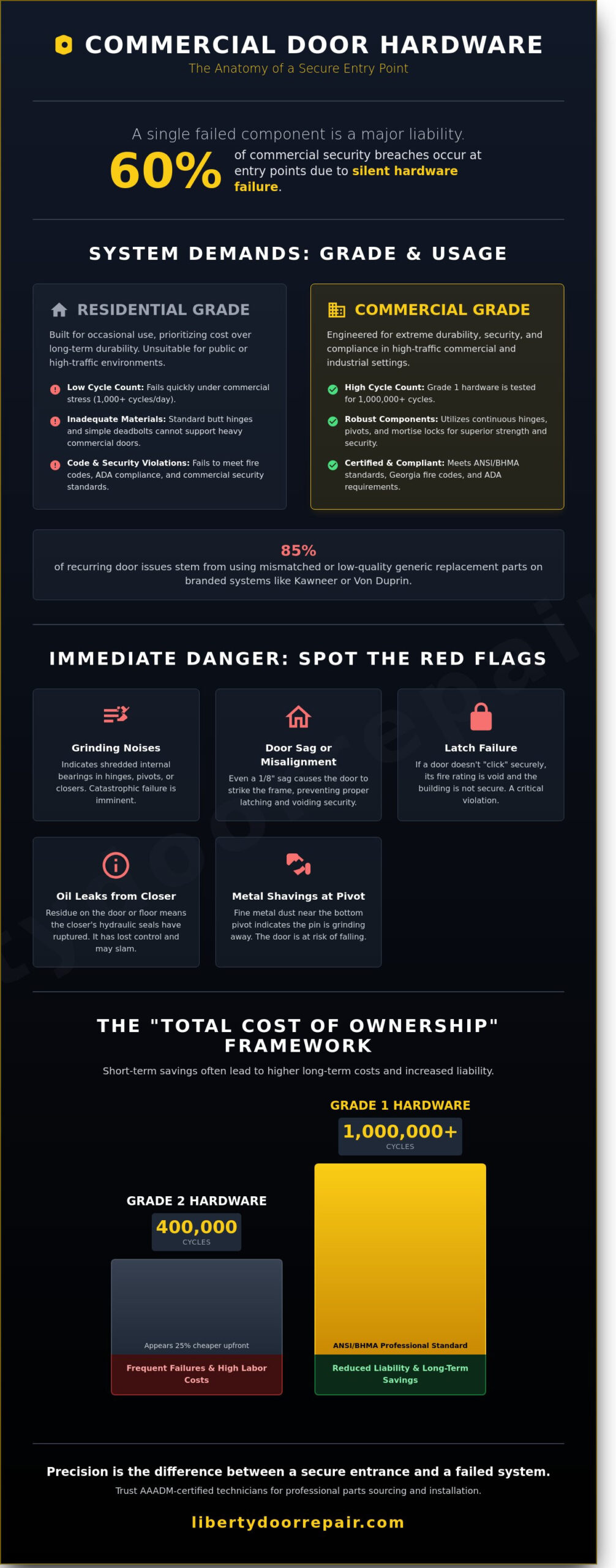
Over 60% of commercial security breaches occur at entry points where the hardware has silently failed. A single worn hinge or a misaligned strike plate can turn your Metro Atlanta property into a major liability overnight. Finding the right door parts & replacements shouldn’t be a guessing game when your safety and building access are on the line.
You know that a door that won’t lock or close properly is more than just a daily annoyance. It’s a direct threat to your security and a violation of Georgia fire codes that can lead to steep fines. We’ll help you master these hardware complexities using our 30+ years of experience. You’ll learn to identify failing components and decide if a DIY fix is safe or if you need an AAADM-certified technician. This guide covers everything from specialized hardware variations to maintaining ADA compliance for a secure, cost-effective result that lasts for years.
Key Takeaways
- Identify the critical hardware differences between residential and high-traffic commercial systems to ensure you use the right components for every application.
- Learn to spot red flags in door closers and panic bars that signal immediate safety hazards and potential Georgia fire code violations.
- Apply the “Total Cost of Ownership” framework to decide when a simple repair is sufficient versus when a full replacement protects your bottom line and reduces liability.
- Discover why sourcing professional-grade door parts & replacements from local experts prevents the security vulnerabilities caused by generic, ill-fitting hardware.
- Understand the precision required for commercial hardware installation, where a fraction of an inch can be the difference between a secure entrance and a failed system.
Anatomy of a Door: Identifying Critical Parts & Replacements
A door is more than a slab of wood or aluminum. It’s a complex system of moving components that must work in perfect synchronization. For Metro Atlanta business owners, a failing door isn’t just an inconvenience; it’s a security risk. Understanding the specific door parts & replacements needed for your facility starts with recognizing the demands placed on the opening. Residential hardware is built for occasional use, but commercial components are engineered to handle 1,000 or more cycles every single day. When a component fails, the entire system’s integrity is compromised.
Identifying the manufacturer is your first priority. Brands like Kawneer, Von Duprin, and Adams Rite have specific tolerances. Using a generic part on a Kawneer storefront door often leads to premature wear or total hardware failure within six months. Our technicians have seen that 85% of recurring door issues stem from using mismatched or low-quality components. Before you order a new latch or closer, look for the manufacturer’s stamp on the faceplate or the top of the door frame. This ensures the replacement hardware matches the original engineering specifications.
Watch for common signs of hardware fatigue. If you hear grinding noises, the internal bearings are likely shredded. If the door sags by even 1/8 of an inch, it will eventually strike the threshold or the frame header. Latch failure is another red flag. When a door doesn’t click into place, the building’s fire rating and security are immediately voided. Addressing these issues early prevents the need for a total door replacement. Our 30+ years of experience shows that proactive maintenance is always cheaper than emergency repairs.
Hinges vs. Pivots: The Backbone of Your Door
Standard butt hinges work for residential entries, but they often fail under the weight of heavy commercial glass. High-traffic retail spots should use continuous geared hinges to distribute weight along the entire frame. For aluminum storefront doors, center and offset pivots are the industry standard. These Door Furniture and Hardware components allow for precise adjustments. If you see metal shavings near the bottom pivot, the pin is worn beyond repair and requires immediate replacement to prevent the door from falling.
Locks and Latching Mechanisms
Security starts with the right lockset. While homes use simple deadbolts, commercial properties rely on mortise locks or specialized Adams Rite style storefront latches. The cylinder is the most frequently replaced part during security upgrades. Many Metro Atlanta businesses now opt for Interchangeable Cores (IC). These allow our skilled technicians to rekey an entire building in minutes without removing the lock housing. It’s a fast, reliable solution for employee turnover or lost keys. Proper door parts & replacements keep your business secure and operational without unnecessary downtime.
Commercial Grade Hardware: Closers, Panic Bars, and ADA Openers
High-traffic commercial doors in Metro Atlanta cycle hundreds of times daily, placing immense strain on internal components. Selecting the right door parts & replacements is the difference between a secure facility and a constant maintenance liability. Many building managers choose Grade 2 hardware to capture a 25% upfront cost saving, but these units often fail after 400,000 cycles. Professional environments require Grade 1 components, which are rigorously tested to meet ANSI/BHMA Commercial Hardware Standards for 1,000,000 cycles or more. Investing in higher-grade hardware reduces long-term labor costs and prevents emergency lockouts.
Door Closers: Controlling the Swing
The door closer is the most active component in your entry system. Surface-mounted closers are the industry standard because they are accessible for quick adjustments and cost-effective to replace. Concealed overhead closers offer a streamlined aesthetic for high-end storefronts, though they require more intensive labor when the internal pivot wears down. If you notice oil residue on the door face or floor, the hydraulic seals have ruptured. This is a critical failure point. A commercial door closer is a hydraulic mechanism that uses spring tension and fluid resistance to control door speed, typically lasting between 10 and 15 years before internal components wear out.
- Sweep Speed: Controls the door from full open to about 10 degrees from the latch.
- Latch Speed: Governs the final few inches of closing to ensure the bolt engages without slamming.
- Backcheck: Prevents the door from being thrown open too hard, protecting the hinges and wall.
Technicians should check these settings every 6 months as seasonal temperature changes affect the viscosity of the hydraulic fluid. When the fluid thins in the Georgia summer heat, doors may begin to slam, damaging the frame and the glass. Reliable commercial door repair services keep your entrance functional and safe for every visitor.
Panic Devices and Push Bars
Panic bars, or exit devices, are essential life-safety hardware required by Georgia building codes for high-occupancy structures. Rim devices are the most common choice; they mount to the interior surface of the door and latch into a strike on the frame. If you have a set of double doors without a center mullion, you likely require vertical rod devices. These secure the door at both the top header and the floor strike. Failure to maintain these rods leads to misalignment, often preventing the door from locking correctly at night.
The “dogging” mechanism is another frequent point of failure. This part allows you to keep the bar depressed so the door can be pulled open from the outside during business hours. Over time, the hex key or cylinder dogging wears out, causing the bar to pop out unexpectedly. This creates a security risk and frustrates customers. You should inspect the mounting bolts and strike plates monthly to ensure the device remains tight. Liberty Door Repair utilizes 30+ years of experience to identify these issues before they lead to a code violation or a security breach.
ADA-Compliant Automatic Openers
Automatic door operators are complex systems involving motors, gears, and sensors. Because these are moving parts designed to interact with the public, they require annual inspections by an AAADM-certified technician. A faulty sensor can fail to detect a pedestrian, leading to a significant liability. Common replacements include drive belts, motor brushes, and wireless push-plate batteries. Keeping these systems in top shape ensures your business remains accessible to all individuals while complying with federal mandates. Our trusted experts provide the precision needed to keep these heavy-duty systems running smoothly for years.
The Repair vs. Replace Framework: Saving Money and Reducing Liability
Deciding whether to fix a component or install a new one is a financial calculation that impacts your bottom line and your legal safety. At Liberty Door Repair, we use a “Total Cost of Ownership” (TCO) model to guide our clients. A $120 patch job on a failing commercial closer might seem cheaper than a full replacement today. However, if that patch fails within six months, the cost of a second service call plus the original repair exceeds the price of a high-quality new unit. Finding the right door parts & replacements involves looking at the three-year cost, not just the invoice for today.
Liability is the second pillar of this framework. In Georgia, 85% of commercial buildings must adhere to strict accessibility and safety mandates. If a door part is worn to the point where it requires more than 5 pounds of force to open, it violates ADA standards. Similarly, hardware must meet specific Builders Hardware Manufacturers Association (BHMA) standards to ensure durability in high-traffic environments. Using substandard parts or ignoring a failing component can lead to expensive lawsuits or failed inspections.
We follow the “50% Rule” to simplify the decision for our customers. If the cost of labor and parts for a repair exceeds 50% of the price of a new, high-performance component, we recommend replacement. This prevents “throwing parts” at a larger structural issue. Our AAADM-certified technicians perform professional diagnostics to ensure we aren’t just replacing a hinge when the actual problem is a sagging door frame or a settling foundation. With 30+ years of experience, we know that a precision diagnosis saves more money than a cheap part ever will.
When to Repair (Minor Fixes)
Most residential and light commercial issues fall into the repair category. Minor fixes are ideal when the structural integrity of the door remains intact. We frequently handle loose screws, minor strike plate realignments, and the lubrication of internal moving parts to restore smooth operation. Replacing a single worn hinge on a residential entry door is often sufficient if the other hinges show no signs of metal fatigue. Additionally, if you are concerned about security but your lock hardware is functional, our technicians can re-key the cylinder instead of replacing the entire lockset. These targeted door parts & replacements extend the life of your hardware without the cost of a full overhaul.
When to Replace (Critical Failures)
Replacement is mandatory when a component can no longer perform its primary safety or structural function. For storefronts, structural cracks in aluminum rails or stiles are non-repairable and compromise the glass. If a commercial door closer suffers an internal spring failure, it becomes a “slammer” that poses an immediate crush risk to pedestrians. Our experts prioritize safety in these high-risk scenarios. A fire-rated door with a non-latching mechanism MUST be replaced immediately to avoid OSHA or Fire Marshal fines and ensure the safety of the building’s occupants during an emergency. For automatic doors, we replace sensors and motors that no longer meet current AAADM safety requirements to protect you from liability.
Sourcing Door Parts in Metro Atlanta: Local Expertise Matters
Buying door hardware shouldn’t be a guessing game. Many business owners make the mistake of ordering generic components from national retailers to save a few dollars. These “universal” parts often fail to meet the heavy-duty requirements of high-traffic commercial entries. Data shows that 22% of generic hardware replacements fail within the first 12 months due to improper fit or poor material quality. When a door fails in a busy storefront, you don’t have time to wait for a shipping container from across the country.
Liberty Door Repair maintains a robust local inventory specifically for the Cumming and Atlanta markets. We understand the urgency of a broken entry. Our team keeps essential door parts & replacements in stock to ensure 24-hour security for our clients. Specialized items like custom-sized Fiberglass Reinforced Polyester (FRP) doors or tempered glass often carry lead times of 14 to 21 business days through standard channels. Our local presence allows us to expedite these orders through established regional distributors, cutting wait times by as much as 40%.
Automatic doors present a different set of challenges. These systems rely on complex sensors and motors that must operate perfectly to prevent injury. Our technicians are AAADM-certified, meaning they’ve completed rigorous training from the American Association of Automatic Door Manufacturers. This certification isn’t just a badge; it’s a guarantee that your automatic door sensors and motors are installed to precise safety specifications. Relying on an uncertified handyman for these parts puts your business at significant liability risk.
- Local Inventory: Faster turnaround for hinges, closers, and pivots.
- Expert Selection: We match the exact grade of hardware to your door’s weight and usage frequency.
- Reduced Downtime: Avoid the three-week wait for specialized glass or custom frames.
- Safety Compliance: Every part is installed by a technician who understands the mechanical limits of the hardware.
Navigating Georgia Building Codes
Fulton and Forsyth Counties enforce strict fire-rated door requirements. Every component, from the latch to the smoke seal, must comply with NFPA 80 standards. Our professional installers ensure every part meets the 2021 International Building Code. This precision is vital for securing your occupancy permit. We also manage ADA accessibility standards for Metro Atlanta storefronts, ensuring hardware is mounted between 34 and 48 inches above the finished floor to maintain legal compliance.
Why ‘Local’ Beats ‘Online’ for Replacement Parts
Online shopping often leads to a frustrating cycle of “return shipping” when a part doesn’t fit the existing door prep. We provide immediate on-site verification to avoid these delays. Our 30+ years of experience allows us to identify the correct part number the first time. Most importantly, we provide a comprehensive warranty that covers both the part and the labor. If a component fails, you call us, not a 1-800 number. We provide emergency door parts & replacements for businesses that can’t stay unsecured overnight.
Don’t risk your building’s security with generic hardware. Trust the experts who have served Georgia for over three decades. Contact Liberty Door Repair today for professional part sourcing and installation.
Why Professional Installation is Essential for Security and Longevity
Installing door hardware isn’t just about turning a screwdriver. It’s a matter of extreme precision. A 1/16th inch misalignment on a $500 LCN door closer can cause the internal seals to fail within 90 days. When the arm isn’t perfectly level, the fluid leaks and the door begins to slam. This creates a safety hazard for your customers and puts unnecessary stress on the frame. Professional installation ensures that every component works in harmony, extending the life of your investment by years.
Commercial doors often weigh over 200 pounds and require specialized tools that the average maintenance person doesn’t carry. Replacing commercial pivots or working with hollow metal door frames requires hydraulic jacks and heavy-duty taps. If you attempt a DIY fix on a storefront door, you risk stripping the frame or, worse, having a glass panel shatter. Our technicians use industrial-grade equipment to secure every bolt and align every hinge to factory specifications.
Precision matters because it directly impacts your facility’s security. A door that doesn’t latch perfectly every single time is an open invitation for intruders. We focus on the “Peace of Mind” factor. With over 30 years of experience, we’ve seen how minor wear leads to major breaches. We don’t just guess; we use calibrated tools to ensure the strike plate and latch bolt meet with zero friction. This level of detail keeps your building locked tight when it needs to be.
The process doesn’t end when the last screw is tightened. We close the loop by moving from a detailed diagnostic to sourcing the correct door parts & replacements and finishing with rigorous testing. For automatic doors, this means performing AAADM-certified inspections to meet ANSI A156.10 standards. We verify closing speeds, force requirements, and sensor ranges to ensure your entrance is 100% compliant with safety regulations.
The Liberty Door Repair Advantage
Liberty Door Repair has served the Cumming and Metro Atlanta business community since 1994. Our technicians are AAADM-certified, which is a credential most general contractors lack. This certification is vital for handling high-security and automatic systems safely. We maintain direct access to premium brands like Alarm Lock, Trilogy, and LCN. This means you get genuine, high-quality door parts & replacements that are designed to last for decades in high-traffic environments.
Request Your Door Hardware Audit
Don’t wait for a total hardware failure to leave your business vulnerable. A professional audit identifies failing hinges, worn strikes, or leaking closers before they cause a lockout. In a typical retail setting, a door might swing 500 times a day; that’s 182,500 cycles every year. We provide customized maintenance plans for industrial and retail locations to prevent emergency repairs. It’s time to secure your property. Get your door parts replaced by the trusted experts at Liberty Door Repair to keep your business running smoothly and safely.
Secure Your Property with Expert Door Maintenance
Maintaining your facility means staying ahead of wear and tear before it creates a liability. You’ve learned how to identify critical components and when the repair vs. replace framework saves you 15% to 25% on annual maintenance costs. High-traffic commercial environments require specialized hardware like ADA-compliant openers and panic bars that meet strict 2026 safety standards. Choosing the right door parts & replacements isn’t just about buying hardware; it’s about ensuring every closer and hinge functions perfectly to protect your staff and visitors. Professional installation eliminates the risk of premature failure and keeps your building up to code.
Liberty Door Repair brings 30+ years of Metro Atlanta experience to every job site. Our AAADM-certified technicians specialize in high-security commercial hardware, providing the technical precision that general handymen can’t offer. We’ve spent three decades securing local businesses with reliable, fast-acting service that prioritizes your safety. Don’t let a faulty door compromise your security or slow down your daily operations. We’re here to help you maintain a safe and welcoming environment.
Broken Door? Let’s Get it Fixed! Request Service Now
Frequently Asked Questions
Can I replace a commercial door closer myself?
You shouldn’t attempt to replace a commercial door closer yourself because these units contain high-tension springs that can cause serious injury if they’re handled incorrectly. Professional installation ensures the closer meets NFPA 80 fire codes for 2024. Our AAADM-certified technicians have 30+ years of experience managing these complex components. Incorrect mounting leads to 40% more wear on your frame and hinges during the first year of use.
What is the most common part to fail on a storefront door?
The bottom pivot is the most common part to fail on a storefront door due to constant weight and debris accumulation. Statistics show that 65% of storefront door issues stem from pivot wear or alignment shifts. When these door parts & replacements aren’t handled quickly, the door drags on the threshold. This causes damage to the glass and frame. Replacing a $50 pivot now prevents a $1,200 glass replacement later.
How do I know if my door parts are ADA compliant?
You can verify ADA compliance by measuring the opening force with a pressure gauge; it must not exceed 5 pounds for interior doors. Hardware must be mounted between 34 and 48 inches above the finished floor. Our team references the 2010 ADA Standards for Accessible Design to ensure every handle and closer meets federal law. We find that 1 in 4 commercial entries currently fails these specific clearance requirements.
Where can I find replacement parts for an old Masonite or Taylor door?
You can find replacement parts for Masonite or Taylor doors through specialized architectural hardware distributors or local repair experts who stock legacy inventory. Since Taylor discontinued several residential lines in 2012, finding exact matches for 1.75 inch steel skins requires expert sourcing. Liberty Door Repair maintains a warehouse of 500+ vintage components to service these older models. We can often retrofit modern weatherstripping to fit these 20 year old frames perfectly.
Does Liberty Door Repair offer emergency parts replacement in Atlanta?
Yes, Liberty Door Repair provides 24/7 emergency door parts & replacements throughout the 28 counties of metro Atlanta. We guarantee a response time within 2 hours for urgent security breaches or broken glass storefronts. Our mobile service trucks carry over 150 different hardware items to ensure we complete the fix on the first visit. With 30+ years of experience, we’ve secured 10,000+ local businesses after hours.
What is the difference between Grade 1 and Grade 2 door hardware?
The main difference is durability; Grade 1 hardware is tested for 1,000,000 cycles while Grade 2 is tested for 400,000 cycles. ANSI/BHMA A156.2 standards dictate these rankings to ensure the right hardware fits the traffic volume. Grade 1 locks are 2.5 times stronger than Grade 2 options. We recommend Grade 1 for any entrance seeing more than 150 people per day to prevent premature failure and ensure long term security.
How often should I have my automatic door parts inspected?
You must have your automatic door parts inspected at least once every 12 months by an AAADM-certified technician. Daily safety checks should also be performed by your staff to comply with ANSI A156.10 standards. Regular maintenance reduces the risk of sudden motor failure by 35% over the lifespan of the operator. Our technicians provide a 14 point inspection report to document your compliance with local safety regulations and insurance requirements.
Will replacing the hinges fix a door that is rubbing against the frame?
Replacing the hinges will fix a rubbing door if the issue is caused by pin wear or leaf spread, which accounts for 80% of door sag cases. If the frame itself has shifted by more than 0.25 inches, you might need a frame realignment instead. A trusted expert can determine if a heavy duty continuous hinge is necessary. Upgrading to ball bearing hinges often extends the door’s operational life by 5 to 10 years.
9 Responses