

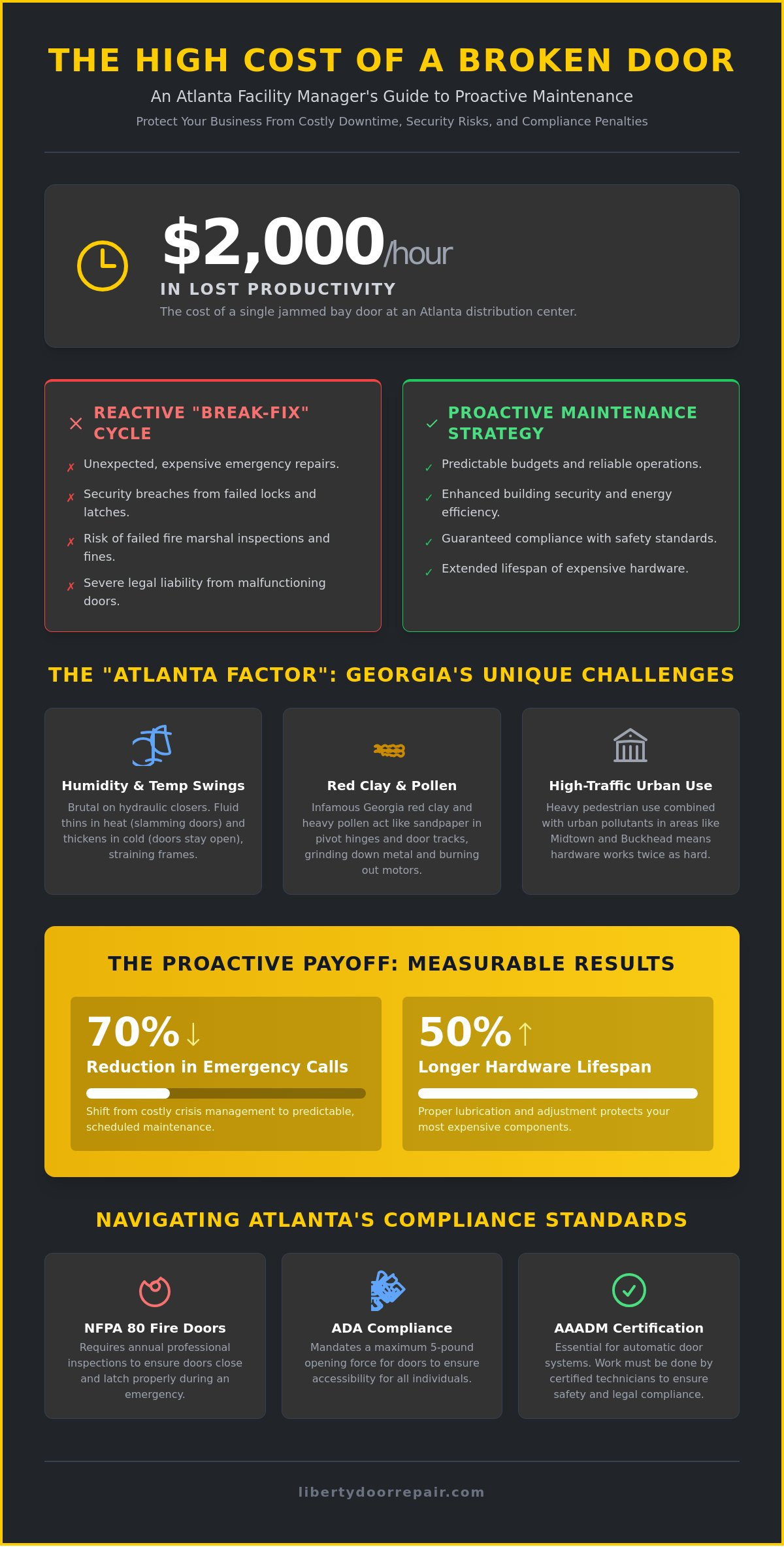
Did you know a single jammed bay door can cost an Atlanta distribution center up to $2,000 per hour in lost productivity? For facility managers in Georgia, a door that won’t open or close is more than a nuisance. It’s a direct threat to your bottom line and your building’s security. You’re likely already juggling tight budgets while worrying about the next surprise repair bill or a failed fire marshal inspection. It’s exhausting to stay reactive when the stakes for your property are this high. Professional commercial door maintenance atlanta services are the only way to shift from constant firefighting to predictable, reliable operations.
We understand the pressure of keeping a high-traffic facility running without interruptions. This guide will show you exactly how to protect your business from costly downtime and legal liability through proactive care. We’ll preview the latest 2026 local requirements, including Atlanta Ordinance 26-O-1001, and explain how regular inspections can reduce your emergency call volume by 70%. You’ll learn how to ensure full compliance with Georgia fire safety standards while extending the lifespan of your most expensive hardware, from automatic openers to panic devices.
Key Takeaways
- Understand how Atlanta’s extreme humidity and temperature swings specifically degrade hydraulic door closers and critical hardware components.
- Access a detailed 2026 maintenance checklist tailored for storefront, fire-rated, and automatic doors to streamline your facility operations.
- Master local compliance standards, including NFPA 80 annual inspections and ADA-mandated 5-pound opening force requirements.
- Learn how a proactive commercial door maintenance atlanta strategy can slash emergency repair expenses and extend hardware lifespan by up to 50%.
- Discover why AAADM-certified technicians are essential for ensuring the safety and legal compliance of your automatic door systems.
Why Proactive Commercial Door Maintenance is Critical for Atlanta Businesses
Commercial door maintenance atlanta businesses rely on isn’t just a luxury; it’s a critical facility management strategy. We define Proactive Commercial Door Maintenance as a rigorous, scheduled regimen of inspection, lubrication, and precision adjustment. This approach moves your facility away from the stressful “break-fix” cycle. Instead, you’re embracing predictive asset management. By identifying worn rollers or leaking closers before they fail, you protect your building’s security, boost energy efficiency, and ensure that every customer’s first impression is one of professional excellence.
The “Atlanta Factor” is a real phenomenon that accelerates hardware wear. Our region’s high humidity and sudden temperature swings are brutal on hydraulic door closers. When the mercury rises, the internal fluid thins out, causing doors to slam. When it drops, the fluid thickens, leaving doors standing open. These fluctuations don’t just annoy visitors. They strain the entire frame and hinge assembly, leading to premature failure of expensive components. Staying ahead of these changes is the only way to maintain a consistent, safe entry point.
The High Cost of Neglect: Security and Liability
Security starts at the perimeter. A door that drags on the threshold or a latch that fails to engage creates a “soft target” for intruders. In a high-stakes environment, a malfunctioning storefront door is an invitation for unauthorized access. Beyond security, the legal implications are severe. If a fire door fails to close and latch during an emergency because of a neglected closer, the resulting liability can be catastrophic for a business owner. The liability gap created by unmaintained automatic doors often results from a failure to perform daily safety checks and annual professional certifications.
Environmental Impact on Metro Atlanta Hardware
Georgia’s environment presents unique challenges for commercial hardware. Our infamous red clay and heavy seasonal pollen act like sandpaper when they get into pivot hinges and automatic door tracks. This grit grinds down metal components, causing friction that burns out motors. Extreme summer heat also alters the viscosity of door closer fluid, leading to inconsistent closing speeds. For businesses in high-traffic areas like Buckhead or Midtown, we recommend increasing inspection frequency. The combination of heavy pedestrian use and urban pollutants means your hardware works twice as hard as doors in quieter suburbs.
Comprehensive 2026 Commercial Door Maintenance Checklist
A structured checklist is the backbone of effective commercial door maintenance atlanta. You shouldn’t rely on guesswork when the safety of your staff and the security of your inventory are on the line. Every inspection must integrate your access control hardware. This ensures that electronic strikes, maglocks, and card readers release correctly during an emergency. We recommend a monthly walk-through by facility staff, followed by a professional deep-dive inspection twice a year to catch hidden wear in hardware like panic bars and continuous hinges.
Hardware-specific tasks are the most overlooked part of facility management. Panic bars require frequent testing to ensure the internal springs haven’t lost tension. Pivots and hinges must be checked for metal-to-metal contact or “dusting,” which indicates a lack of lubrication. If your doors use continuous hinges, inspect the full length for any sagging that could prevent the latch from engaging. Keeping these components in peak condition is a simple way to avoid the high cost of emergency hardware replacement.
Storefront and Glass Entry Door Maintenance
Start by checking the integrity of your door sweeps. In the humid Georgia climate, a worn sweep allows conditioned air to escape, driving up your utility bills. Next, test the “closing speed” of the door. It should take approximately 5 to 7 seconds to close from a 90-degree angle. A door that slams is a liability that can lead to shattered glass or hand injuries. If you find hardware that won’t align or closers that are leaking oil, you may need Commercial door repair Atlanta services to restore your building’s security immediately.
Automatic and ADA-Compliant Systems
These systems require specialized expertise. Always verify that your inspections are handled by AAADM-certified technicians to ensure compliance with national safety standards. Test all motion sensors and safety mats to prevent accidental contact with pedestrians. You must also check the battery backups for keyless entry systems and automatic openers. A power surge can easily drain these batteries, leaving your facility vulnerable during an outage. Our professional automatic door services provide the documented certification you need for insurance and liability protection.
Industrial and Warehouse Dock Door Inspections
Warehouse doors are high-impact assets. Regularly lubricate all rollers, tracks, and hinges on rolling steel or sectional overhead doors. Carefully inspect tension springs and lift cables for any signs of fraying or fatigue. A snapped cable on a heavy bay door can cause catastrophic downtime and severe injury. Don’t forget to perform safety checks on dock levelers and vehicle restraints. For total peace of mind, you can schedule a professional assessment to ensure your fire-rated assemblies meet Fire Door Safety standards under NFPA 80.
Navigating Atlanta’s Compliance Standards: ADA and Fire Door Safety
Compliance with local and federal regulations is a non-negotiable part of commercial door maintenance atlanta. You don’t want to wait for a fire marshal inspection or a legal notice to discover your facility is out of code. In Georgia, the National Fire Protection Association (NFPA) 80 standard dictates how you must manage fire-rated openings. Every fire door must be self-closing and self-latching to prevent the spread of smoke and flames. If your door stays propped open or fails to click into the frame, your building is at risk and your insurance coverage could be in jeopardy.
A critical component of Navigating Atlanta’s Compliance Standards involves the Americans with Disabilities Act (ADA). For most interior doors, the maximum opening force is strictly limited to 5 pounds. If your door closers are poorly adjusted, they may exceed this limit, creating a barrier for individuals with disabilities. Proper maintenance ensures your hardware remains within these legal bounds while protecting you from “strike” or “slip and fall” lawsuits that arise from malfunctioning automatic systems.
Fire Door Inspection (FDI) Requirements
Under the NFPA 80 standards, your fire-rated door assemblies require a documented annual inspection. This isn’t just a quick check. It involves a rigorous 13-point evaluation covering frame integrity, door alignment, and the condition of gaskets and seals. Professional fire door services are essential because these records are required for insurance audits and fire marshal reviews. We frequently see common failures like painted-over fire labels, which immediately voids the door’s rating, or the use of non-compliant hardware that prevents the door from latching securely during a fire event.
ADA Accessibility and Automatic Operators
Accessibility standards require a minimum clear opening width of 32 inches for commercial entries. Beyond width, you must maintain the functionality of “push-to-exit” buttons and wave-to-open sensors. With the passage of Atlanta Ordinance 26-O-1001, many street-facing businesses are now required to provide push-button access to improve accessibility. Regular maintenance prevents these electronic components from failing when they’re needed most. Keeping these systems in peak condition is the best way to avoid the high cost of legal settlements and ensure a welcoming environment for all patrons.
For those who manage pet-friendly facilities, ensuring that visiting animals are well-behaved is another key part of maintaining a safe and professional environment. In the North Atlanta area, Alan’s K9 Academy can help; you can explore Professional Dog Training and Behavioral Services to keep your premises orderly and inviting.
Compliance Audit Tip for 2026: Before your next scheduled inspection, conduct a “walk-and-pull” test. Use a force gauge to verify the 5-pound opening limit and check every fire door label for legibility. If a label is painted over or missing, it must be recertified or replaced before the fire marshal arrives to avoid significant fines.
The Financial Impact: Preventative Maintenance vs. Emergency Repair Costs
Facility managers often view commercial door maintenance atlanta as an optional expense. In reality, it’s a high-yield investment that prevents massive budget leaks. When you wait for a door to fail, you’re not just paying for a fix. You’re paying for an emergency. Industry data shows that emergency service calls typically cost three to five times more than a scheduled preventative visit. By catching a worn pivot or a misaligned track early, you avoid the premium rates and inflated parts pricing associated with urgent, after-hours repairs.
The savings extend far beyond the repair bill. A standard commercial storefront door can cost upwards of $5,000 to replace. Regular lubrication and adjustment can extend the service life of that asset by 30% to 50%. You’re also protecting your utility budget. In the peak of an Atlanta summer, a door that fails to seal properly acts like an open exhaust for your air conditioning. Properly maintained weather stripping and closers ensure your HVAC system isn’t working overtime to compensate for a “leaky” building envelope.
Retail businesses face an additional “Downtime Tax” when an entry fails. A jammed front door or a malfunctioning automatic slider directly reduces foot traffic. Customers who see a “Use Other Door” sign or a struggling entrance often keep walking, leading to immediate revenue loss. Maintaining your entryways is a form of revenue protection. It ensures your business remains accessible and inviting during every hour of operation.
This principle of proactive care extends to all guest-facing amenities. For property owners managing hospitality or recreational spaces, keeping high-value features in peak condition with Marlin Exteriors, Inc. ensures that every part of your facility, from the front door to the swimming pool, remains a professional and inviting asset.
Calculating the ROI of a Maintenance Plan
A consistent maintenance regime significantly alters the longevity of your hardware. Components like pivots and continuous hinges can last decades if they’re kept clean and aligned. Without care, they can grind down and fail in just a few years. Adjusting a dirty sensor is a minor expense compared to the massive cost of replacing an entire burnt-out motor assembly. To understand what’s at stake for your specific hardware, you can review our commercial door parts & replacements guide for more technical context. Taking a proactive stance today is the most effective way to protect your facility budget for the long term.
Reducing Emergency Service Disruptions
Experienced facility managers know the “Friday Afternoon Rule.” Doors never seem to break on a quiet Tuesday morning; they fail right before a holiday weekend or during your busiest shift. Scheduled inspections identify “impending failures” like fraying cables or leaking hydraulic fluid before they stop your operations. This allows you to schedule repairs during low-traffic hours rather than scrambling for a technician while your security is compromised. If you’ve inherited a building where the hardware is already beyond its prime, our Commercial door replacement guide can help you plan a structured upgrade instead of a forced emergency installation.
Liberty Door Repair: Professional Maintenance for Metro Atlanta Businesses
Liberty Door Repair has served the Georgia business community since 2015. This longevity isn’t a coincidence. It’s the result of a relentless focus on professional expertise and dependable service. We’ve seen every hardware failure imaginable across since 2015. Our deep roots in the region allow us to provide a level of specialized knowledge that national chains simply can’t match. Whether you’re managing a retail storefront in Decatur or a sprawling warehouse in Marietta, we bring a serious, no-nonsense approach to your facility. We don’t just fix problems; we build partnerships that keep your doors swinging and your business secure.
Our service area covers the entire Metro Atlanta footprint. We maintain a fleet of technicians ready to assist businesses in Alpharetta, Marietta, Decatur, and throughout the surrounding counties. We specialize in the hardware that keeps your facility compliant and accessible. This includes ADA-compliant door openers, fire door assemblies, panic devices, and complex access control solutions. We arrive with the diagnostic equipment and parts needed to address issues quickly. Our goal is to ensure your facility remains a safe, welcoming environment for every visitor who walks through your entrance.
Our AAADM-Certified Expertise
AAADM certification is a prerequisite for safety in our industry. It stands for the American Association of Automatic Door Manufacturers. For a business owner, this certification provides immediate peace of mind. It ensures our technicians are trained on the latest national safety standards and diagnostic protocols. We use specialized tools to calibrate sensors and measure closing force with extreme precision. Our personality is that of a competent specialist. We get straight to the point. We identify the technical issue, present a direct solution, and execute the repair without unnecessary jargon. You can trust our mastery of the hardware that protects your property.
Customized Maintenance Plans for Every Industry
Every facility has unique operational demands. A high-traffic retail entrance in Alpharetta needs more frequent attention than a low-traffic industrial site in the Metro region. We tailor our commercial door maintenance atlanta plans to your specific usage patterns and hardware types. The “Liberty Difference” is our commitment to rigorous documentation. We provide detailed reporting for every inspection and adjustment we perform. These records are vital for your insurance audits and fire marshal reviews. They prove you’re taking proactive steps to maintain a safe building. Stop worrying about the next surprise repair bill. Schedule your 2026 commercial door maintenance audit today.
Protect Your Bottom Line with Proactive Door Care
Neglecting your building’s entry points is a risk you can’t afford in 2026. Staying ahead of ADA accessibility requirements and fire safety codes isn’t just about avoiding fines. It’s about protecting your customers and your budget from the high price of emergency failures. Implementing a consistent commercial door maintenance atlanta strategy ensures your facility remains secure, efficient, and fully compliant with local Georgia standards. You’ve seen how proactive care extends the life of expensive hardware and prevents the “Downtime Tax” from hurting your revenue.
Don’t wait for a hardware breakdown to disrupt your operations. Liberty Door Repair has served North Georgia businesses since 2015 and AAADM certified technicians to every job. We currently serve over 20 Metro Atlanta cities with dependable, expert service designed for high-traffic environments. We’re ready to help you transition from reactive repairs to a predictable, professional maintenance partnership. Take the first step toward a more reliable facility today.
Secure Your Business with Professional Door Maintenance
Your business deserves the peace of mind that comes with expert door care. We look forward to helping you keep your facility safe and accessible for years to come.
Frequently Asked Questions
How often should commercial doors be serviced in Atlanta?
High-traffic entrances require professional servicing at least every six months to ensure safety and performance. Facilities with heavy pedestrian volume, such as retail hubs in Buckhead or Midtown, often benefit from quarterly inspections. Regular checks prevent the accelerated wear caused by Georgia’s extreme humidity and temperature fluctuations.
What is an AAADM-certified technician, and why do I need one?
An AAADM-certified technician is a specialist trained by the American Association of Automatic Door Manufacturers to inspect and maintain automatic door systems. You need one to ensure your facility complies with national safety standards. These experts use precision tools to calibrate sensors and closing speeds, which protects your business from liability and pedestrian accidents.
Are fire door inspections legally required for my business in Georgia?
Yes, annual fire door inspections are a legal requirement under NFPA 80 standards, which are strictly enforced by the Georgia fire marshal. You must keep documented proof of these inspections on file for your insurance provider and local authorities. Failing to provide this documentation can result in significant fines and the loss of your certificate of occupancy.
Can I perform commercial door maintenance myself?
Facility managers can handle basic tasks like cleaning tracks and performing daily visual safety checks. However, technical adjustments to hydraulic closers, tension springs, or electronic access control systems require specialized training and tools. Attempting complex repairs without professional experience can lead to severe injury and may void your hardware warranties.
What are the most common causes of commercial door failure in Atlanta?
The leading causes of failure in our region are hydraulic fluid leaks and grit accumulation. Extreme heat causes closer fluid to thin and leak, leading to slamming doors. Additionally, local red clay and seasonal pollen often foul the pivot hinges and tracks, causing the door to drag or fail to latch securely.
Does door maintenance help with my business insurance premiums?
Maintaining a documented history of professional commercial door maintenance atlanta can help mitigate liability risks in the eyes of your insurer. While every policy is different, many providers view proactive maintenance as a critical step in preventing “slip and fall” or “strike” claims. This documentation is essential evidence if you ever need to defend your facility’s safety record.
What happens if my storefront door fails to lock at night?
A door that fails to lock is a critical security breach that requires an immediate professional solution. This issue is often caused by a sagging frame or a misaligned strike plate that prevents the bolt from engaging. You should contact a specialist to realign the hardware and secure your perimeter before the building is left unattended for the night.
How much does a typical commercial door maintenance plan cost?
The cost of a maintenance plan depends on the total number of doors and the complexity of your hardware, such as automatic openers or fire-rated assemblies. While we don’t quote flat rates here, a proactive plan is always more affordable than a single emergency repair. Scheduled visits allow you to budget for minor adjustments rather than facing the high cost of total hardware replacement.