

Did you know a malfunctioning bay door can cost your business between $500 and $2,000 every single hour in lost productivity and shipping delays? For a warehouse or storefront in Metro Atlanta, a jammed door isn’t just an inconvenience; it’s a critical security vulnerability and a major safety hazard for your team. You need commercial overhead door repair that prioritizes speed without sacrificing technical precision. We understand that every minute your door remains stuck, your revenue and your employees are at risk.
This expert guide ensures your business stays secure and operational by detailing the best practices for commercial overhead door repair, routine maintenance, and professional service options. Serving North Georgia businesses since 2015, with AAADM-certified technicians, we provide the reliable expertise required to handle heavy, malfunctioning hardware safely. You’ll learn how to minimize operational downtime, demand transparent pricing, and navigate the 2024 International Building Code updates effective in Georgia as of January 2026. We’ll preview the essential steps to achieve a long-lasting fix that keeps your business flowing smoothly from Marietta to Alpharetta.
Key Takeaways
- Understand the critical security risks and logistical bottlenecks caused by delaying essential commercial overhead door repair.
- Spot common mechanical failures like torsion spring fatigue and off-track rollers to prevent sudden operational shutdowns.
- Evaluate the age and structural integrity of your sectional doors to decide between a targeted repair or a full replacement.
- Adopt a professional maintenance routine to maximize the lifespan of your loading dock hardware through regular inspections and lubrication.
- Ensure your facility remains compliant with updated Georgia safety standards by partnering with local, AAADM-certified experts.
Why Fast Commercial Overhead Door Repair is Critical for Atlanta Businesses
A malfunctioning door is an open invitation for unauthorized access. In a major logistics hub like Metro Atlanta, a warehouse or storefront that cannot be fully secured overnight faces immediate risk. Beyond security, an unsealed or stuck door leads to massive HVAC loss. Georgia’s humidity and summer heat can drive up energy bills rapidly when conditioned air escapes through a gap in a loading dock. Commercial overhead door repair addresses these environmental and security vulnerabilities before they escalate into expensive emergencies. Understanding the various garage door types and mechanisms is essential for identifying whether a simple seal replacement or a complex mechanical overhaul is required. Professional service ensures that your facility remains a controlled, secure environment.
Operational flow is the backbone of your business. When a door fails to open, it doesn’t just block a single exit; it disrupts the entire movement of goods. For Atlanta businesses relying on tight shipping windows, a mechanical failure can lead to missed deadlines and frustrated partners. We prioritize swift interventions because we know that a door that won’t move is a direct threat to your reputation and your daily output. Addressing these issues early prevents small mechanical hiccups from turning into total system failures.
The High Cost of Business Downtime
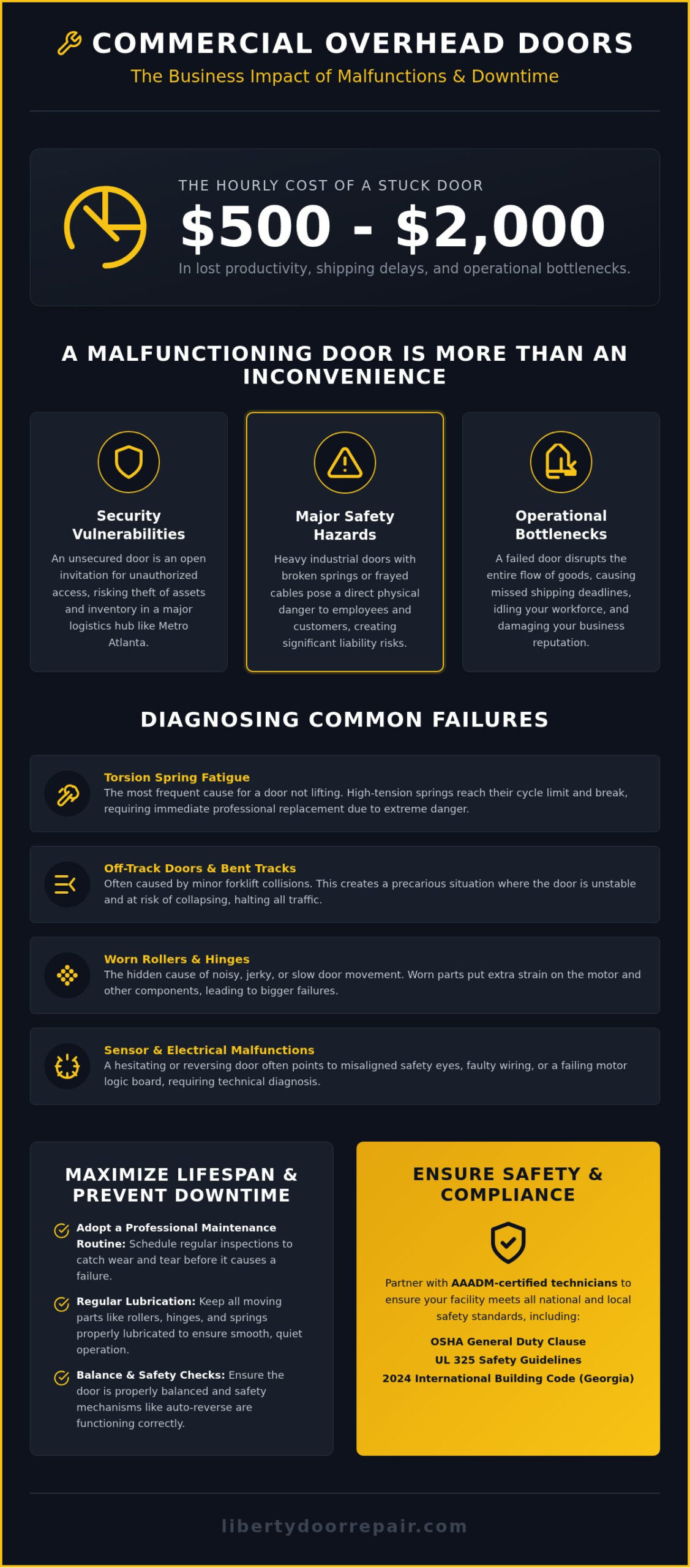
Efficiency is the lifeblood of industrial operations. When a loading dock door fails, the entire facility feels the impact. Industry data suggests that a jammed bay door can cost a business between $500 and $2,000 per hour in lost productivity and shipping delays. In Metro Atlanta, where supply chain reliability is a competitive advantage, these delays ripple through your entire schedule and affect your bottom line. An operational bottleneck is a single point of technical failure, such as a seized motor or broken track, that halts the movement of inventory and idles your workforce. Fast commercial overhead door repair keeps your logistics on track and prevents your revenue from stalling at the dock.
Safety and Liability Concerns
Safety is not negotiable in a commercial setting. Industrial doors are among the heaviest pieces of moving equipment in your facility. A door with a broken torsion spring or a frayed cable is a physical danger to every employee walking beneath it. While OSHA does not have a specific standard solely for overhead doors, the General Duty Clause requires employers to provide a workplace free from recognized hazards. Using faulty hardware can lead to severe legal liabilities and workers’ compensation claims. Our AAADM-certified technicians perform rigorous inspections to ensure your equipment meets national safety standards, including UL 325 guidelines. Professional oversight is especially critical for public-facing storefronts where customer safety is paramount. Relying on expert service protects your staff, your customers, and your business assets.
Common Industrial Overhead Door Problems and Technical Solutions
Industrial doors are heavy, complex systems that endure hundreds of cycles every week. When a single component fails, the entire facility’s operation can grind to a halt. Effective commercial overhead door repair starts with an accurate diagnosis of whether the issue is mechanical, structural, or electrical. Torsion spring failure is the most frequent reason a door refuses to lift. These springs are under immense tension and eventually reach their metal fatigue limit. Another common problem in busy Atlanta distribution centers is the off-track door. Minor collisions with forklifts often bend tracks or knock rollers out of alignment. This creates a precarious situation where the door might collapse. Worn rollers and hinges are the hidden culprits behind noisy or jerky movement. If your door hesitates, it’s likely a sign of electrical sensor malfunctions or misaligned safety eyes.
Torsion Springs vs. Extension Springs
Torsion springs are the preferred choice for high-cycle commercial settings. They are mounted on a shaft above the door and provide more balanced lifting power than extension springs. In a high-traffic Atlanta warehouse, these springs are rated for specific cycle counts, often ranging from 10,000 to 50,000. Business owners should never attempt to replace these springs themselves. The tension involved is high enough to cause fatal injuries if the hardware isn’t handled with professional-grade winding bars. Our certified team matches the spring’s wire gauge and length to your door’s exact weight for maximum longevity.
Cable and Track Alignment
Cables and tracks must remain in perfect sync to prevent mechanical failure. Frayed cables represent a major safety risk because they can snap without warning. Sudden door collapses are often the result of neglected cable maintenance. Precision is mandatory when realigning tracks after a structural impact from a vehicle. Even a slight misalignment forces the opener to work harder, leading to motor burnout. Maintaining these systems is part of staying compliant with OSHA’s General Duty Clause. For more information on identifying specific hardware failures, you can review our guide on door parts & replacements. If you suspect your tracks are warped, it’s best to request a professional mechanical inspection immediately to prevent a total system failure.
Evaluating Your Options: Repairing vs. Replacing Commercial Sectional Doors
Deciding between a targeted fix and a full system overhaul is one of the most significant financial choices a facility manager faces. While commercial overhead door repair is often the fastest way to restore operations, there’s a point where maintenance costs outweigh the value of the equipment. The age factor is the primary indicator; a door that has been in service for 15 years or more often becomes a money pit. At this stage, metal fatigue in the panels and wear in the tracking systems lead to frequent, unpredictable breakdowns. If you’re calling for service more than twice a year for the same door, you’re likely chasing diminishing returns. We help you evaluate whether your current hardware can still provide the security and reliability your Atlanta business demands.
The extent of physical damage also dictates your next move. Cosmetic panel dents from minor bumps are usually repairable or require simple panel swaps. However, structural frame warping is a different story. If a forklift impact has twisted the vertical tracks or compromised the door’s integrity, the system may no longer seat properly against the weather stripping. This leads to massive energy loss. Following DASMA inspection guidelines helps our technicians determine if the door’s safety features, such as the bottom bar or sensing edges, can still function as intended. If the structural skeleton is compromised, a replacement is often the only way to ensure long-term safety and compliance with the 2024 International Building Code standards adopted in Georgia in 2026.
Cost-Benefit Analysis for Property Managers
Property managers must balance short-term repair costs against long-term capital expenditures. Upgrading to modern, insulated doors often pays for itself through utility savings, as high-efficiency models can reduce heat transfer by 25-35%. With motorized systems now representing approximately 71% of new deployments, moving from manual operation to smart, access-controlled hardware is a major efficiency boost. Additionally, federal and local tax incentives available in 2026 for energy-efficient commercial upgrades can significantly offset the initial cost. For a deeper look at the financial side of these upgrades, consult our commercial door replacement guide tailored for Metro Atlanta owners.
Signs Replacement is Unavoidable
- Multiple panel failures that compromise the door’s structural integrity or security.
- Obsolete parts for older models that can no longer be sourced from manufacturers.
- Frequent mechanical breakdowns that cause recurring operational bottlenecks in your warehouse.
- Consistent failure to meet modern safety standards or building code requirements.
Maximizing Lifespan: Maintenance Tips for Warehouse and Loading Dock Doors
Proactive care is the most effective way to avoid the high costs of emergency commercial overhead door repair. High-traffic facilities in Metro Atlanta put immense strain on their hardware every day. A consistent maintenance schedule prevents small mechanical issues from spiraling into total system failures. Your facility team should perform monthly visual inspections. Look for frayed cables, dented tracks, or rollers that wiggle excessively in their brackets. If you see metal shavings near the tracks, it’s a clear sign of improper alignment that requires immediate technical attention. Catching these early signs of wear keeps your operation moving without interruption.
- Lubrication schedules: Apply a high-quality silicone or lithium spray to rollers, hinges, and springs every three months. Never use heavy grease on tracks. Grease attracts dust and pallet debris that eventually causes rollers to jam or seize.
- Safety sensor testing: Verify that your auto-reverse feature works by placing an object in the door’s path. If the door doesn’t immediately reverse upon contact or when the photo-eye is blocked, your sensors are misaligned or failing.
- Hardware tightening: High-speed motorized operation creates constant vibrations. Use a socket wrench to tighten all bolts on the tracks and hinges to prevent structural instability and noisy operation.
Quarterly Professional Tune-ups
While your internal team can handle basic checks, high-traffic facilities in Marietta or Roswell benefit from quarterly professional interventions. A certified technician uses specialized tools to measure spring tension and calibrate motor limits that a standard maintenance crew might miss. These deep-dive inspections catch hairline fractures in springs before they snap under pressure. You can explore our comprehensive commercial door services to see how we tailor maintenance plans for local industrial hubs. Professional oversight ensures your facility remains compliant with safety standards while significantly extending the life of your equipment.
Cleaning and Weatherstripping
Keeping your tracks clean is a simple but vital task for long-term health. Remove dirt, rocks, and debris that can derail a roller and cause a mechanical crisis. Georgia humidity and local pests are also constant threats to your door’s integrity. Inspect bottom seals and weatherstripping monthly to ensure a tight fit against the concrete. This prevents moisture from corroding the bottom panels and keeps unconditioned air from driving up your energy bills. Preventative maintenance ROI is the measurable financial gain achieved by extending equipment lifespan and avoiding the $500 to $2,000 hourly losses associated with operational downtime. If your doors haven’t been inspected this year, schedule a professional maintenance check today to protect your facility.
Professional Overhead Door Services in Metro Atlanta: The Liberty Advantage
Experience is the most reliable predictor of quality in the industrial service sector. Liberty Door Repair has served North Georgia businesses since 2015/strong> project we undertake. We’ve spent decades serving the Metro Atlanta business community, evolving alongside the city’s growth into a global logistics powerhouse. Our team doesn’t just fix hardware; we provide specialized solutions that keep warehouses, distribution centers, and retail storefronts operational. From high-cycle torsion spring replacements to the integration of complex access control systems, we possess the technical depth required for modern industrial facilities. We understand that your doors are essential to your security and your bottom line.
Reliability is built on specialized training. Our AAADM-certified technicians ensure that every repair and installation meets rigorous national safety standards. This certification is a critical differentiator. It means our team is qualified to handle the sophisticated sensors and motorized operators that now dominate the industry. Whether you’re managing a high-security facility in Alpharetta or a high-traffic loading dock in Kennesaw, we provide the authoritative oversight necessary to prevent accidents and equipment failure. We prioritize rapid response times for Lawrenceville and surrounding areas because we know that a single stuck door can halt your entire supply chain.
Serving the Metro Atlanta Business Hub
Local expertise matters because Georgia’s environment presents unique challenges. We design our service plans to address regional needs, such as heavy-duty weather protection against high humidity and high-security solutions for urban storefronts. Our deep roots in the community allow us to navigate the specific logistical demands of various municipalities. We provide consistent, professional service across a wide range of cities, including:
- Decatur and Duluth
- Suwanee and Marietta
- Roswell and Alpharetta
- Kennesaw and Lawrenceville
For a detailed look at how we secure local businesses, visit our guide on commercial door repair Atlanta. We are the dependable partner you need to maintain a safe and accessible facility.
Why Certification Matters
A general handyman often lacks the specialized tools and technical knowledge required for heavy industrial hardware. Professional commercial overhead door repair requires a certified specialist who understands the physics of high-tension springs and the intricacies of automated safety eyes. Liberty Door Repair ensures that every project complies with the 2026 Georgia building codes, including the updated 2024 International Building Code (IBC) amendments. We also verify that your fire doors meet the latest NFPA 101 Life Safety Code requirements. Choosing a certified expert protects you from liability and ensures your equipment remains a safe asset rather than a workplace hazard. Don’t leave your facility’s security to chance.
Schedule your commercial overhead door repair with Liberty Door Repair today!
Secure Your Facility and Restore Efficiency Today
Your loading dock is the gateway to your business success. Neglecting signs of wear or mechanical fatigue leads to the exact operational bottlenecks and security risks we addressed. Fast, expert commercial overhead door repair is the only way to protect your bottom line and your employees from avoidable accidents. By prioritizing regular maintenance and professional inspections, you ensure your facility stays fully compliant with 2026 Georgia safety codes while maximizing the lifespan of your heavy-duty hardware. It’s an investment in your company’s long-term stability and daily productivity.
Don’t let a malfunctioning door stall your shipping schedule or leave your warehouse vulnerable overnight. Liberty Door Repair provides the dependable expertise needed for even the most urgent mechanical situations. With AAADM-certified technicians and experience serving North Georgia businesses since 2015 serving the Metro Atlanta area, we deliver the A+ rated local service your business deserves. We understand the high stakes of industrial downtime and are ready to provide a safe, long-lasting solution immediately. You can trust our team to get your doors back on track with technical precision and minimal disruption. We look forward to helping you keep your operations running smoothly.
Contact Liberty Door Repair for Expert Commercial Service to keep your business moving forward safely and efficiently.
Frequently Asked Questions
How much does commercial overhead door repair typically cost in Atlanta?
Repair costs vary based on the extent of the damage and the specific hardware required for your system. Factors like door size, weight, and the complexity of the motorized operator influence the final investment. We provide transparent assessments after a technical diagnosis to ensure you understand the scope of work. It’s best to address minor issues early to avoid the higher costs associated with total system failure or structural damage.
Can I repair a commercial door spring myself?
You should never attempt to repair or replace a commercial door spring yourself. These components are under extreme tension and can cause fatal injuries if they snap or if the winding bars slip. Professional technicians use specialized tools and safety gear to manage the torque safely. Always hire a specialist for any commercial overhead door repair involving high-cycle torsion springs to protect your staff and facility.
What is the average response time for emergency commercial door repair?
We prioritize rapid response times for all urgent business requests across Metro Atlanta to minimize your operational downtime. We understand that a stuck bay door halts your shipping schedule and compromises your facility’s security overnight. Our team coordinates dispatch efficiently to reach your site as quickly as possible. Contact us immediately to receive an estimated arrival time for your specific location and current situation.
How often should I have my warehouse dock doors professionally serviced?
High-traffic facilities should have their loading dock doors professionally serviced at least once every three months. Facilities with lower usage might only need a semi-annual tune-up. Regular professional oversight identifies hairline fractures in springs and misaligned tracks before they cause an expensive operational shutdown. This preventative approach maximizes equipment lifespan and ensures ongoing compliance with national safety standards and local building codes.
What are the signs that my commercial door opener is failing?
Common signs of a failing commercial door opener include intermittent operation, excessive grinding noises, or the door moving slower than usual. If the door starts to close but immediately reverses without an obstruction, your safety sensors or motor limits may be failing. Addressing these electrical and mechanical symptoms early prevents a total burnout of the operator motor and keeps your warehouse traffic flowing smoothly.
Does Liberty Door Repair offer services in Alpharetta and Marietta?
Yes, we provide full service coverage for businesses in Alpharetta, Marietta, and the entire Metro Atlanta area. Our technicians are frequently dispatched to Roswell, Kennesaw, and Lawrenceville to handle urgent mechanical issues and routine maintenance. Being a local specialist means we understand the specific security and environmental needs of businesses throughout the metropolitan region, from urban storefronts to suburban distribution hubs.
Are your technicians certified to work on fire-rated overhead doors?
Our technicians are fully certified and specialized in the repair and maintenance of fire-rated overhead doors. We ensure that your fire doors meet the latest NFPA 101 Life Safety Code requirements and Georgia state amendments. Maintaining these specialized doors is critical for both employee safety and passing your annual fire marshal inspections. We provide the technical expertise required to keep these life-saving systems fully functional.
What is the difference between residential and commercial overhead door repair?
Commercial doors are significantly heavier and built for a much higher duty cycle than standard residential models. They use heavy-duty hardware, high-cycle springs, and specialized motors designed for constant industrial use. Commercial overhead door repair also requires adherence to stricter safety regulations like UL 325 and the General Duty Clause. This ensures that the equipment remains safe for employees and customers in a high-traffic business environment.