

Imagine arriving at your warehouse only to find a jammed loading dock door stalling your entire morning shift. When a heavy-duty entrance fails, it’s more than a mechanical glitch; it’s a direct threat to your building’s security and your bottom line. You need professional rolling steel door repair that doesn’t just patch the problem but restores full operational flow immediately. Every minute your dock stays blocked is a minute of lost revenue and increased risk for your Metro Atlanta business.
We understand that managing a commercial property involves balancing tight schedules with increasingly strict safety regulations. It’s stressful to deal with equipment that disrupts your day, especially when fire safety inspections are looming. This article provides the expert solutions you need to address immediate malfunctions while ensuring your facility meets the latest 2026 NFPA 80 compliance standards. You’ll learn about the necessity of annual drop testing, the value of AAADM-certified troubleshooting, and how proactive maintenance prevents the high costs of emergency repairs. We’ll help you secure your perimeter and keep your business moving forward without the fear of failing a surprise inspection.
Key Takeaways
- Identify common mechanical jams and motor malfunctions to minimize operational downtime and restore building security.
- Ensure your facility meets the 2026 NFPA 80 standards with professional rolling steel door repair and mandatory annual drop testing.
- Protect your staff and your bottom line by understanding the life-safety risks and warranty traps associated with DIY door maintenance.
- Follow our facility manager’s checklist to safely troubleshoot basic power and obstruction issues before calling in the experts.
- Leverage experience serving North Georgia businesses since 2015 from AAADM-certified technicians serving businesses across Metro Atlanta.
Common Rolling Steel Door Failures: Identifying the Root Cause
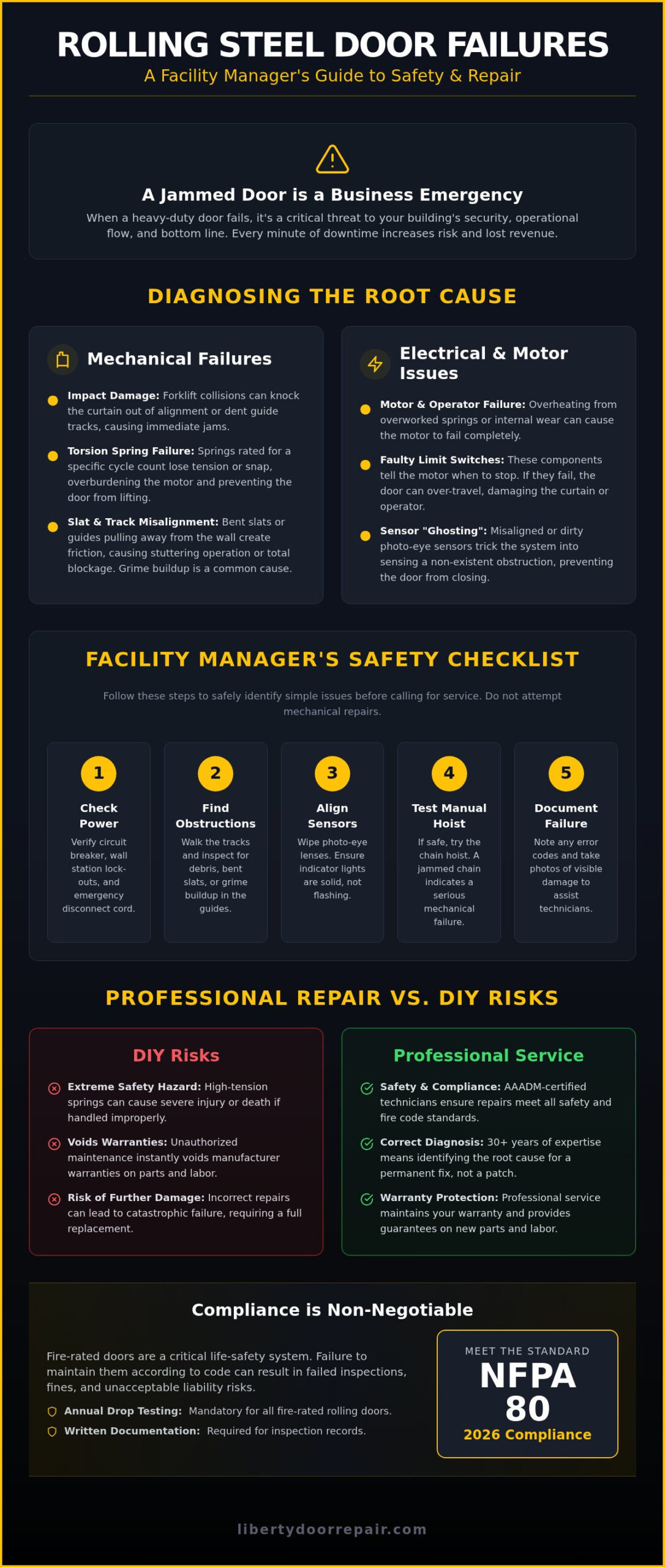
Identifying why your door failed is the first step toward a permanent fix. In heavy-duty commercial environments, these systems endure constant stress from daily operations. A malfunction usually stems from either mechanical wear or an electronic breakdown. Quick diagnosis prevents minor issues from turning into expensive, full-scale replacements. since 2015, our technicians have seen how local conditions, like Atlanta’s high humidity, accelerate track corrosion and grease buildup. Professional rolling steel door repair starts with a thorough inspection of the curtain, motor, and mounting hardware.
Impact damage is a frequent culprit at busy loading docks. A single forklift collision can knock the entire curtain out of alignment or dent the guides. Beyond accidents, torsion springs are the most common mechanical failure point. These components are rated for a specific number of cycles. Once they reach that limit, they lose tension or snap entirely. Without proper spring tension, your motor works twice as hard, leading to premature operator failure. Understanding Roller shutter components helps facility managers spot these issues before a total shutdown occurs.
Slat and Track Misalignment
Bent slats are more than an eyesore; they’re a mechanical hazard. If a single slat is crimped or twisted, it will jam inside the guides as the curtain rolls up. This creates a ripple effect that can damage the internal barrel assembly. You should also watch for guides pulling away from the wall mount. This often happens in older Atlanta warehouses where masonry or steel supports have shifted over time. Regular cleaning of the tracks is essential. Built-up grime and old grease create friction that forces the door to stutter or stop mid-cycle.
Motor and Operator Issues
Modern smart systems introduce a different set of challenges. Motor malfunctions often start with failing limit switches. These small components tell the motor when to stop. If they fail, the door may over-travel, causing the curtain to wrap too tightly or crash into the floor. Power surges are another “invisible” threat in the Metro area. A sudden spike can fry sensitive control boards, leaving your door frozen. If your door refuses to close despite a clear path, you’re likely dealing with “ghosting” sensors. Misaligned photo eyes or dust on the lenses can trick the system into sensing an obstruction that isn’t there. Reliable rolling steel door repair requires a technician who understands these complex electrical diagnostics.
Step-by-Step Troubleshooting for Facility Managers
When a heavy entrance fails, your priority is to restore operation without compromising safety. Many issues that look like total system failures are actually simple fixes. Before you call for rolling steel door repair, follow these steps to narrow down the cause. This process helps you determine if the problem is a minor electrical glitch or a major mechanical breakdown.
- Step 1: Check power and disconnects. Look at the circuit breaker first. Ensure the wall station hasn’t been locked out. Verify that the emergency manual disconnect (usually a red pull cord) hasn’t been engaged by mistake.
- Step 2: Search for physical obstructions. Walk the length of the track. Even a small piece of shipping debris or a bent slat can trigger a safety stop. Check for buildup in the guides that might be causing excessive friction.
- Step 3: Clean and align sensors. Photo-eyes are sensitive to dust and vibration. Wipe the lenses with a soft cloth and ensure the indicator lights are solid, not flashing. If the safety edge at the bottom of the door is damaged, the system will refuse to close.
- Step 4: Test the manual chain hoist. Pull the release and try to operate the door by hand. If the door moves smoothly, your motor or control board is likely the issue. If the chain is jammed, you have a mechanical failure in the barrel or springs.
- Step 5: Document the failure. Take clear photos of any damaged slats or error codes on the motor display. Note exactly when the failure occurred and what the door was doing at the time.
If the manual chain won’t budge or you see visible damage to the hardware, it’s time to contact Liberty Door Repair for a professional assessment. Our technicians use this documentation to arrive prepared with the right parts for your specific system.
Initial Safety Checks
Listen for red flag sounds. Grinding, screeching, or a loud “bang” usually indicates a snapped spring or a stripped gear. Never stand under a door that is stuck in a partially open position. If you have fire-rated doors, check the thermal links and release devices. An accidental trigger of the fire release will drop the door and may require a professional reset to meet compliance standards.
When to Stop and Call a Pro
Know your limits to avoid serious injury. High-tension torsion springs store enough energy to be lethal; never attempt to tighten or remove them yourself. Most industrial operators run on high-voltage 480V power, which poses a severe electrocution risk to untrained staff. A minor track issue becomes a structural hazard the moment the guide rail pulls away from the wall or the curtain begins to telescope within the head assembly. Professional rolling steel door repair is the only way to ensure these high-risk components are handled safely.
2026 Compliance: NFPA 80 and Fire-Rated Door Standards
Fire safety compliance is a moving target for Atlanta business owners. The National Fire Protection Association recently published the 2025 edition of NFPA 80, yet most local jurisdictions currently enforce the 2022 standards. Staying ahead of these updates is critical for your building’s safety and legal standing. According to the U.S. Fire Administration, commercial building fires increased by 19% between 2014 and 2023. This data highlights why functional fire doors are not optional. If your fire-rated system fails to close during an emergency, the liability risks for your Georgia business are immense. Professional rolling steel door repair ensures your barriers operate exactly when the alarm sounds.
Modern rolling steel doors now integrate directly with your building’s fire alarm and smoke detection systems. When the alarm triggers, the door must release and close automatically to contain the threat. If the door hangs or moves too slowly, it voids your fire rating. NFPA 80 requires that the average closing speed for these doors stays between 6 and 24 inches per second. Anything outside this range requires immediate mechanical adjustment to maintain compliance.
The Annual Drop-Test Requirement
You must perform a mandatory drop test every year. This is a two-step verification process. A technician drops the door once to verify it closes completely and latches. They then reset the door and drop it a second time to ensure the automatic-closing device is fully functional. Common failures during these inspections include painted-over labels, excessive gaps between the curtain and the frame, or a failed reset mechanism. Our specialized fire door services provide the written documentation required by the Authority Having Jurisdiction (AHJ). You must keep the initial acceptance test report for the life of the door and maintain annual records for at least three years.
Retrofitting for Modern Safety
Older facilities often struggle to meet 2026 standards because of outdated hardware. We recommend upgrading older units with auto-resetting fire governors. These devices allow your staff to reset the door easily after a test or a false alarm without specialized tools. You also need to ensure that smoke gaskets and seals remain intact. Heat and age cause these materials to degrade, which lets toxic smoke bypass the barrier. Investing in these upgrades during a standard rolling steel door repair call often leads to better insurance premium stability. Insurance providers view documented, proactive maintenance as a sign of reduced risk, which can protect your bottom line over the long term.
Professional Repair vs. DIY: The Hidden Risks
Attempting to fix a heavy industrial entrance without specialized training is a gamble with your facility’s safety. While a “quick fix” might seem cost-effective in the moment, the reality is that amateur rolling steel door repair often leads to catastrophic failure. These systems are massive, complex machines. A single mistake during a manual adjustment can trigger a sudden chain reaction. It could destroy the motor or cause the entire curtain to drop without warning. These are risks no business should take, especially when your operational uptime is on the line.
The “warranty trap” is another significant concern for facility managers. Most manufacturers require certified technicians for all maintenance and repairs. If you attempt a DIY fix, you likely void your equipment’s warranty immediately. This means a small saving today could result in a massive replacement bill next month when the manufacturer refuses to cover a failed barrel or operator. Professional rolling steel door repair offers a much higher long-term ROI. A same-day professional fix prevents the cycle of recurring failures that plagues facilities relying on uncertified internal maintenance staff.
The Dangers of Torsion Springs
Torsion springs are the most lethal components of any rolling assembly. They store thousands of pounds of energy to balance the weight of the steel curtain. Safely adjusting or replacing them requires specialized winding cones and hardened steel bars. Without these specific tools, a spring can unwind instantly with enough force to cause severe injury or death. Industry reports consistently show that warehouse accidents often stem from improper door maintenance performed by unqualified personnel. Our technicians have served North Georgia businesses since 2015, working with handle these high-tension components safely.
Operational Integrity
Professional service ensures your system remains in peak condition and maintains its structural integrity. Using genuine door parts & replacements is the only way to guarantee OEM compatibility and long-term reliability. Many DIY attempts involve hardware store sprays, but these are not a substitute for industrial-grade lubrication. Standard sprays actually attract dust and grit that grinds down your gears over time. We also ensure every repair meets current ADA and AAADM accessibility standards to keep your building inclusive and compliant.
Don’t risk your staff’s safety or your building’s security on a temporary patch. Contact the experts at Liberty Door Repair to secure your facility with a professional, guaranteed solution today.
Rolling Steel Door Solutions in Metro Atlanta
Atlanta’s commercial landscape moves at a relentless pace. You need a service partner that understands the specific demands of local industrial parks and retail centers. Liberty Door Repair has served North Georgia businesses since 2015. We don’t just provide a mechanical fix; we focus on full security restoration. Our team understands the pressure of a blocked loading dock. Professional rolling steel door repair is essential for maintaining your building’s perimeter and keeping your daily operations on schedule. We position ourselves as the urgent, expert responder for businesses that can’t afford a single hour of downtime.
Our AAADM-certified technicians specialize in high-traffic retail and industrial sites. These certifications prove our mastery of complex automatic and fire-rated systems. We arrive prepared with the specialized tools needed for heavy-duty torsion springs and motor diagnostics. Whether you’re dealing with a jammed curtain or a failed electronic sensor, we deliver a reliable solution that lasts. Our decades of local presence mean we’ve likely worked on a system similar to yours right here in the Metro area.
Our Metro Atlanta Service Area
We provide priority service for commercial hubs across the region. Our technicians are frequently dispatched to Marietta, Roswell, and Norcross to handle urgent warehouse malfunctions. We have extensive experience managing commercial door repair in Atlanta for major retailers who need to keep their storefronts accessible and safe. From the industrial parks in Sandy Springs to the logistics centers in Brookhaven, we understand the unique structural requirements of local buildings. This localized expertise ensures we meet the specific expectations of the Atlanta fire marshal and building inspectors.
Scheduling Your Inspection or Repair
Getting your facility back to peak performance is a straightforward process. If your current system is beyond its mechanical lifecycle, we can provide a detailed commercial door replacement quote that includes the latest 2026 technology. However, we often find that preventative maintenance is the best defense against total door failure. Regular inspections identify worn slats and fatigued springs before they snap. This proactive approach saves you from the stress and high costs of emergency repairs. Don’t wait for your security to be compromised by a failing entrance. Contact Liberty Door Repair today for immediate, professional rolling steel door repair and ensure your business stays moving.
Secure Your Perimeter and Restore Operational Flow
Maintaining a functional and compliant entrance is vital for your building’s safety. You now understand how identifying mechanical root causes early saves time and how adhering to 2026 fire safety codes protects your business from legal liability. Handling high-tension assemblies is risky work that requires specialized expertise to avoid severe injury or permanent equipment damage. Choosing a professional rolling steel door repair ensures your facility remains secure and your operational flow is restored without delay.
Liberty Door Repair has served North Georgia businesses since 2015rea. Our AAADM-certified technicians understand the urgency of a blocked loading dock and provide a rapid response for commercial sites across Atlanta. Don’t let a mechanical failure stall your revenue or lead to a failed fire inspection. Secure Your Business with Expert Rolling Steel Door Repair today. Your facility is in good hands, and you’ll be back to full capacity immediately.
Frequently Asked Questions
How much does it cost to repair a rolling steel door in Atlanta?
Repair costs depend on the specific parts required and the total labor time needed for the fix. Factors like the door’s size, the extent of the damage, and the complexity of the diagnostic process all influence the final price. You should contact a local specialist for a detailed quote that reflects the current parts market and technical requirements for your specific system.
Can I replace just one slat in my rolling door curtain?
You can replace individual slats if the rest of the curtain remains structurally sound. Technicians slide the damaged slat out of the guides and insert a matching OEM replacement into the assembly. This is a common and cost-effective solution for minor impact damage that doesn’t require a full curtain replacement.
How often do rolling steel fire doors need to be drop-tested?
Rolling steel fire doors must undergo a mandatory drop test once every year to remain compliant with NFPA 80 standards. This annual test verifies that the automatic closing mechanism and fire governor will function perfectly during an emergency. You are required to keep written documentation of these inspections for at least three years for the local fire marshal’s review.
What is the difference between a rolling service door and a fire door?
A rolling service door is designed for daily security, weather protection, and access control in commercial buildings. A fire door is a specialized life-safety device equipped with automatic closing mechanisms and fire-rated components that contain smoke and flames. Because of these complex safety features, rolling steel door repair for fire-rated units requires specific technical knowledge and compliance testing.
Why is my rolling steel door making a loud grinding noise?
Loud grinding usually indicates that the metal curtain is rubbing against the guides due to misalignment or a lack of industrial-grade lubrication. It can also be a sign that the internal bearings or the motor’s drive chain are beginning to fail. You should stop using the door immediately to prevent a total mechanical jam or a costly motor burnout.
Does Liberty Door Repair offer service in Alpharetta or Marietta?
We provide expert door services to commercial clients throughout Metro Atlanta, including major hubs like Alpharetta, Marietta, and Roswell. Our technicians are familiar with the specific needs of local industrial parks and retail centers in these areas. We prioritize commercial service calls to help local businesses restore their security and operational flow as quickly as possible.
Are your technicians certified to work on automatic rolling grilles?
Our technicians are AAADM-certified to handle a wide range of automatic commercial systems, including rolling grilles and security shutters. This certification ensures that our team has the specialized training to diagnose electronic failures and maintain compliance with accessibility standards. We focus on professional rolling steel door repair that meets the highest industry qualifications for safety and reliability.
How long does a typical spring replacement take for a commercial door?
A standard torsion spring replacement usually takes between two and four hours to complete. The duration depends on the accessibility of the head assembly and the physical size of the door curtain. Since these springs are under extreme tension, the process requires specialized winding bars and professional expertise to ensure the door is balanced correctly and safely.