

Did you know that national data indicates over 75% of fire doors fail to meet NFPA 80 standards during inspections? For facility managers in Metro Atlanta, this statistic represents a serious risk to both occupant safety and your bottom line. As of January 1, 2026, Georgia has adopted the 2024 editions of the International Building Code and International Fire Code. This change means that securing expert fire door recertification services georgia is now a critical priority to ensure your building remains compliant with the State Fire Marshal’s latest requirements.
We understand that keeping up with complex NFPA 80 regulations can feel overwhelming. It’s stressful to worry about a surprise inspection, especially when you need a partner who can handle both the technical inspection and the necessary repairs. This guide simplifies the process by outlining exactly what you need for a successful recertification. We will walk you through the mandatory 13-point checklist, the impact of the new Georgia fire incident reporting systems, and how to maintain the detailed documentation required to protect your facility and its occupants.
Key Takeaways
- Master the updated 2026 Georgia building and fire codes to ensure your facility remains compliant with NFPA 80 annual inspection mandates.
- Partner with professional fire door recertification services georgia to complete the mandatory 13-point checklist and verify critical UL or FM safety labels.
- Identify common failure points like excessive clearances and improper hardware that frequently lead to failed fire marshal inspections in Metro Atlanta.
- Establish a robust documentation system and on-site inspection schedule to meet the rigorous reporting standards required by the State Fire Marshal.
- Implement an efficient “inspect and repair” strategy to resolve deficiencies immediately and maintain functional, code-compliant door assemblies.
Fire Door Recertification in Georgia: Meeting NFPA 80 Standards
Fire door recertification is the formal verification that a fire-rated door assembly meets the strict standards of NFPA 80. It’s more than a quick visual check. It’s a comprehensive evaluation of the door, frame, and all hardware components to ensure they function as intended during a fire. In Georgia, this process is a legal mandate. Commercial buildings must undergo these inspections every year to ensure life safety systems remain fully operational.
The Georgia State Fire Marshal’s Office serves as the primary Authority Having Jurisdiction (AHJ) for the entire state. As of January 1, 2026, Georgia has adopted the 2024 editions of the International Building Code (IBC) and International Fire Code (IFC). This update means your facility in Metro Atlanta must comply with the newest safety benchmarks. Local fire marshals in Atlanta and surrounding suburbs are tasked with enforcing these rules. If they find non-compliant doors during a walkthrough, the consequences are severe. You may face significant fines, stop-work orders, or legal penalties that disrupt your business operations.
Failing to maintain your Fire Door assemblies also creates massive insurance liabilities. If a fire occurs and your documentation is out of date, your carrier may deny your claim. They often view a lack of recertification as a breach of your safety obligations. Professional fire door recertification services georgia help you avoid these risks by providing the expert oversight and documentation required by law.
Why NFPA 80 Compliance Matters for Your Business
Fire-rated openings are your building’s primary defense against smoke and fire spread. Their core purpose is smoke containment. A door that doesn’t latch or has excessive gaps allows toxic fumes to bypass safety zones. This puts lives at risk. Local fire marshals in cities like Marietta and Atlanta prioritize these inspections because they directly impact occupant survival rates. Proper compliance provides a critical liability shift. By securing a passing report, you demonstrate that your facility has met all state-mandated safety protocols.
The Difference Between Inspection and Recertification
It’s vital to understand that an inspection and recertification are not the same thing. An inspection identifies problems like missing labels, damaged frames, or faulty closers. Recertification is the final step that confirms those problems are solved. A list of deficiencies won’t satisfy the AHJ. You need a formal document stating the door is fully compliant. Using qualified technicians ensures your documentation is accurate and legally defensible. Recertification proves your doors don’t just exist; they work.
The 13-Point Fire Door Inspection and Recertification Process
Compliance isn’t a guess; it’s a rigorous 13-point technical evaluation. When you hire fire door recertification services georgia, the inspector must verify every mechanical and structural aspect of the opening. This protocol is dictated by NFPA 80 standards to ensure the assembly performs under fire conditions. The process begins with a visual check for damage and concludes with functional tests that prove the door can save lives.
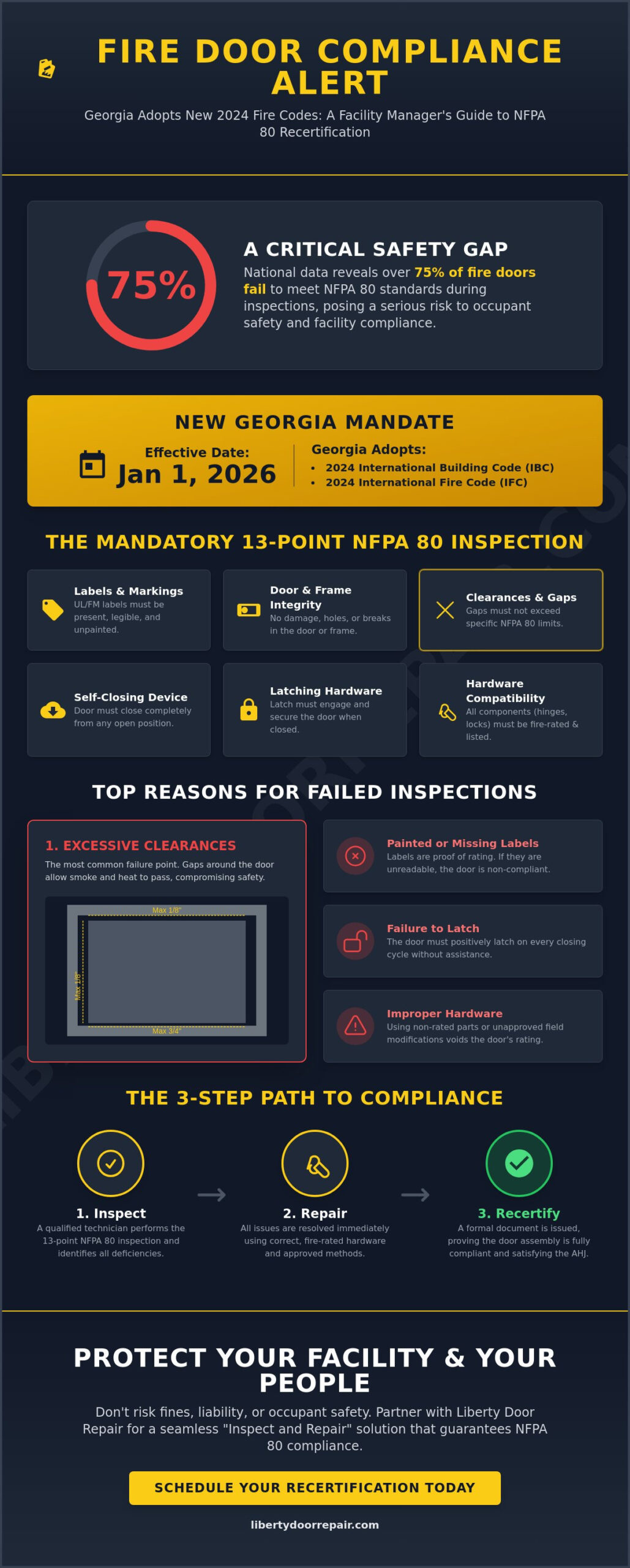
A critical part of this process involves measuring clearances. Gaps between the door and the frame cannot exceed 1/8 inch at the head and jambs for wood doors, or 1/8 inch plus or minus 1/16 inch for steel doors. For the bottom of the door, the clearance must not exceed 3/4 inch above the floor or sill. If these measurements are off, the door won’t effectively block smoke or heat. Functional testing is equally vital. The door must self-close and self-latch from any position. If a latch doesn’t click into place every single time, the door fails the recertification test. Securing professional fire door recertification services georgia provides the peace of mind that your facility meets these stringent benchmarks.
Labeling and Identification Requirements
Every fire door must have a legible UL or FM label. If a label is missing or has been painted over, the door technically loses its fire rating. This is a common point of failure. In these cases, a “qualified person” must perform field labeling. This involves verifying the door’s construction and applying a new, permanent certification tag. Our fire door services include comprehensive label verification to ensure your AHJ sees the necessary proof of rating. If you are unsure about your door’s current status, scheduling a professional inspection and repair walkthrough is the best first step.
Hardware and Component Verification
The inspection also covers every piece of hardware attached to the door. Panic hardware and fire exit bolts must operate with minimal force. We check for non-compliant field modifications, such as unsealed holes from previous hardware installations or the use of improper hinges. Any hole larger than one inch must be filled with steel bolts or fire-rated caulk. Finally, we verify that smoke seals and gaskets are intact. These components must be properly rated and free of tears to prevent smoke migration during an emergency. Every component must work in harmony to achieve a passing recertification report.
Why Fire Doors Fail Recertification: Common Deficiencies
Most fire doors in Georgia fail for simple, preventable reasons. Excessive gaps are the most common deficiency found during inspections. If the space between the door and the frame exceeds the NFPA 80 limits, your facility won’t pass. Heat causes materials to expand during a fire. If clearances are incorrect, the door might jam or allow toxic smoke to bypass the opening. Using professional fire door recertification services georgia allows you to catch these issues before the Fire Marshal arrives. It’s much easier to adjust a door now than to deal with a failed inspection report later.
Hardware choice also plays a major role in failure. Installing non-rated kick plates or residential-grade closers on a fire-rated assembly is a major violation. In busy Metro Atlanta corridors, high-traffic storefronts often suffer from structural misalignment. Constant use leads to sagging hinges and worn pivots. This shifts the door’s position, creating illegal clearances. Georgia’s humidity and temperature swings can also cause frames to swell or settle, further complicating the fit. Additionally, many employees prop doors open with wooden wedges or disable closing devices for convenience. These actions create a direct path for fire and smoke, rendering the door useless in an emergency.
The Dangers of Improper Field Modifications
Drilling holes into a fire door to install unrated hardware or security cameras voids the fire rating immediately. You can’t just slap on any accessory. If you have abandoned holes from old hardware, you must seal them properly to maintain compliance. We use fire-rated steel through-bolts or specific fire-caulk to restore the door’s integrity. Always insist on OEM parts during commercial door repair atlanta. This ensures every component matches the door’s original certification and preserves the manufacturer’s warranty. Proper parts are essential for a passing grade.
Addressing Closing and Latching Failures
A fire door that doesn’t latch is effectively just a standard door. It won’t stay closed against the pressure and air currents created during a fire. Common culprits include leaking hydraulic closers, worn pivots, or frames that have settled over time. It’s a common pain point for facility managers who fear they need a full replacement. However, you don’t always need a new door. Professional adjustments can often realign the assembly and restore proper latching. Reliable fire door recertification services georgia provide the technical expertise to fix these mechanical failures on the spot. This approach saves you money and ensures your doors are functional, not just present.
Managing Fire Safety Documentation for Metro Atlanta Facilities
Documentation is your primary legal shield during a fire marshal walkthrough. It isn’t enough to simply have functional doors; you must prove they have been maintained according to state law. Effective January 1, 2026, the Georgia State Fire Marshal’s Office adopted the National Emergency Reporting Incident System (NERIS). This transition highlights the importance of standardized, digital record-keeping. Professional fire door recertification services georgia provide the itemized, technical reports that local authorities now expect to see in their digital databases. Without this paper trail, your facility is technically non-compliant, regardless of the doors’ physical condition.
NFPA 80 mandates that a “Fire Door Inspection Schedule” be maintained on-site and made available to the Authority Having Jurisdiction (AHJ). This log must include the specific location of each door, the date of inspection, and the name of the qualified person who performed the work. You should keep these records for at least three years to satisfy both fire code requirements and insurance renewal audits. Digital reporting simplifies this by allowing you to pull up compliance history on a tablet or phone the moment an inspector arrives. Clear records demonstrate a culture of safety and professionalism that fire marshals appreciate.
Working with the Local Authority Having Jurisdiction (AHJ)
Facility managers in Alpharetta and Kennesaw often face rigorous inspection schedules. When the AHJ arrives, presenting your recertification paperwork immediately shows you are proactive. This transparency often leads to a smoother inspection process. If the inspector identifies a deficiency, they typically grant a short grace period to complete repairs. Having a documented history of regular service proves you aren’t neglecting the hardware. Quick action during this window is essential to avoid formal citations or financial penalties.
Creating a Preventative Maintenance Plan
A preventative maintenance plan is the best way to avoid the stress of a failed inspection. Quarterly self-checks allow your team to spot issues like propped-open doors or leaking hydraulic closers before they become code violations. Our commercial door services help businesses in Cumming and throughout Metro Atlanta stay ahead of wear and tear. Train your staff to report any latching or closing problems immediately. A minor adjustment today prevents a costly recertification failure tomorrow. Don’t wait for an official notice; contact us to organize your compliance documentation and schedule a professional walkthrough today.
Professional Fire Door Recertification by Liberty Door Repair
Liberty Door Repair brings over 30 years of specialized experience to the Metro Atlanta business community. We understand that fire safety isn’t just a technical checkbox; it’s a fundamental part of your property’s security and liability management. Our team provides expert fire door recertification services georgia for facilities ranging from small retail offices to large industrial complexes. We maintain a strong local presence in cities like Decatur, Lawrenceville, and Woodstock. This geographical focus ensures we can reach your site quickly when compliance deadlines loom. Our long-standing history in Georgia means we’ve seen every type of door failure and know exactly how to resolve them to meet the State Fire Marshal’s expectations.
Our ‘Inspect and Repair’ approach sets us apart from many inspection-only firms. Most services will hand you a list of failures and leave you to find another contractor for the fixes. This creates unnecessary facility downtime. It also leaves your building vulnerable while you wait for a second service call. We solve this problem by deploying certified technicians who are equipped to perform on-site repairs. Whether it’s adjusting a sagging closer or replacing a non-rated hinge, we aim to bring your doors into compliance during our initial visit. This efficient model ensures your fire door recertification services georgia result in a passing report, not just a list of expensive problems. We value effectiveness and speed because we know your business can’t afford to wait.
Comprehensive Commercial Door Solutions
Our expertise spans the full spectrum of fire-rated systems. We handle everything from commercial door replacement for severely damaged units to precision hardware fixes that restore a door’s integrity. Our technicians are highly skilled in working with hollow metal, steel, and wood fire-rated door assemblies. Local businesses trust Liberty Door Repair because we prioritize urgent security and safety needs. We don’t just look at the door; we look at the entire opening. We ensure every component, from the frame to the latching hardware, is solid and secure. Our decades of presence in the region have built a reputation for dependable expertise that facility managers rely on year after year.
Schedule Your Georgia Fire Door Inspection Today
Getting your annual recertification scheduled is a simple, direct process. When you reach out, we provide a clear path to compliance starting with a professional walkthrough of your property. During the visit, our technician will perform the mandatory NFPA 80 tests. They provide immediate, direct feedback on any deficiencies found. You won’t be left guessing about your compliance status or what steps to take next. Once the inspection and any necessary repairs are finished, we provide the formal, detailed documentation required by the Fire Marshal. Take the stress out of your 2026 fire code audit. Contact Liberty Door Repair for your fire door recertification and ensure your facility is fully protected today.
Secure Your Facility with Reliable Fire Door Compliance
The 2024 IBC and IFC updates have shifted the landscape for Georgia facility managers. Maintaining NFPA 80 standards is a critical legal requirement that protects both your occupants and your business assets. You now understand that meticulous documentation and precise clearances are the keys to a successful fire marshal walkthrough. Our fire door recertification services georgia simplify this complex process by combining professional inspections with immediate, on-site repairs.
Liberty Door Repair provides 30+ years of local experience and AAADM certified technicians for every safety project. We serve all of Metro Atlanta and the surrounding suburbs with a focus on technical accuracy and speed. Don’t let a failed inspection or missing documentation put your facility at risk. Schedule Your Fire Door Recertification with Liberty Door Repair today. We are ready to help you achieve full compliance and total peace of mind.
Frequently Asked Questions
How often is fire door recertification required in Georgia?
Fire door recertification is required once every year according to NFPA 80 standards. This annual mandate ensures that safety components like closers and latches remain functional under stress. Georgia fire marshals verify these yearly records during their routine building inspections to confirm your facility stays compliant with the 2024 International Fire Code.
What happens if my fire door is missing its UL label?
If your fire door is missing its UL label, you must have it field-labeled by a qualified person to maintain its fire rating. A missing or painted-over tag is an automatic failure during an inspection. Professional fire door recertification services georgia include verifying these labels and coordinating the necessary field certification to ensure the Authority Having Jurisdiction (AHJ) accepts the door.
Can any locksmith perform a fire door recertification?
Not just any locksmith can perform this service; NFPA 80 requires a “qualified person” with specialized knowledge of fire-rated assemblies. This individual must understand the technical requirements for clearances, hardware, and smoke seals. Choosing a specialist with decades of industry experience ensures your documentation is legally defensible and meets the rigorous standards of the Georgia State Fire Marshal.
What are the maximum allowable gaps for a fire-rated door?
Maximum allowable gaps for wood doors are 1/8 inch at the head and jambs. For the bottom of the door, the clearance cannot exceed 3/4 inch above the floor or sill. Steel doors allow for 1/8 inch plus or minus 1/16 inch. These precise measurements are vital for smoke containment and prevent the door from jamming during a fire.
Is a fire door inspection the same as a fire door recertification?
A fire door inspection is the initial assessment that identifies deficiencies, while recertification is the formal confirmation that the door meets all code requirements. You can’t achieve recertification if the door has open violations. Our “inspect and repair” model streamlines this by fixing mechanical issues on the spot so you receive a passing report without multiple service visits.
Do all commercial doors in my building need to be fire-rated?
No, only doors located in fire-rated walls, stairwells, or specific hazardous areas must be fire-rated. These openings are designed to compartmentalize a building and protect exit paths. Your building’s life safety plans or a professional walkthrough can identify which specific doors require fire door recertification services georgia to satisfy local fire codes.
How long does a typical fire door recertification take for a medium-sized office?
The duration of a recertification visit depends on the number of fire-rated openings in your facility. For a medium-sized office with ten to fifteen doors, the process typically takes four to six hours. This includes the 13-point inspection for each door and the generation of the required technical documentation. Extensive repairs may extend this timeframe.
Can I repair a fire door myself to meet compliance standards?
You shouldn’t attempt to repair a fire door yourself because NFPA 80 mandates that all maintenance be performed by a qualified individual. Improper repairs, such as using unrated hardware or incorrect fasteners, will void the door’s fire rating. It’s safer to use professional technicians who understand the specific mechanical requirements needed to keep your facility compliant and your occupants protected.