

Imagine it’s the peak of a humid Georgia afternoon and your main entrance suddenly fails to shut. An automatic door not closing is more than a simple mechanical glitch. It’s an immediate security breach, a drain on your HVAC system, and a significant safety hazard for every customer walking through your frame. You likely feel the pressure of rising energy costs and the frustration of a building that’s left wide open to the elements. These issues demand a fast, professional resolution to keep your operations running smoothly.
We understand that a malfunctioning door stops your business in its tracks. In this guide, you’ll learn how to identify the specific triggers behind these failures, from simple sensor obstructions to complex electrical issues. We’ll show you which problems you can resolve in minutes and when it’s time to call an AAADM-certified technician to ensure compliance with the 2024 International Building Code Georgia Amendments. By the end of this article, you’ll have a clear path to securing your facility and restoring the reliable operation your Atlanta business depends on.
Key Takeaways
- Identify the primary mechanical and electronic reasons for an automatic door not closing to prevent immediate security risks and energy loss.
- Master a safe, five-step visual inspection routine to clear common obstructions and check “Hold Open” settings without specialized tools.
- Learn the critical safety risks of DIY motor adjustments and why AAADM certification is essential for Georgia building code compliance.
- Protect your hardware from Atlanta’s unique environmental challenges, including high humidity and heavy seasonal pollen that can interfere with sensors.
- Understand when to leverage 30 years of local expertise to restore the reliable operation and safety of your commercial entrance.
Why Your Automatic Door Won’t Close: Common Culprits
An automatic door not closing usually signals a safety override or a physical blockage. This “stuck open” phenomenon happens in both sliding and swinging doors when the system detects a potential hazard. While it’s a vital safety feature, it leaves your building vulnerable. Most issues stem from simple environmental triggers or overlooked settings that you can identify quickly.
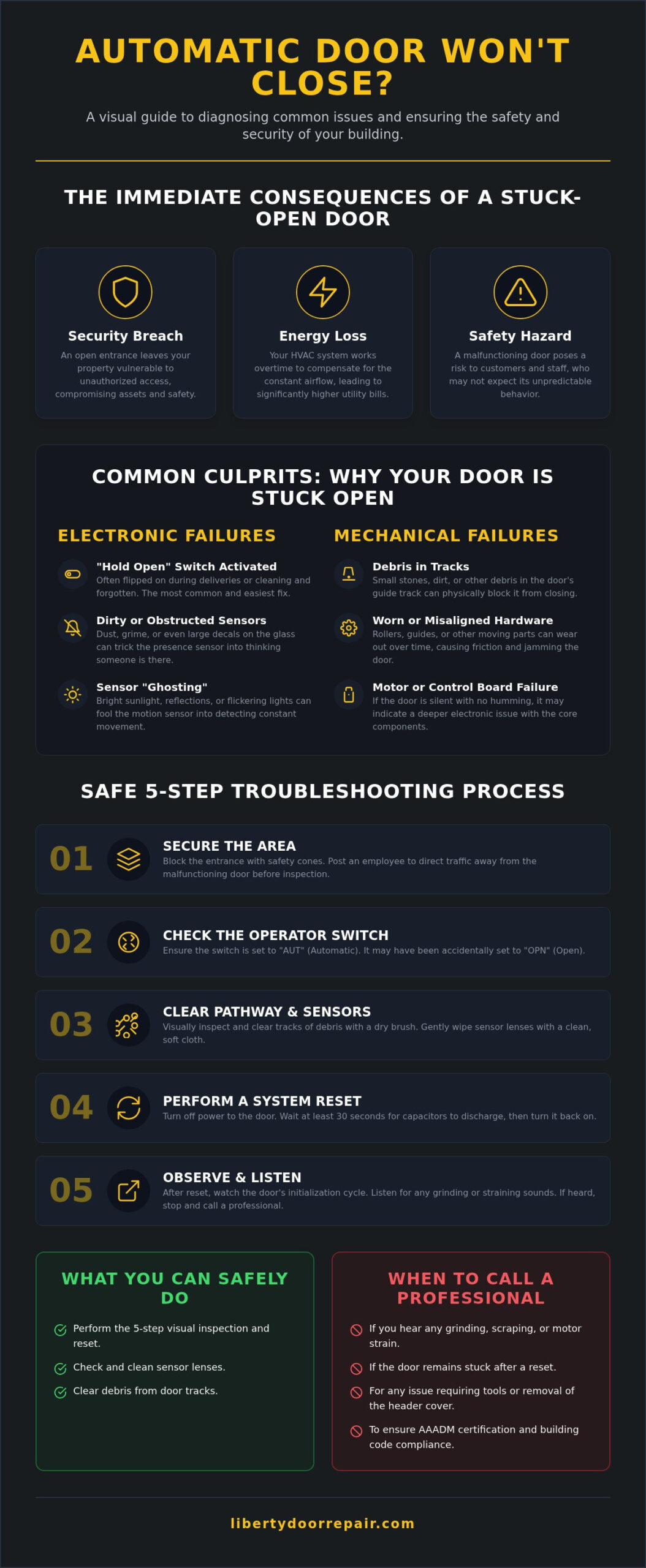
Check the “Hold Open” switch first. It’s the most common cause of a door staying open. This switch is often flipped during deliveries or cleaning and then forgotten. If the switch is set to “Auto” but the door remains still, you might be dealing with sensor ghosting. This happens when bright sunlight, reflections from glass, or flickering lights trick the sensor into detecting motion. The system assumes a person is approaching and holds the door open indefinitely.
Mechanical obstructions also play a major role. Debris in the threshold track, such as small stones or trash, can stop a sliding door from completing its cycle. In swinging doors, hardware in the upper track assembly can loosen over time and create physical resistance. Even a small piece of gravel can trigger the safety reverse, keeping the door in a perpetual open state.
Electronic vs. Mechanical Failures
You must determine if the motor is trying to work. Listen for a humming sound or look for slight movement. If the motor engages but the door doesn’t move, you likely have a mechanical failure. Worn-out rollers or a jammed track are common culprits. If the system is completely silent and idle, the issue is electronic. Modern control boards in 2026 systems are highly advanced but sensitive. A minor power surge can scramble the board’s logic, requiring a professional recalibration to restore the closing cycle.
The Role of Safety Sensors
Automatic doors rely on two sensor types: motion and presence. Motion sensors trigger the initial opening, while presence sensors ensure the door stays open if someone is standing in the way. A dirty lens is a frequent problem. Dust or grease on the sensor can look like an object to the system, preventing the door from closing. Sensor lockout is a safety protocol that prevents the door from detecting its own moving panels as an obstruction during the closing cycle.
5 Steps to Troubleshoot an Automatic Door Not Closing
Before you touch any hardware, secure the scene. An automatic door not closing creates a hazard for staff and visitors. Block the entrance with safety cones or have an employee direct traffic away from the opening. You don’t want the door to suddenly engage while you’re inspecting the threshold or standing in the swing path. Safety is the priority during any diagnostic attempt.
Check the operator switch settings once the area is clear. Most commercial headers have a small toggle or digital display with options like AUT (Automatic), OPN (Open), CLS (Closed), and OFF. Ensure the switch is set to “AUT.” If it’s accidentally flipped to “OPN,” the door will remain open indefinitely. If the setting is correct but the door is stuck, listen for mechanical grinding. If you hear metal-on-metal sounds, stop your troubleshooting immediately. Forcing a jammed door can burn out the motor, making automatic door services more expensive than a simple track alignment.
Clearing the Pathway and Tracks
Small stones, grit, or even salt buildup during rare Atlanta freezes can trigger a safety reversal. Inspect the guide tracks and threshold for any visible debris. Never use WD-40 or heavy grease on the tracks; these substances attract dirt and eventually jam the rollers. Use a dry brush or a vacuum to remove particulates instead. Also, look for “signage interference.” Large decals or loose “Push” signs on the door glass can hang into the sensor’s field of view, causing the system to stay open because it thinks an object is in the way.
Performing a System Reset
Perform a soft reset to clear the control board’s memory. Locate the power switch, usually found on the header or the side jamb. Flip the power off and follow the “30-second rule.” You must wait at least 30 seconds to allow the capacitors to discharge fully, which resets the logic board. Flip the power back on and let the door perform its initialization cycle. The door will move slowly at first to “learn” its stop points. If the door remains open after a reboot and a thorough cleaning of the sensors, the internal hardware likely requires a professional diagnostic to ensure it meets current safety standards.
Test the activation sensors as a final step. Stand at a distance and watch the sensor’s indicator light. If the light stays on without anyone nearby, the sensor is stuck in a “detect” state. This often happens if the lens is coated in Atlanta’s heavy seasonal pollen. Wipe the lens with a dry, lint-free cloth and check the operation again.
DIY Troubleshooting vs. Professional Repair: Knowing the Risks
Attempting a DIY fix for an automatic door not closing often leads to more than just a broken hinge. While clearing a track is safe, adjusting internal components like spring tension or motor torque requires specialized training. These systems operate under significant mechanical pressure. A single mistake during a torque adjustment can cause the door to slam with dangerous force, posing a severe risk to anyone in the threshold. In Georgia, business owners face strict liability standards regarding public safety, making amateur repairs a gamble with your company’s future.
Consider the long-term financial impact of an uncertified repair. A professional service call is a minor expense compared to a potential injury lawsuit or a fire code violation. When you choose Professional Automatic Door Services, you’re investing in documented safety. Certified technicians ensure your hardware meets the ANSI/BHMA A156.19-2026 standard, which is the current benchmark for power-operated doors. This documentation is your first line of defense if an accident ever occurs on your property.
When to Step Away and Call an Expert
Stop all troubleshooting immediately if you notice any of these critical red flags:
- Grinding or screeching: This indicates internal gear failure or a motor that’s about to seize.
- Burning smells: The scent of ozone or burning electronics suggests a short circuit in the control board.
- Erratic movement: If the door lunges forward or closes with excessive force, the safety logic is compromised.
- Fire alarm issues: Any failure in the system’s ability to integrate with your building’s fire alarm or emergency breakout must be handled by a specialist.
The AAADM Certification Advantage
AAADM certification is the gold standard for automatic door safety. An AAADM-certified technician performs a rigorous multi-point inspection that a general handyman simply isn’t equipped to handle. This includes testing sensor range, closing speed, and entrapment protection to ensure full compliance with ADA (Americans with Disabilities Act) standards. These inspections are vital for maintaining your business’s insurance standing. Most commercial policies require that specialized hardware, like automatic sliders, be maintained by certified professionals to keep coverage active. Using an expert protects your customers, your employees, and your bottom line.
Preventing Automatic Door Failures in Metro Atlanta
Preventative maintenance is the most effective way to avoid the crisis of an automatic door not closing during business hours. In a high-traffic environment, small alignment shifts or sensor drifts happen gradually. If you don’t catch these minor changes, they eventually lead to a total system lockout. Establishing a consistent oversight protocol ensures your entrance remains safe, secure, and energy-efficient year-round.
Daily inspections are your first line of defense against unexpected downtime. Facility managers should designate a staff member to perform a walk-through every morning before the building opens to the public. This routine identifies physical wear and electronic glitches before they escalate into costly repairs. For comprehensive protection, most businesses benefit from a structured Commercial Door Repair Atlanta maintenance plan that includes professional recalibration of all safety systems.
Daily Safety Checklists for Businesses
Start by testing the “electronic eye” for blind spots. Walk slowly through the doorway at different angles to ensure the sensors detect movement across the entire threshold. Observe the closing cycle carefully. The door should move smoothly without hesitating or closing with excessive force. Finally, check the emergency “break-out” function. Ensure that no seasonal displays, floor mats, or security hardware obstruct the door panels from swinging outward in the event of a fire or power failure.
Managing Environmental Factors
Atlanta’s unique climate poses specific challenges for sensitive door electronics. High humidity levels can cause condensation to build up inside sensor housings, leading to “ghosting” or signal interference. During peak season, heavy pollen counts in areas like Suwanee or Decatur can coat sensor lenses, tricking the system into thinking an object is permanently in the doorway. This is a frequent cause of an automatic door not closing properly.
Direct sunlight and glare also impact performance. Bright afternoon sun hitting a glass storefront can blind infrared sensors, causing the door to stay open as a safety precaution. High-rise buildings in Metro Atlanta often face “wind-stack” issues, where air pressure differences between the interior and exterior prevent the door from latching correctly. Regular cleaning of external sensors with a lint-free cloth and adjusting the motor’s closing force can mitigate these local environmental stressors.
Don’t wait for a total system failure to address your building’s security. If you notice sluggish performance or sensor inconsistencies, contact our AAADM-certified specialists to schedule a professional safety inspection today.
Expert Automatic Door Repair in Metro Atlanta
Liberty Door Repair has anchored the Metro Atlanta business community for over 30 years. We specialize in resolving the immediate security risks and energy losses associated with an automatic door not closing. From the corporate corridors of Alpharetta and Roswell to the bustling retail centers of Marietta, our technicians bring specialized expertise to every job site. We don’t just patch problems; we provide long-term stability for ADA-compliant and high-security automatic systems. If your current hardware has reached the end of its operational lifespan, our Commercial Door Replacement guide offers a clear roadmap for modernizing your facility with the latest safety standards.
Why Local Businesses Trust Liberty Door Repair
Local businesses trust us because we understand the urgency of a failed entrance. We maintain a rapid response presence for clients in Canton, Woodstock, and Kennesaw to ensure your building isn’t left vulnerable to the elements or unauthorized access. Our team is fully trained in the latest 2026 access control integrations. This ensures your automatic doors sync perfectly with modern smartphone-based security software and remote monitoring systems. We carry a comprehensive parts inventory on every service truck. This allows us to perform immediate on-site repairs, often resolving complex issues in a single visit. We value your time and prioritize getting your entrance back in service without unnecessary delays.
Schedule Your AAADM-Certified Inspection Today
An automatic door not closing requires more than a quick visual check. It demands a technical diagnostic by an AAADM-certified specialist who understands the nuances of local building codes. We use advanced diagnostic tools to pinpoint failures in sensitive sensor arrays and motor controllers that a standard handyman might miss. Our commitment to keeping your Metro Atlanta storefront secure is backed by 30 years of hands-on experience in the field. We verify every safety zone and closing force setting to ensure your entrance meets the current ANSI/BHMA standards. Don’t let a minor electronic glitch become a major security breach for your business. Take the first step toward a safer, more efficient building by booking a professional evaluation today.
Contact Liberty Door Repair for Expert Service and experience the reliability that comes with three decades of local mastery across Metro Atlanta.
Restore Your Building’s Security and Efficiency Today
An automatic door not closing is an immediate priority that impacts your building’s safety, energy costs, and customer experience. You now understand the difference between a simple sensor obstruction and a complex mechanical failure that requires specialized intervention. Proactive maintenance and professional recalibration are the only ways to ensure your facility remains compliant with current safety standards and protected from Atlanta’s high humidity and pollen. Don’t leave your entrance vulnerable to further damage or security breaches.
Liberty Door Repair provides the dependable expertise you need to resolve these issues quickly. With 30+ years of local experience serving 19+ Metro Atlanta cities, we understand the unique needs of Georgia business owners. Our AAADM-certified technicians are ready to restore your system’s reliability and performance. Take the next step toward a secure and accessible storefront. Get Expert Automatic Door Repair in Atlanta and let our specialists handle the technical details while you focus on your business. You can trust our team to deliver professional results every time.
Frequently Asked Questions
Why is my automatic sliding door staying open?
Most sliding doors stay open because the safety sensor detects an obstruction or the “Hold Open” switch is engaged. It might be as simple as a misplaced floor mat or a dirty lens. If the door remains open without a visible cause, the system may be stuck in a safety lockout mode. This prevents the door from closing to protect pedestrians until the error is cleared by a professional.
Can I manually close an automatic door that is stuck?
You can often manually close the door by gently pushing the panels, provided the “break-out” function is active and the power is off. However, you should never force a door that feels physically jammed or makes grinding noises. Forcing the door can damage the drive belt or motor gears. If the door won’t move easily, keep the area clear and call a technician to avoid making the mechanical failure worse.
How do I reset the sensors on my automatic door?
Resetting the sensors usually involves a full power cycle of the door operator. Locate the power switch on the header or side jamb and turn it off for at least 30 seconds. This allows the internal capacitors to discharge fully. When you turn the power back on, stay clear of the sensors while the door performs its initialization. The door will slowly cycle to recalibrate its opening and closing limits.
Is it safe to use WD-40 on automatic door tracks?
No, you should never use WD-40 or any oil-based lubricants on automatic door tracks. These substances attract dust, grit, and Atlanta’s seasonal pollen, which creates a sticky paste that eventually jams the rollers. Clean the tracks using a dry brush or a vacuum to remove debris. If the door is noisy or sluggish, the rollers likely need professional replacement rather than temporary lubrication that will cause more harm.
How much does it cost to repair an automatic door in Atlanta?
Repair costs in Metro Atlanta vary based on the specific hardware failure and the parts required for the fix. Factors like the age of the system, the type of sensors, and whether the motor needs replacement influence the final invoice. While some minor adjustments are affordable, complex electronic failures require specialized tools. We recommend scheduling a professional safety inspection to receive an accurate diagnostic and a detailed estimate for your specific entrance.
What are the signs that my automatic door motor is failing?
Common signs of a failing motor include sluggish movement, unusual humming sounds, or a burning smell coming from the header. If your door moves at inconsistent speeds or fails to complete a full cycle, the motor may be overheating or losing torque. These symptoms often precede a total system failure. Addressing these red flags early can prevent a situation where you find your automatic door not closing during a busy shift.
Does my business need an AAADM-certified technician for repairs?
Yes, hiring an AAADM-certified technician is the industry standard for ensuring safety and limiting commercial liability. These specialists are trained to inspect doors according to the latest ANSI standards and Georgia building codes. Using an uncertified handyman can void your equipment warranty and leave your business vulnerable if a pedestrian injury occurs. Certification ensures that every sensor and safety zone is calibrated to protect your customers and your insurance standing.
What should I do if my door won’t close after a power outage?
If your door stays open after power is restored, it may be stuck in an “emergency open” mode triggered by the battery backup system. Perform a soft reset by cycling the main power switch off and on. If the door still won’t close, the power surge may have damaged the control board or blown a fuse. Keep the entrance monitored and contact a specialist to recalibrate the logic board and verify the battery’s health.