

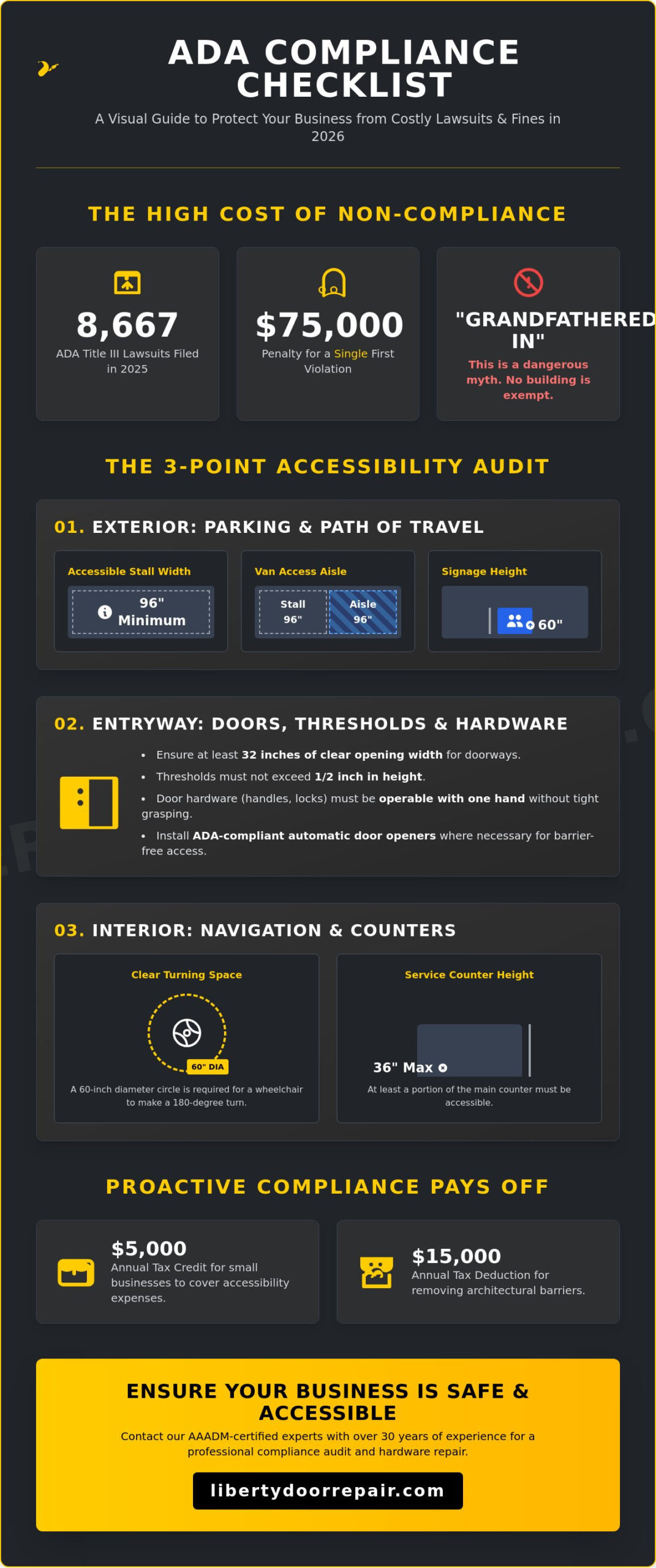
In 2025, plaintiffs filed 8,667 ADA Title III federal lawsuits against businesses just like yours. Many of these legal actions target physical barriers that are easy to spot but expensive to ignore. If you are searching for a reliable is my business ADA compliant checklist to protect your company, you are already taking the right first step. It is natural to feel overwhelmed by shifting regulations or to worry that a drive-by lawsuit could result in a $75,000 penalty for a single violation.
Virtually all private businesses that serve the public must follow these standards. This includes restaurants, retail stores, hotels, and service providers like barbershops or law firms. For a community-focused establishment like Neighbors Bar, ensuring everyone can participate in the social atmosphere is a top priority that starts with accessibility. Even small businesses with only a handful of employees must provide access. While private clubs and religious organizations are generally exempt from Title III, the rules change if they lease space to a secular business. If a customer cannot physically enter your storefront, your business is a liability. Our AAADM-certified experts have seen how even a one inch gap can lead to a legal nightmare.
We understand that you want to provide a welcoming environment without the constant fear of litigation. This guide offers a direct, step-by-step path to evaluating your building’s physical accessibility and identifying the exact hardware fixes you need. We will cover the 2010 Standards for Accessible Design, explain how to claim your $5,000 annual tax credit for repairs, and show you how to find an AAADM-certified expert to ensure your entryways are fully compliant. With over 30 years of experience, we help you replace uncertainty with the confidence that your business is safe, accessible, and legally sound.
Key Takeaways
- Debunk the “grandfathered” myth and understand how Title III accessibility requirements apply to even the oldest commercial buildings in Atlanta.
- Audit your exterior path of travel using specific requirements for van-accessible parking spaces and required signage.
- Use this is my business ADA compliant checklist to measure door openings and thresholds against the strict 2010 Standards for Accessible Design.
- Ensure interior navigation meets federal law by verifying the 60-inch turning space rule and 36-inch maximum height for service counters.
- Learn how to protect your business from lawsuits by identifying necessary hardware repairs and installing ADA-compliant door openers.
Understanding ADA Title III: Does Your Business Need a Checklist?
Under the Americans with Disabilities Act of 1990, Title III mandates that all “public accommodations” provide equal access to individuals with disabilities. In 2026, this law applies to almost every private business that invites the public inside. If you are wondering, “is my business ADA compliant checklist necessary for my small shop?” the answer is a firm yes. Federal courts recorded 8,667 ADA Title III lawsuits in 2025. Most of these cases focused on physical barriers that prevent basic entry. You cannot afford to wait for a lawsuit to arrive before you evaluate your building.
Many business owners in metro Atlanta believe their older buildings are “grandfathered in” and exempt from new rules. This is a dangerous myth. There is no grandfather clause in the ADA. If your building was constructed before 1990, you still have a continuous obligation to remove barriers when the fix is “readily achievable.” This legal standard means the repair is easily accomplishable and can be carried out without much difficulty or expense. Adjusting a door’s closing speed or installing a compliant threshold usually fits this description. If a fix is possible, the law expects you to do it.
Who Must Comply with ADA Standards?
Virtually all private businesses that serve the public must follow these standards. This includes restaurants, retail stores, hotels, and service providers like barbershops or law firms. Even small businesses with only a handful of employees must provide access. While private clubs and religious organizations are generally exempt from Title III, the rules change if they lease space to a secular business. If a customer cannot physically enter your storefront, your business is a liability. Our AAADM-certified experts have seen how even a one inch gap can lead to a legal nightmare.
The Cost of Non-Compliance in 2026
The financial risks of ignoring accessibility are steep. The Department of Justice can impose fines up to $75,000 for a first violation and up to $150,000 for subsequent ones. Beyond government fines, you face the cost of private settlements and legal fees. However, the government provides incentives for those who take action. Small businesses can claim a tax credit of up to $5,000 per year for eligible accessibility expenses. There is also a $15,000 annual tax deduction available for removing architectural barriers. Proactive commercial door repair atlanta is your best defense. We bring over 30 years of experience to every job, ensuring your hardware meets the strict 2010 Standards for Accessible Design.
The Exterior Checklist: Parking and Path of Travel
Compliance begins before a customer ever reaches your front door. If your parking lot fails to meet federal standards, you are essentially inviting a Title III lawsuit. Your exterior is often the primary target for “drive-by” legal actions because violations are visible from the street. Using a detailed is my business ADA compliant checklist helps you spot these vulnerabilities before they become legal liabilities. According to the ADA Checklist for Existing Facilities, the path of travel must be stable, firm, and slip-resistant from the moment a person leaves their vehicle.
A compliant exterior requires more than just blue paint. You must evaluate the total number of parking spaces to determine the required accessible count. For example, a lot with 1 to 25 total spaces must have at least one van-accessible spot. If your lot has 51 to 75 spaces, you need three accessible spots. Failing to provide the correct ratio is a common and costly mistake. If you are unsure about your current layout, consulting a trusted expert can help you identify necessary modifications quickly.
Accessible Parking Requirements
- Stall Width: Accessible spaces must be at least 96 inches wide. Van-accessible spaces require a width of 132 inches or a 96-inch stall with a 96-inch wide access aisle.
- Access Aisles: These must be marked with hatched lines to discourage parking. They must also be level with the parking space.
- Signage: Signs must feature the International Symbol of Accessibility. For van spaces, an additional “Van Accessible” sign is mandatory. Mount these signs at least 60 inches above the ground so they remain visible when a vehicle is parked in the spot.
Ramps and Walkways
The path from the parking lot to your entrance must be clear of obstructions. The standard is my business ADA compliant checklist requires a 1:12 slope ratio for all ramps. This means for every one inch of vertical rise, you must have 12 inches of ramp length. Anything steeper is considered a barrier. Curb ramps must also include detectable warnings, such as truncated domes, to alert visually impaired pedestrians that they are entering a vehicular way.
Walkways must be smooth and free of “trip hazards.” Any vertical change in level greater than 1/4 inch requires a bevel or a ramp. If a ramp has a rise higher than 6 inches, you must install handrails on both sides. These rails must be continuous and extend beyond the top and bottom of the ramp run. Maintaining these exterior elements protects your customers and shields your business from predatory litigation. We have spent 30+ years helping Atlanta business owners solve these technical challenges with reliable solutions.
The Entryway Checklist: Doors, Thresholds, and Hardware
The entryway is the most frequent site of accessibility failures. If a customer cannot physically pass through your door, your business is a target for litigation. When using an is my business ADA compliant checklist, the entryway requires your strictest attention to detail. Every element, from the handle to the floor, must meet ADA Title III requirements for businesses. A single non-compliant door can result in a $75,000 fine for a first-time violation. We focus on fixing these issues quickly to keep your business running safely.
Start with clear measurements. The opening width must be at least 32 inches. You must measure this when the door is open at a 90-degree angle. Measure from the face of the door to the stop on the frame. If the opening is even 31 inches, it’s a violation. Thresholds are another “danger zone” for wheelchair users. They cannot exceed 1/2 inch in height for most doors. If the threshold is higher, it must be beveled. A customer shouldn’t have to struggle to cross your door’s bottom rail. Our technicians see these issues daily and know exactly how to correct them.
Operating force is a technical detail most owners miss. Interior doors must require no more than 5 lbs of force to open. You can measure this with a simple force gauge. Handles and locks must allow for one-hand operation. If a person has to twist their wrist or grasp tightly, the hardware is non-compliant. This is why traditional round doorknobs are illegal in commercial spaces. We provide reliable solutions that ensure your doors are easy for everyone to use.
Compliant Door Hardware and Handles
Replace doorknobs with lever-style handles immediately. These allow a person to open the door with a closed fist or a single finger. Panic bars and push paddles are excellent for emergency exits and general access. For high-traffic areas, automatic door services provide the most reliable solution. These systems eliminate manual force requirements entirely. Our AAADM-certified technicians ensure these systems operate safely and meet all federal standards.
Closing Speed and Maneuvering Clearance
Door closers must be adjusted so the door takes at least 5 seconds to close from an open position of 90 degrees. This prevents the door from hitting a person using a walker or wheelchair. You also need strike-side clearance. This is the clear floor space next to the handle on the pull side. If you have a narrow storefront that cannot meet these space requirements, commercial door replacement might be necessary. We have 30+ years of experience helping Atlanta businesses navigate these technical repairs.
The Interior Checklist: Navigation, Counters, and Restrooms
Once a customer passes through your entryway, the interior layout must allow for independent movement. Navigating your store or office shouldn’t feel like an obstacle course for someone using a mobility aid. Using a comprehensive is my business ADA compliant checklist helps you identify tight corners and blocked paths that increase your legal risk. Federal standards require a “turning space” in every room. This is typically a 60 inch diameter circle that allows a wheelchair user to make a full 180 degree turn without hitting furniture or walls.
Sales and service counters are frequent points of failure during accessibility audits. To remain compliant, at least one portion of your main counter must be no higher than 36 inches above the floor. This section must also be at least 36 inches long. If your counters are too high, you must provide an auxiliary table or a folding shelf to accommodate customers. You also need to watch for protruding objects. Wall-mounted items like fire extinguishers or sconces cannot stick out more than 4 inches into the walkway if they are mounted between 27 and 80 inches off the floor. These “blind hazards” are common triggers for Title III litigation.
Signage and Effective Communication
Accessibility isn’t just about floor space; it includes how people find their way through your building. Permanent room signs, such as those for restrooms or exits, must include Braille and tactile characters. Mount these signs on the latch side of the door between 48 and 60 inches above the floor. Use high-contrast lettering with a non-glare finish to help visually impaired visitors. When you schedule fire door services, ensure your technician also checks that your exit signage is clearly visible and properly mounted according to current life safety codes.
Restroom Doors and Hardware
Restrooms are the most scrutinized areas in any commercial building. The door must not swing into the required clear floor space of any fixture, such as the sink or toilet. Privacy latches and locks must be easy to use with a closed fist. If a customer has to pinch or twist their wrist to lock the stall, the hardware is non-compliant. We often find that heavy restroom doors have too much resistance. Installing low-resistance door closers ensures that everyone can exit the room safely without struggling against a heavy spring. Don’t wait for a complaint to fix these small but critical details.
Is your interior layout putting you at risk? Contact Liberty Door Repair today to request a professional hardware audit and secure your building’s compliance.
How to Conduct a Professional ADA Audit in Metro Atlanta
Performing a self-audit is the first step toward securing your facility. You can use the 2010 ADA Standards for Accessible Design to build your initial is my business ADA compliant checklist. However, business owners often become blind to their own building’s flaws. A threshold you step over every day might be a half-inch too high for a wheelchair. A door that feels fine to you might require 12 lbs of force to open. This is why a fresh pair of eyes is critical to your success. You must prioritize your repairs to maximize your budget and minimize legal exposure. Always start with the primary entrance. If a customer cannot get inside, nothing else matters. Once the entryway is secure, move to your primary service areas and then your restrooms.
A professional audit provides a level of detail that a simple walkthrough cannot match. Our technicians use specialized tools to measure door pressure, closing speeds, and exact floor slopes. We look for the technical violations that “drive-by” plaintiffs use to trigger lawsuits. By identifying these barriers now, you can create a timeline for repairs that fits your cash flow. This proactive approach turns a potential legal nightmare into a manageable maintenance schedule. We have spent 30+ years helping local businesses stay open and accessible.
Why Professional Inspection Matters
A general contractor might understand framing, but they rarely know the specific physics required for AAADM-certified compliance. There is a massive difference between a door that stays shut and a door that meets federal access laws. Documenting your “readily achievable” plan is your best defense. If you can show a court that you have a documented plan to remove barriers, it demonstrates good faith. We serve businesses throughout the metro area, including Alpharetta, Marietta, and Roswell. Our team understands the specific local codes and the high-pressure legal environment facing Georgia business owners.
Next Steps for Your Business
The first step is scheduling a professional walk-through with an AAADM-certified technician. We will measure every door, handle, and threshold in your building. You will receive a clear, direct quote for necessary hardware upgrades. This might include installing ADA-compliant automatic openers or replacing illegal doorknobs with lever sets. Finalizing your 2026 accessibility plan ensures long-term compliance and peace of mind. Don’t wait for a process server to arrive at your door. Let’s get your building fixed and compliant today.
Take Control of Your Building’s Compliance Today
Securing your facility against Title III lawsuits is a continuous process that requires precision and regular maintenance. You now have the foundational knowledge to review your parking lot, measure your entryway width, and evaluate your interior service counters. While an is my business ADA compliant checklist is an excellent starting point for a self-audit, the technical details of door pressure and closing speeds require a specialist’s touch. Small errors in hardware installation can lead to significant legal exposure.
Don’t leave your business vulnerable to predatory litigation or expensive federal fines. Our AAADM-certified technicians bring 30+ years of Metro Atlanta experience to every inspection. We are specialists in ADA-compliant automatic openers and high-traffic hardware solutions that keep your doors swinging safely and legally. We understand the urgency of these repairs and provide the reliable expertise you need to protect your reputation. Take the guesswork out of federal regulations right now.
Request a Professional ADA Door Audit from Liberty Door Repair to ensure your building is fully compliant. We are ready to help you create a safer, more accessible environment for every customer who walks through your doors.
Frequently Asked Questions
Is my business grandfathered in if the building was built before 1990?
No, the ADA does not include a grandfather clause for existing buildings. All businesses must remove architectural barriers when it’s readily achievable to do so. This means if a fix is easy and affordable, the law requires you to make it. Ignoring these updates leaves you open to Title III lawsuits, which reached a record 8,667 federal filings in 2025. Proactive repairs are the only way to ensure your older property remains compliant.
What is the minimum door width for ADA compliance in 2026?
The minimum clear opening width is 32 inches. You must measure this from the face of the door to the opposite stop while the door is open at 90 degrees. If your current entrance is too narrow, we often recommend a commercial door replacement to meet federal standards. Using an is my business ADA compliant checklist will help you identify these measurements across all your public entryways and interior passages to avoid common violations.
Do I have to install automatic doors to be ADA compliant?
Automatic doors are not strictly required, but they are the most reliable way to meet force requirements. Manual interior doors must not exceed 5 lbs of opening force. If your heavy commercial doors cannot meet this limit even after adjustment, an automatic opener is the best solution. Our AAADM-certified technicians specialize in installing these systems to ensure effortless access for all customers while eliminating the risk of force-related legal citations.
Can I be sued if I am currently making plans to fix accessibility issues?
Yes, having a plan does not provide legal immunity from lawsuits. However, a documented readily achievable barrier removal plan serves as vital evidence of good faith in court. It shows you are actively working toward compliance. Since 94.8% of websites and many physical storefronts failed basic checks in 2025, starting your hardware repairs immediately is the best way to protect your business from predatory legal actions and expensive settlements.
What does ‘readily achievable’ mean for a small business with limited funds?
Readily achievable means the barrier removal is easily accomplishable without much difficulty or expense. For a small shop, this usually includes simple fixes like installing lever handles, adjusting door closers, or adding a ramp. The DOJ considers your business size and financial resources when evaluating this standard. If a repair costs more than the business can afford, you should document why it isn’t currently achievable while fixing smaller, affordable issues first.
Are there specific ADA requirements for restroom door handles?
Restroom door hardware must be operable with one hand and without tight grasping, pinching, or twisting of the wrist. Traditional round doorknobs are non-compliant and must be replaced with levers, pull bars, or panic devices. These handles allow someone with limited manual dexterity to open the door using a closed fist. Ensuring your restroom hardware is accessible is a critical part of any is my business ADA compliant checklist and prevents frequent legal complaints.
How often should I check my door’s opening force for compliance?
You should check your door’s opening force at least twice a year. Hardware like door closers and hinges can wear down or shift due to temperature changes and heavy use. A door that was compliant in January might require 8 lbs of force by July. Regular inspections by a trusted expert ensure your interior doors stay below the 5 lb federal limit. This simple maintenance task prevents unexpected legal trouble and keeps your entryway functioning properly.
What tax incentives are available for making my Atlanta business accessible?
Small businesses with 30 or fewer employees can claim a tax credit of up to $5,000 per year for accessibility expenses. This covers 50% of eligible costs between $250 and $10,250. Additionally, all businesses can take a tax deduction of up to $15,000 annually for removing architectural barriers. These incentives, verified as of April 2026, make it much more affordable to hire skilled technicians for your necessary door and hardware upgrades in metro Atlanta.