

Could a single jammed door handle be the reason your Atlanta business fails its next fire marshal inspection? It’s a stressful reality for many local property managers. You need your exit hardware to work perfectly every time. However, many facilities struggle with noisy “crash bars” or devices that stick. When you invest in professional panic bar installation in Atlanta, you aren’t just buying a piece of hardware. You’re securing your building and protecting your staff. Serving North Georgia businesses since 2015, we know that reliability is non-negotiable for commercial safety.
We understand the frustration of navigating complex NFPA and OSHA standards. You shouldn’t have to guess whether a rim device or a vertical rod system is right for your commercial doors. This guide provides the expert insights you need to choose hardware that remains code-compliant and secure. You’ll learn how to select the right exit devices, integrate them with your existing access control, and avoid the liability of a failing system. We’ll show you how to achieve a fully compliant exit system that provides peace of mind for your business and ensures every occupant has a safe way out.
Key Takeaways
- Learn the legal distinction between exit devices and crash bars to ensure your facility meets strict life safety standards.
- Discover how professional panic bar installation in Atlanta helps your business pass fire marshal inspections by adhering to current NFPA 101 codes.
- Identify the differences between Grade 1 and Grade 2 hardware to choose the right durability level for your building’s traffic volume.
- Understand ADA mounting height and operating force requirements to maintain accessibility and avoid costly compliance penalties.
- See how experience serving North Georgia businesses since 2015 and AAADM-certified technicians ensure your security systems integrate seamlessly with emergency hardware.
Understanding Panic Bars & Exit Devices for Atlanta Commercial Properties
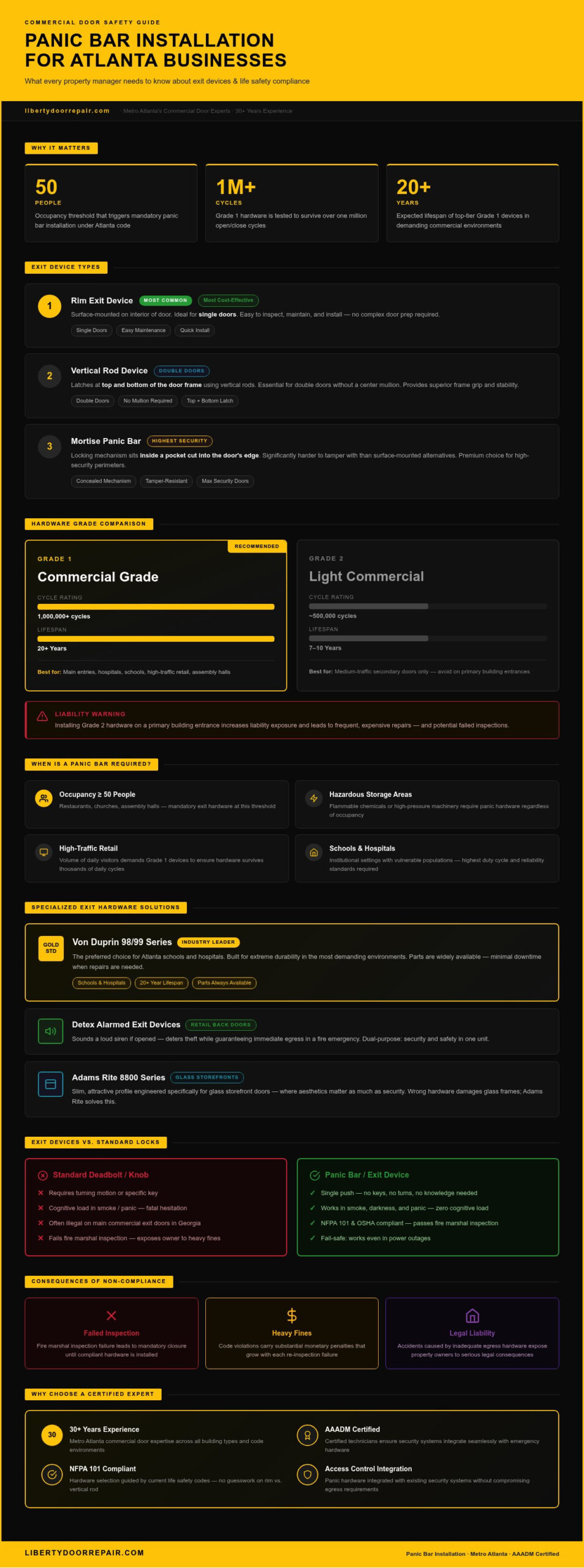
In the commercial door industry, terminology matters. While most people call them “crash bars,” building codes refer to them as “exit devices.” These mechanical bars allow occupants to open a door by simply pushing the horizontal bar. Safety is the priority. During a fire or emergency, occupants shouldn’t have to struggle with keys, knobs, or complex latches. A standard deadbolt requires a turning motion or a specific key. That split second of confusion can be fatal in a crowded room. This is why standard locks are often illegal for main commercial exit doors in Georgia. Choosing professional panic bar installation in Atlanta ensures your facility meets these life-safety standards immediately.
The core purpose of an exit device is to provide “immediate egress.” This means anyone can exit the building without specialized knowledge or effort. It’s a fail-safe system. Even if the power goes out or the building is filled with smoke, a simple push against the bar clears the path to safety. For business owners, this isn’t just about safety; it’s about liability. Failing to provide proper egress hardware can lead to failed inspections, heavy fines, or serious legal consequences if an accident occurs.
Common Types of Exit Hardware
- Rim Exit Devices: These are the most common and reliable options for single doors. They are surface-mounted on the interior of the door, which makes them easy to inspect and maintain. Because they don’t require complex internal prep, they’re often the most cost-effective choice for panic bar installation in Atlanta.
- Vertical Rod Devices: You’ll typically see these on double doors. They use rods to latch the door at both the top and bottom of the frame. This is essential for securing double doors that don’t have a center post, known as a mullion.
- Mortise Panic Bars: These offer the highest level of security. The locking mechanism sits inside a pocket cut into the door’s edge. It’s much harder for a burglar to tamper with a mortise device compared to a surface-mounted one.
When Does Your Atlanta Business Need a Panic Bar?
Code compliance isn’t optional. Most Atlanta businesses must install exit devices when the occupancy load reaches 50 people. If you operate a restaurant, church, or assembly hall, this is a non-negotiable safety requirement. Hazardous material storage areas also require specialized hardware. Even if your occupancy is low, rooms with high-pressure machinery or flammable chemicals must have panic hardware to protect employees. High-traffic retail environments should also prioritize these devices. Grade 1 hardware is tested for over one million cycles, ensuring your doors work perfectly even with thousands of daily visitors.
Comparing High-Performance Panic Bar Brands
Hardware grading is the primary factor in the longevity of your exit system. When planning a panic bar installation in Atlanta, you must distinguish between Grade 1 and Grade 2 hardware. Grade 1 devices are the minimum recommendation for main entries because they are tested to survive over one million cycles. Choosing sub-par hardware for a high-traffic entrance increases your liability and leads to frequent, expensive repairs. Grade 2 hardware is suitable for medium-traffic areas, but it often fails prematurely if installed on a primary building entrance.
The Gold Standard: Von Duprin 98/99 Series
Von Duprin is widely considered the gold standard for commercial exit hardware. Their 98 and 99 series devices are the preferred choice for Atlanta schools and hospitals due to their extreme durability. These units are built to last 20 years or more in the most demanding environments. Maintenance is straightforward. Since Von Duprin is the industry leader, parts are readily available, ensuring your building stays secure without long downtimes. Grade 1 hardware like the Von Duprin 99 is the minimum recommendation for main entries to guarantee both occupant safety and long-term reliability.
Specialized Exit Solutions: Alarmed and Glass Door Bars
Different doors require unique mechanical solutions. You shouldn’t use the same hardware on a glass storefront that you use on a steel warehouse door. Specialized brands offer targeted solutions for these specific needs:
- Detex Alarmed Exit Devices: These are excellent for retail back doors. They sound a loud siren if opened, which discourages theft while still allowing immediate egress during a fire.
- Adams Rite 8800 Series: This series provides a slim, attractive profile specifically for aluminum storefront doors. It maintains the aesthetic of your glass entry without sacrificing security.
- Maintenance: Integrating the right door parts & replacements, such as high-quality cylinders or strikes, can significantly extend the life of these specialized devices.
You don’t always need the most expensive hardware for every door in your building. For low-traffic areas like mechanical rooms or employee-only storage, Grade 2 hardware from reputable brands offers a reliable, code-compliant alternative. These devices provide the safety you need without the premium cost of high-cycle hospital-grade equipment. If you need help choosing the right hardware for your specific traffic volume, our team can provide a professional assessment to ensure you don’t overspend while staying fully compliant.
Navigating Life Safety Codes and ADA Compliance in Georgia
Atlanta fire marshals follow the NFPA 101 Life Safety Code strictly. If your hardware doesn’t meet these standards, you risk failing your inspection and facing immediate fines. One critical rule is the “One Motion” requirement. Any occupant must be able to exit with a single, fluid movement. If you have a deadbolt installed above a panic bar, you are likely in violation. You can’t require two separate actions to open an emergency exit. Proper panic bar installation in Atlanta ensures that your locking mechanisms and exit hardware work as a unified, compliant system.
Liability is a major concern for local property managers. Beyond fire codes, you must also consider the Americans with Disabilities Act (ADA). These federal mandates ensure that every person, regardless of physical ability, can exit your building safely. Failing to meet these standards doesn’t just lead to failed inspections; it creates significant legal exposure for your business. We prioritize these details during every installation to keep your facility secure and accessible.
NFPA 101 and Fire-Rated Openings
A major point of confusion for business owners is the difference between standard panic hardware and fire exit hardware. Standard devices often feature “dogging.” This allows the bar to stay pushed in so the door remains unlocked for high-traffic periods. Fire-rated doors are different. They must latch automatically to contain smoke and flames. Therefore, fire exit hardware cannot have a mechanical dogging feature. Your door must also have a functional self-closing mechanism. If the door doesn’t latch fully every time it closes, it’s a code violation. For comprehensive support, our fire door services cover everything from hardware selection to full compliance inspections.
ADA Accessibility Standards
The ADA sets strict physical requirements for door hardware. To stay compliant, your panic bar installation in Atlanta must meet specific measurements:
- Mounting Height: The push bar must be installed between 34 and 48 inches above the finished floor.
- Operating Force: The device must require no more than 5 pounds of pressure to operate. If a person with limited strength cannot push the bar easily, the door is non-compliant.
- Clear Width: Commercial entries must provide a minimum clear width of 32 inches to accommodate wheelchairs.
Many local businesses fail inspections because their doors are too heavy or the hardware is mounted at the wrong height. We see this often in older buildings where original hardware has shifted or been replaced incorrectly. Ensuring your hardware meets these force and height requirements is essential for avoiding liability and ensuring total building accessibility.
Planning Your Panic Bar Installation or Security Upgrade
Successful preparation prevents costly mistakes during a panic bar installation in Atlanta. You must evaluate four specific factors before purchasing hardware. First, identify your door material. Hollow metal doors require different fasteners and internal reinforcement than aluminum storefront or solid wood doors. Second, calculate your daily traffic volume. As previously discussed, high-use entrances demand Grade 1 hardware to avoid premature failure. Third, decide on your exterior trim. You need to determine if the door requires a keyed lever for entry or if it should remain an exit-only opening with a simple pull plate. Finally, determine if you need to integrate access control solutions to manage staff entry and track building access.
Integrating Access Control and Keyless Entry
Modern security often requires more than just a mechanical bar. You can upgrade your exit hardware with electrified strikes or electric latch retraction (ELR). ELR is the superior choice for high-traffic areas because it is quieter and reduces mechanical wear. Trilogy alarm locks are another excellent option. These combine a panic bar with a standalone keypad, allowing you to restrict unauthorized entry during business hours without a complex wired system. You must ensure that any electronic upgrade still allows for immediate egress. The “One Motion” rule applies even when the power is out or the card reader fails.
Retrofitting vs. New Installation
You don’t always need to replace an entire door to upgrade your security. Retrofitting allows you to swap out aging internal components while keeping the existing door leaf. However, old hardware often leaves “scar tissue” or exposed holes in the door. We use specialized mounting plates to cover these gaps, providing a clean, professional finish that maintains the door’s structural integrity. If the door frame is sagging or the hinges are pulled loose, a retrofit might not be enough. In these cases, you should prepare for a full commercial door replacement to ensure the new panic hardware functions correctly. A perfectly installed bar won’t work if the door itself is out of alignment.
Our technicians specialize in assessing whether your current doors can support a hardware upgrade or if a complete replacement is necessary for safety. We focus on providing the most cost-effective solution that guarantees long-term compliance. If you are ready to secure your facility and pass your next inspection, contact our Atlanta team today for a professional hardware assessment.
Why Choose Liberty Door Repair for Atlanta Panic Bar Services
Liberty Door Repair has served the Metro Atlanta business community since 2015. We are a locally owned specialist. We understand the high stakes of fire marshal inspections and the stress of potential liability. When you require professional panic bar installation in Atlanta, you need a team that understands both the mechanical and legal requirements of your facility. Our technicians are AAADM-certified. This certification ensures they have the specialized training to handle complex commercial door systems. We prioritize speed and effectiveness. If your building has a compromised security point or a failed inspection report, we provide the urgent response needed to restore safety immediately.
Our Professional Installation Process
A reliable exit system starts with a technical assessment. We don’t just swap parts; we evaluate the entire opening. Our technicians perform a detailed on-site evaluation to ensure your new hardware matches the door’s fire rating and structural capacity. Precision mounting is the most important step. Improperly installed bars often lead to sagging, dragging, or latching failures. These issues are common with general handyman or DIY attempts. We use high-grade fasteners and professional alignment tools to prevent these mechanical problems. After the hardware is set, we perform rigorous post-installation testing. We check operating force and mounting height to guarantee compliance with all local Atlanta codes. This ensures your doors are ready for the next fire marshal visit.
Serving the Metro Atlanta Business Community
Our reputation is built on decades of dependable service for local property managers and business owners. We provide dedicated support for retail shops, industrial warehouses, and large office complexes. Our service fleet covers the entire Metro Atlanta area. We regularly assist clients in Alpharetta, Roswell, Marietta, and Decatur. We understand the unique architectural and regulatory environments of these different districts. Our commitment to commercial door repair in Atlanta means we prioritize your building’s safety and accessibility. We help you avoid the liability of non-functional exit hardware. Call us today to schedule your panic bar assessment. We’ll ensure your facility remains secure and code-compliant for years to come.
Secure Your Facility and Ensure Full Code Compliance
Your building’s safety depends on hardware that works every single time. By prioritizing Grade 1 devices and understanding the strict “One Motion” egress rule, you protect both your occupants and your bottom line. Proper panic bar installation in Atlanta isn’t just about mounting a bar; it’s about integrating durability with life-safety codes. Whether you are retrofitting an older storefront or planning a security upgrade with modern access control, the right hardware choices eliminate the fear of failed inspections and costly liability gaps.
Liberty Door Repair has served North Georgia businesses since 2015. Our AAADM certified technicians serve all Metro Atlanta ZIP codes, from Marietta to Decatur. We understand the urgency of commercial safety and provide the expert precision your facility deserves. Don’t leave your compliance to chance. Schedule Your Atlanta Panic Bar Installation Today to guarantee a secure, code-compliant environment for your business. We are ready to help you maintain a safe and accessible facility for years to come.
Frequently Asked Questions
Is a panic bar required by law for my Atlanta business?
Yes, it is mandatory if your occupancy load is 50 people or more. Atlanta fire marshals enforce these codes to ensure safe egress in assembly or high-hazard areas. Your specific building use determines the exact hardware needed. If you run a restaurant, school, or large retail space, you are legally required to have these devices. A professional inspection confirms your current status and identifies any doors that are currently non-compliant with local safety laws.
Can I install a panic bar on a glass storefront door?
Yes, specialized hardware exists for aluminum-framed glass doors. Slim-profile devices like the Adams Rite 8800 series fit narrow stiles without blocking the view. You don’t have to choose between a beautiful glass entry and building safety. Selecting the right hardware for panic bar installation in Atlanta storefronts ensures your business stays secure against break-ins while providing a clear exit path. Professional mounting prevents the glass from shattering during heavy use.
What is the difference between a panic bar and a fire exit device?
Fire exit devices are labeled for both panic egress and fire protection. They cannot have a “dogging” feature, which means they must latch every time the door closes. This prevents the spread of fire and smoke between rooms. Standard panic bars are for doors that aren’t fire-rated. If your door has a fire-rating label on the edge, you must use fire-labeled hardware to remain compliant with Georgia state safety codes.
For those managing facilities that require high-performance materials, partnering with a specialized 防火門供應商 ensures that your fire-rated glass and door assemblies provide maximum safety and code compliance.
Why is my panic bar sticking or making a grinding noise?
Grinding or sticking signals internal mechanical wear or a sagging door. Dust and metal shavings build up inside the housing over time. This creates friction that makes the bar difficult to push. It is a major liability. If someone can’t open the door during an emergency, the consequences are severe. Immediate service is necessary to lubricate the linkages or replace the device. Never ignore a noisy bar; it’s a warning of imminent failure.
Can I add a keypad or card reader to my existing panic bar?
Adding a keypad or card reader is a standard upgrade for modern Atlanta businesses. This is achieved by installing an electric strike or an electrified panic bar. These components allow for restricted entry while ensuring the door always opens from the inside with one motion. This is a popular security upgrade for panic bar installation in Atlanta commercial spaces. Our technicians ensure your electronic locks are correctly wired to your fire alarm system for automatic release during emergencies.
Does a panic bar satisfy ADA requirements for my building?
Panic bars only meet ADA standards if they are specifically designed and installed for accessibility. The push bar must be easy to operate with a single hand and require minimal force. If your current hardware is too stiff or mounted too high, you are in violation of federal law. We help you select and install hardware that balances heavy-duty security with the accessibility requirements needed to keep your Atlanta business open to everyone.
How often should I have my exit devices inspected for safety?
You should have your exit devices inspected by a professional at least once per year. High-traffic facilities like retail stores or hospitals should schedule inspections every six months. Technicians check for loose screws, worn latch bolts, and proper door closing speed. Regular maintenance prevents the “jammed door” scenarios that lead to failed fire inspections. It also extends the life of your hardware, saving you from expensive full-system replacements in the future.