

Imagine arriving at your Atlanta storefront only to find a line of frustrated customers because your entrance is stuck. Every minute your automatic door not opening persists, you’re losing foot traffic and risking serious ADA compliance violations. It’s a stressful situation that compromises both your security and your bottom line. You need a functional entryway to keep your business moving, but a malfunctioning motor or sensor has brought everything to a halt.
You probably expect your hardware to work seamlessly every day. When it fails, the loss of accessibility is more than just an inconvenience. It can lead to a 30% increase in HVAC energy loss if the door remains open or create a major safety hazard if it’s jammed shut. You deserve a solution that restores your business flow immediately while meeting strict national safety standards.
This article explains how to identify the root cause of your door failure and when you need a certified technician to step in. You’ll learn about common sensor malfunctions, mechanical obstructions, and the importance of AAADM-certified repairs. We’ll also preview the ANSI/BHMA standards required to keep your commercial property safe, legal, and fully operational for every visitor.
Key Takeaways
- Perform an immediate 3-point check on power sources and physical obstructions to rule out simple fixes before calling for help.
- Identify specific symptoms of sensor failure to determine why your automatic door not opening is blocking customer access.
- Listen for distinct auditory cues that signal a failing drive belt or motor before a minor mechanical issue becomes a costly replacement.
- Protect your business from legal liability by understanding the ADA compliance requirements and safety risks associated with uncertified door repairs.
- Apply a professional decision framework to choose between repairing or replacing aging equipment with local, AAADM-certified expertise.
Troubleshooting an Automatic Door Not Opening: Start with the Basics
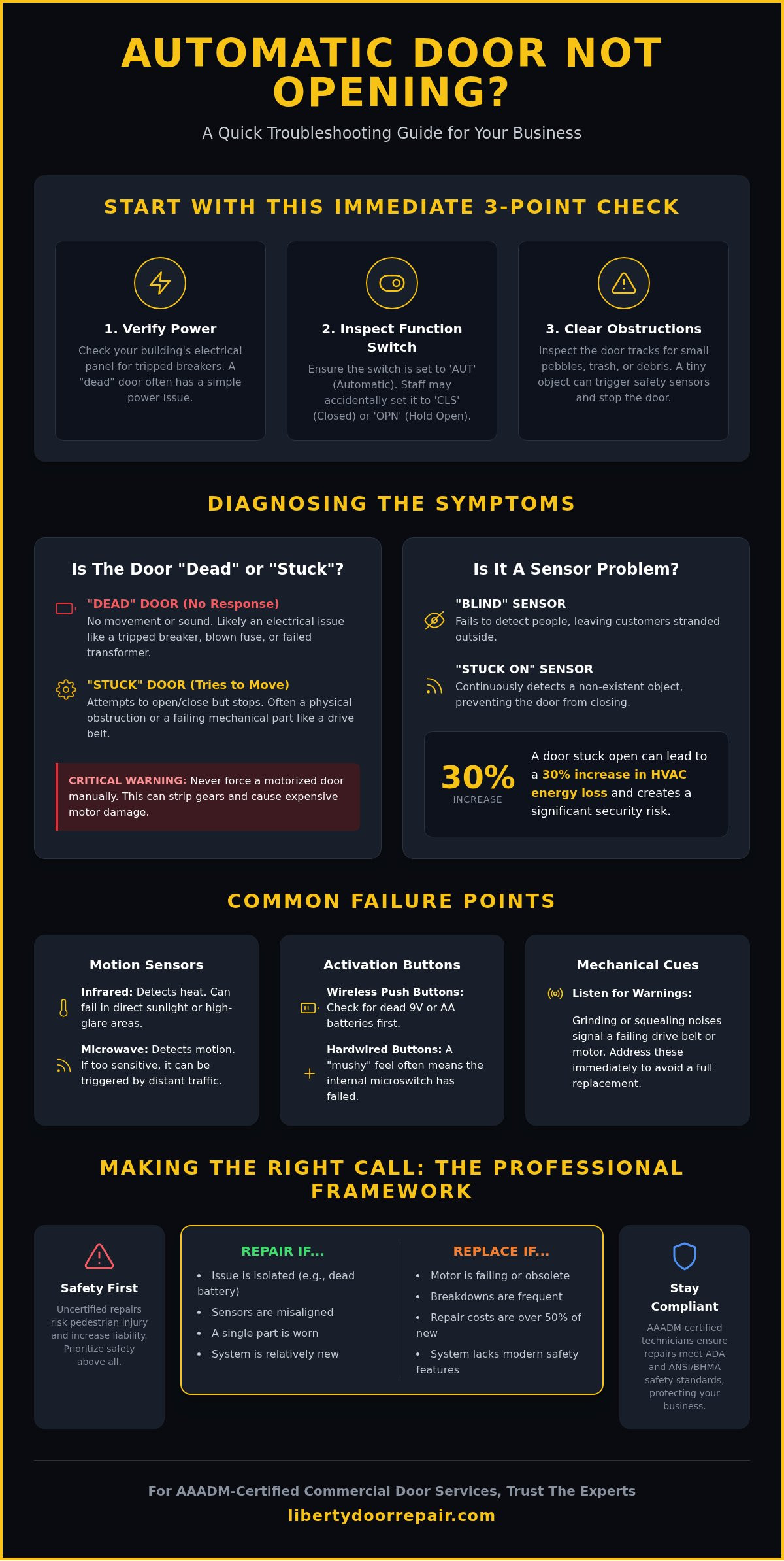
An automatic door not opening creates an immediate barrier for your customers. Before calling for a technician, perform a quick 3-point check: verify the power, inspect the function switch, and clear the tracks. You must first distinguish between a “dead” door and a “stuck” door. A dead door has no power or response. A stuck door attempts to move but encounters resistance. Never force a motorized door open manually. This can strip drive gears or damage the internal motor, leading to much higher repair costs.
Power Supply and Circuit Breaker Checks
Automatic door technology relies on a consistent 120V signal to the header unit. If the door shows no signs of life, the issue is likely electrical. Check your building’s main electrical panel for tripped breakers. In older Atlanta commercial buildings, power surges can frequently blow the small glass fuses located on the door’s internal control board. If the breaker is on but the unit remains unresponsive, a blown fuse or a failed transformer is the probable culprit.
The Function Switch: AUT, OPN, and CLS
Most commercial doors feature a function switch with three primary settings. “AUT” is the standard automatic mode. “OPN” holds the door in a permanent open state, while “CLS” locks the door shut. It’s common for cleaning crews or staff to accidentally toggle this switch. If your door is unresponsive, ensure it hasn’t been set to “CLS” or “Hold Open.” Retail storefronts with key-switches should also check for physical damage or loose wiring behind the switch plate. A loose wire can easily prevent the activation signal from reaching the motor.
Clearing Physical Obstructions and Tracks
Sliding doors are extremely sensitive to debris. A single pebble or a piece of trash in the threshold track can trigger a safety reversal, making it seem like the door is broken. Inspect the tracks for buildup or hardened grease that might cause the rollers to bind. “Ghosting,” where the door cycles without a user present, is often caused by loose weather stripping or hanging promotional signs that drift into the sensor’s field of view. Keep the threshold clear to maintain a smooth, uninterrupted cycle and prevent the motor from overworking.
Diagnosing Sensor and Activation Failures
Sensors serve as the eyes of your entryway. When they fail, the entire system loses its ability to detect pedestrians, leading to an automatic door not opening or a door that remains dangerously stuck open. You can usually categorize sensor failure into two symptoms. A “blind” sensor fails to send an activation signal, leaving customers stranded outside. Conversely, a “stuck on” sensor continuously detects an object that isn’t there, preventing the door from closing. Proper sensor alignment is non-negotiable. For sliding doors, the sensor must cover the threshold area. For swinging doors, the pattern must be precisely tuned to ignore the door’s own movement while still protecting anyone in the swing path.
Infrared vs. Microwave Motion Sensors
Most commercial entrances use a combination of infrared and microwave technology. Infrared sensors detect heat and presence. They are excellent for safety because they know if a person is standing still in the doorway. However, they can fail in direct sunlight or high-glare environments where the “heat signature” becomes washed out. Microwave sensors detect motion and are better for long-range activation. If your door opens every time a car drives by in the parking lot, the microwave sensitivity is likely too high. You must regularly test the “Safety Zone” by standing in the threshold to ensure the door doesn’t close on you. This is a critical part of maintaining ADA accessibility guidelines for doors and preventing pedestrian injuries.
Wave Plates and Remote Activation Buttons
ADA push buttons and modern wave-to-open plates are common points of failure in Metro Atlanta businesses. If you use wireless buttons, the most frequent culprit is a dead battery. Replace the 9V or AA batteries inside the transmitter before assuming the motor is broken. For wave-to-open sensors, a dirty or scratched lens can cause the unit to trigger randomly or stop responding altogether. If a hardwired button feels “mushy” or fails to click, the internal microswitch has likely reached the end of its life cycle. If your sensors or buttons remain unresponsive after a basic cleaning, a professional sensor diagnostic can pinpoint whether the issue is a wiring fault or a total component failure. Testing these activation methods weekly ensures your facility remains accessible to all visitors without interruption.
Identifying Mechanical vs. Electronic Malfunctions
Once you’ve ruled out basic power issues and sensor obstructions, the problem usually lies within the internal header. Distinguishing between a software glitch and a hardware breakdown is essential for a fast resolution. An automatic door not opening due to electronics often shows no physical signs of effort. If the door attempts to move but fails, you’re likely facing a mechanical obstruction or a failed drive component. Listen closely to the header unit during operation. Grinding noises suggest failing bearings, while a high-pitched squeal typically points to a worn or slipping drive belt. Maintaining these systems according to automatic door safety standards ensures longevity even in harsh Southern weather.
Motor and Drive Belt Wear and Tear
Jerky door movements or a loud humming sound without actual motion are classic symptoms of a slipping drive belt. In high-volume Atlanta retail environments, the motor brushes often wear out after years of constant cycling. This leads to intermittent operation where the door works in the morning but fails during the afternoon heat. Avoid the temptation to over-lubricate the tracks or rollers. Excess grease attracts Georgia red clay and dust, creating a thick paste that eventually burns out the motor. If the belt looks frayed or the motor housing is hot to the touch, professional intervention is required to prevent a total system seizure.
Software Errors and Control Board Resets
Modern door operators are essentially specialized computers. Like any computer, they can experience logic errors that lead to an automatic door not opening. You can often clear these temporary glitches by performing a hard reset. Turn the power off at the breaker or the header switch for at least 30 seconds before restarting. If the door remains unresponsive, a power surge from a local thunderstorm may have fried the control board’s capacitors. Our automatic door services include comprehensive board diagnostics. We can determine if a simple recalibration will fix the logic or if a full board replacement is necessary to restore your building’s access control.
Weather Impacts: Humidity and Temperature Swings
The Metro Atlanta climate presents unique challenges for automatic entryways. Extreme Georgia humidity can lead to condensation inside the header, causing rapid electrical corrosion or sensor fogging. Temperature swings also cause metal door frames to expand and contract. On a 95-degree day, a slightly misaligned frame can begin to bind, putting immense strain on the motor. Exterior-facing doors are also susceptible to water infiltration during heavy downpours. If water enters the threshold track, it can short out the bottom-mounted safety sensors, triggering a permanent “open” or “closed” state that a simple reset won’t fix.
Why Safety and ADA Compliance Matter
Facility managers in Metro Atlanta carry a legal responsibility to maintain accessible entrances for all visitors. An automatic door not opening is more than a technical failure. It’s a potential legal liability. If a door is stuck shut, you’re actively blocking access for individuals with disabilities, which can lead to costly lawsuits or federal fines. If the door is malfunctioning and closes with excessive force, the risk of pedestrian injury increases significantly. You must treat every door failure as an urgent safety priority to protect your business and your customers.
Malfunctioning doors often exhibit unpredictable behavior. A door that won’t open today might suddenly cycle with extreme speed tomorrow. High-tension springs and motorized operators can exert hundreds of pounds of force if they aren’t calibrated correctly. Attempting DIY repairs on these complex systems is dangerous. Without the proper diagnostic tools, you risk setting the closing force too high, which can cause serious entrapment injuries. Professional oversight ensures your hardware operates within the strict margins required for public safety.
Understanding ADA Requirements for Automatic Doors
Federal law mandates specific performance standards for commercial entryways. According to ADA standards, interior doors on accessible routes must not exceed 5 pounds of opening force. This requirement often makes the installation of ADA-compliant door openers necessary for many businesses. Additionally, automatic doors must have specific hold-open timings to allow individuals using mobility devices to pass through safely. A malfunctioning sensor that shortens this timing can trigger a compliance audit, leading to mandatory building upgrades and legal fees. Keeping your door in peak condition isn’t just about convenience; it’s about staying on the right side of the law.
The Importance of AAADM-Certified Technicians
The American Association of Automatic Door Manufacturers (AAADM) sets the industry benchmark for safety. You should never allow a general handyman to work on your automatic door headers. These systems require specialized knowledge of ANSI A156.10 and A156.19 standards, which govern full-energy and low-energy doors. AAADM-certified technicians undergo rigorous training to ensure every repair meets these national safety requirements. They perform comprehensive checks on presence sensors, secondary entrapment protection, and emergency breakout features. Using a certified expert provides a documented paper trail of safety compliance, which is your best defense in the event of a liability claim. If your system is failing, request a professional ADA compliance inspection to ensure your facility remains safe and accessible.
Professional Automatic Door Repair Solutions in Atlanta
Liberty Door Repair is the premier specialist for Metro Atlanta businesses facing an automatic door not opening. With 30+ years of local experience, we understand the urgency of a failed entrance. Our AAADM-certified technicians provide a level of expertise that general contractors simply cannot match. We don’t just fix the immediate symptom; we identify the underlying cause to ensure your storefront remains accessible and secure. Rely on us to restore your business flow with precision and speed.
Local Expertise Across Metro Atlanta
We provide localized service across the Marietta, Alpharetta, and Roswell business districts. This geographical focus allows for rapid response times in Decatur and Sandy Springs. Navigating Georgia building codes requires a specialist who understands local enforcement of ADA and fire safety regulations. Our deep roots in the Atlanta community mean we arrive with the right tools and the right knowledge to get your doors back in service. We prioritize your business continuity above all else.
Comprehensive Parts and Replacement Inventory
Our technicians maintain a comprehensive inventory of door parts & replacements for all major industry brands. We specialize in upgrading older, sluggish systems with modern, energy-efficient operators that reduce HVAC strain. Beyond the electronic header, we focus on high-quality hinges and pivots that ensure long-term mechanical reliability. Using the right hardware prevents premature wear and reduces the total cost of ownership for your facility.
Deciding between a repair and a full replacement depends on the age and condition of your equipment. If your door is less than 5 years old and experiencing a sensor failure, a repair is almost always the best choice. However, if the motor has seized on a unit that is 10+ years old, a replacement is often the more cost-effective long-term investment. Modern operators offer better safety features and lower maintenance costs than outdated hardware. We provide a clear decision framework to help you make the best choice for your budget.
A preventative maintenance contract is the most effective way to avoid an automatic door not opening during peak business hours. Regular inspections allow our team to catch worn drive belts and misaligned sensors before they cause a total system shutdown. These scheduled visits extend the lifespan of your equipment and keep your facility in constant compliance with federal safety standards. Don’t let a broken entrance disrupt your business traffic or compromise your security. Contact our team today to schedule a commercial door repair Atlanta estimate.
Restore Your Business Access Today
Maintaining a functional entrance is vital for the safety and accessibility of your Metro Atlanta facility. We’ve covered how to identify common sensor failures, mechanical wear from Georgia’s humidity, and the legal importance of meeting national safety standards. An automatic door not opening is a problem that requires an immediate, professional solution to avoid liability and lost foot traffic.
Trust our AAADM-certified technicians to handle your complex repairs with precision. With 30+ years of local Atlanta experience, we’re the region’s specialists in ADA compliance and high-performance door operators. We arrive prepared with a full inventory of parts to get your storefront back in operation quickly. Don’t let a malfunctioning door block your customers or compromise your security.
Schedule your professional automatic door repair with Liberty Door Repair now! Our team’s ready to provide the dependable expertise you need to keep your business moving forward safely and efficiently.
Frequently Asked Questions
Can I manually open an automatic door if it loses power?
You can manually open most commercial automatic doors during a power failure. Sliding and folding doors are designed with a breakout feature that allows the panels to swing outward in the direction of egress. This is a critical fire code requirement for emergency exiting. If the door feels stuck, don’t force it excessively. Check if the physical lock is engaged or if the motor’s internal brake is preventing movement before attempting to push the panels open.
How much does it typically cost to repair an automatic door sensor?
Repair costs depend on whether the sensor needs simple recalibration or a full component replacement. Microwave and infrared sensors have different price points. A technician must first diagnose if the issue is a wiring fault, a dirty lens, or a failed circuit board. While we don’t provide flat-rate pricing without an inspection, investing in a high-quality sensor replacement often prevents future instances of an automatic door not opening during high-traffic hours.
How often should commercial automatic doors be inspected?
Commercial automatic doors should receive a professional safety inspection at least once every year. High-traffic environments, such as retail storefronts in Alpharetta or hospital entrances in Atlanta, may require quarterly maintenance. These inspections ensure compliance with ANSI/BHMA safety standards and help identify worn drive belts or misaligned sensors before they lead to a total system failure. Regular checks are the best way to prevent unexpected downtime and maintain ADA accessibility.
Why is my automatic sliding door making a grinding noise but not moving?
A grinding noise usually indicates a mechanical failure in the rollers, tracks, or motor gearbox. Debris like pebbles or glass shards can become lodged in the threshold track, causing the rollers to bind or flat-spot. If the noise is coming from the header, the drive belt may be frayed or a bearing in the motor assembly has likely failed. Stop using the door immediately to prevent the motor from burning out due to the added friction.
What is the difference between a low-energy and high-energy automatic door?
Low-energy doors are typically knowing act systems that require a user to press a push-plate or wave a hand to activate. They move slowly and exert minimal force. High-energy doors use sophisticated motion and presence sensors to open automatically as a person approaches. These systems move faster and require more comprehensive safety sensors, such as those meeting ANSI A156.10 standards, to prevent the door from striking pedestrians during its faster operating cycle.
Will a power surge ruin my automatic door control board?
Power surges from Georgia’s frequent thunderstorms can easily damage the sensitive capacitors and microprocessors on a control board. This is a common cause of an automatic door not opening after a local weather event. While many modern operators include basic surge protection, a significant spike can still lead to a total board failure. We recommend installing dedicated surge suppressors at the power source to protect these expensive electronic components from erratic voltage fluctuations.
Do I need a special permit for automatic door installation in Atlanta?
Most new automatic door installations in Metro Atlanta require a building permit to ensure compliance with local fire codes and ADA accessibility guidelines. The specific requirements vary between municipalities like Marietta, Decatur, and the City of Atlanta. A certified installer handles the technical documentation, ensuring the door meets emergency egress and opening force standards. Always verify with your local building department before starting a major entryway renovation to avoid potential fines or delays.
Can cold weather cause my automatic door sensors to fail?
Cold weather and rapid temperature swings can cause sensors to malfunction. Frost or condensation often forms on the sensor lens, blocking the infrared beam or microwave signal. This creates a blind sensor that fails to trigger the door. Additionally, extreme cold can cause metal tracks to contract slightly, increasing friction and making it difficult for the motor to move the panels. Keeping the sensor lenses clean and dry is essential during Atlanta’s winter months.