

A single wedged-open door or an illegible label can be the difference between a passed fire marshal visit and a costly violation. Georgia adopted the 2024 International Fire Code on January 1, 2026, making a professional fire door assembly inspection in Georgia more critical than ever. You know that occupant safety is your primary responsibility, yet the technical requirements of the NFPA 80 standards often feel like a complex maze of red tape.
It’s stressful to worry about failing an inspection or facing business disruptions during testing. We’re here to provide the clarity you need to move forward with confidence. This guide ensures your facility meets the latest 2025 NFPA 80 requirements and passes the mandatory 13-point inspection list with documented proof for your insurance and the Authority Having Jurisdiction. We’ll walk you through the current state mandates, common failure points, and the exact steps to maintain a safe, compliant building.
Key Takeaways
- Understand the mandatory 13-point checklist required by NFPA 80 to ensure your facility remains compliant with the latest Georgia state fire codes.
- Identify the most common reasons for inspection failure, such as improper door clearances and faulty closers, before the fire marshal arrives.
- Learn why scheduling a professional fire door assembly inspection in Georgia is the only way to secure the documented proof required by insurance and local authorities.
- Discover the essential qualifications to look for in a certified inspector, including AAADM certifications and decades of local expertise in the Metro Atlanta market.
- Get actionable steps for remediation to keep your swinging, sliding, or rolling fire doors functional and safe for all building occupants.
Understanding NFPA 80 and Georgia Fire Code Requirements
A fire door assembly is much more than a heavy slab of wood or steel. It’s a precisely engineered life-safety system. Every hinge, latch, and gasket must work in perfect unison to stop the spread of smoke and flames. In Georgia, these assemblies are treated with the same level of scrutiny as fire sprinklers or alarm systems. They aren’t just doors; they’re critical barriers that save lives during a crisis.
As of January 1, 2026, Georgia has officially adopted the 2024 International Fire Code (IFC) and the 2024 International Building Code (IBC). These codes mandate that all commercial facilities follow strict NFPA 80 standards for opening protectives. This transition makes a professional fire door assembly inspection in Georgia a vital part of your annual compliance strategy. These regulations ensure that all Fire Door Components and Regulations are met to protect both your property and its occupants. When a door fails to latch or a seal is compromised, the entire fire rating of the wall is voided.
Who is the AHJ in Georgia?
The Authority Having Jurisdiction (AHJ) is the official responsible for enforcing fire safety. In our state, this is typically your local fire marshal or a state inspector from the Georgia Public Safety Training Center. These individuals have the final word on whether your facility is safe to operate. During a walkthrough, the AHJ will demand to see your annual inspection reports. In Metro Atlanta, fire marshals are increasingly strict about documentation. If you cannot provide a detailed NFPA 80 report, you risk heavy fines or even building closure. The AHJ relies on these reports to confirm that specialized hardware is functioning correctly without having to test every door themselves.
The Legal Deadline for Annual Inspections
NFPA 80 requires fire door assemblies to be inspected and tested at least once a year. This annual deadline is firm. You must keep these records on-site and available for review for at least three years. Many Georgia business owners mistakenly believe a quick visual self-check is enough. It isn’t. Fire marshals rarely accept self-inspections because they lack the technical rigor required by the 13-point mandate. Professional documentation is your primary defense against legal liability and insurance claim denials. If a fire occurs and you lack proof of a professional fire door assembly inspection in Georgia, your insurance provider may have grounds to refuse coverage.
The Mandatory 13-Point Fire Door Inspection Checklist
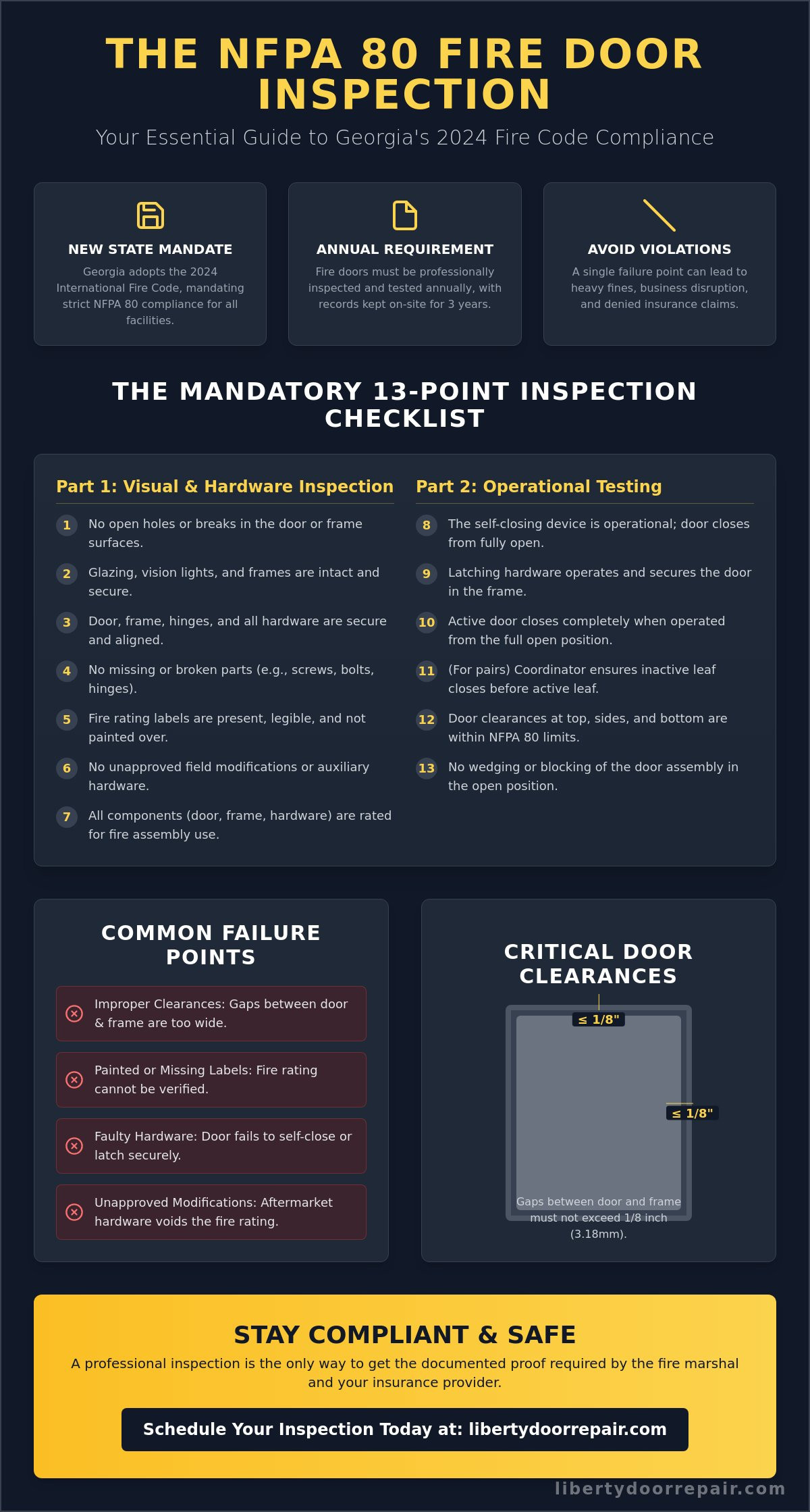
The annual inspection isn’t a suggestion. It’s a strict legal requirement. The NFPA 80 Standard outlines 13 specific points that every door must pass. If a single point fails, the entire assembly is non-compliant. A professional fire door assembly inspection in Georgia meticulously evaluates every component from the frame to the latch. Inspectors don’t just look at the door. They test the entire system under operational stress to ensure it performs when lives are on the line.
NFPA 80 Criteria 1 through 7: Hardware and Surfaces
Inspectors start by looking at the physical condition of the door. They check for holes or breaks in the door and frame surfaces. Every screw, bolt, and hinge must be present and secured tightly. Missing fasteners are a red flag for any fire marshal. We often see doors where labels have been painted over or removed. This is an automatic failure. Fire-rated labels must be attached and legible to prove the door’s hourly rating. If you’ve made field modifications, like adding unapproved security hardware, you’ve likely voided the fire label. All glazing and vision light frames must be intact and securely fastened with the correct fire-rated glass.
NFPA 80 Criteria 8 through 13: Operation and Latches
Once the physical structure is cleared, the focus shifts to how the door moves. The assembly must be self-closing and self-latching without human intervention. Functional testing is rigorous. The door must close completely from the fully open position and latch securely every time. For double doors, a coordinator must ensure the inactive leaf closes before the active leaf. If the doors close in the wrong order, smoke can easily bypass the barrier. Clearances are also vital. Between the door and the frame, the gap must usually be less than 1/8 inch at the top and sides. If the gap is too wide, the door won’t stop the spread of fire. Finally, verify that no auxiliary items, like door wedges or furniture, interfere with the door’s operation. If you’re unsure about your building’s current status, professional fire door services can identify these issues before an official walkthrough.
Common Fire Door Failure Points and Remediation
Failing a fire door assembly inspection in Georgia is often caused by minor issues that have a major impact on safety. The most frequent violation involves improper clearances. NFPA 80 allows very little room for error. The gap between the door and the frame at the top and sides must not exceed 1/8 inch. At the bottom, the undercut must be 3/4 inch or less. If these measurements are off, the door cannot effectively block smoke and fire. Precision is non-negotiable.
Other common failure points include:
- Broken or leaking commercial door closers.
- Torn or missing smoke seals and intumescent gaskets.
- Non-compliant field modifications, such as unrated deadbolts or kick-plates installed by maintenance staff.
- Painted-over fire labels that make the door’s rating impossible to verify.
Fixing Door Closer and Latching Issues
A door that doesn’t latch is useless in a fire. Commercial door closers often lose tension over time or leak hydraulic fluid. This prevents the door from closing completely. Our technicians prioritize adjusting or replacing these units to ensure the door hits the strike plate with enough force to engage the latch every time. We also specialize in repairing panic devices & push bars to guarantee positive latching during high-traffic use. While some hardware can be repaired with new springs or fasteners, fire-rated hardware must be replaced if the internal mechanism is compromised.
Addressing Labeling and Integrity Problems
A missing or illegible label is a critical failure. If a label is painted over, don’t try to scrape it off yourself. This can damage the metal and lead to a rejection by the fire marshal. Instead, professional cleaning or a recertification process is required. Integrity issues often arise with hollow metal doors where holes have been drilled for unapproved hardware. These holes must be filled with steel fasteners or fire-rated caulk using approved methods. Never use wood filler or non-rated putty for a quick fix. These materials will fail instantly in a fire, putting your building at risk.
Remediation is about speed and accuracy. Once our technicians identify a problem during a fire door assembly inspection in Georgia, we provide direct solutions to bring the assembly back into compliance immediately. This proactive approach keeps your facility safe and your business running without interruption. Don’t wait for a failed inspection to address these common issues.
Choosing a Certified Fire Door Inspector in Metro Atlanta
Selecting the right professional is the most important decision you’ll make for your facility’s safety. Not all door technicians are qualified to perform a fire door assembly inspection in Georgia. You need a specialist who understands the nuances of NFPA 80 and the specific amendments adopted by the state on January 1, 2026. Certification from organizations like the Door and Hardware Institute (DHI) or the National Institute for Certification in Engineering Technologies (NICET) is a baseline requirement. These credentials prove the inspector has the technical knowledge to identify life-safety risks that an untrained eye would miss.
Experience in the local market is equally vital. A company Serving North Georgia businesses since 2015, brings a level of stability and reliability that newer outfits can’t match. They’ve seen how Georgia’s humidity affects door hardware and know exactly what local fire marshals look for during a walkthrough. Always verify that your chosen provider carries comprehensive liability insurance specifically for commercial fire door work. This protects your business if an issue arises during the testing process. Documentation is your only proof of compliance. A generic invoice won’t satisfy a fire marshal. You need a detailed, multi-point report that tracks every door’s location, rating, and test results. This record-keeping is a legal mandate. Your insurance provider will also require this documented proof to maintain your coverage and lower your liability profile.
Local Expertise in Alpharetta, Marietta, and Decatur
Municipal fire codes can vary slightly between cities like Alpharetta, Marietta, and Decatur. A local specialist understands these regional differences and maintains professional relationships with the local Authority Having Jurisdiction (AHJ). We provide fast response times for businesses in Suwanee, Norcross, and Roswell. This ensures your documentation is ready before your scheduled inspection. Knowing the local fire marshal’s expectations allows us to prepare your facility for a successful, stress-free visit without the fear of unexpected penalties.
Questions to Ask Your Inspector
Before you hire, ask these critical questions to ensure you’re getting AHJ-ready service:
- Do you provide a written report that satisfies NFPA 80 Section 5.2.2? (The AHJ requires specific data points, not just a pass/fail sticker).
- Can you perform commercial door repairs immediately if a failure is found?
- Are your technicians trained on automatic door systems and fire integration?
If your inspector can’t provide immediate remediation, you’ll be left with a failed report and a ticking clock from the fire marshal. Choose a partner who can fix the problem on the spot during your fire door assembly inspection in Georgia. This efficiency minimizes business disruption and ensures you don’t have to pay for multiple service calls. Secure your facility today by scheduling a professional fire door inspection with our certified team.
Professional Fire Door Assembly Services by Liberty Door Repair
Liberty Door Repair provides the technical mastery required to keep your facility compliant. Our team specializes in the rigorous fire door assembly inspection georgia mandates for all commercial properties. We don’t just identify problems; we solve them. Our technicians handle expert remediation for swinging, sliding, and rolling fire doors to ensure every component meets NFPA 80 standards. From fixing a failed closer to replacing worn smoke seals, we restore your building’s safety barriers effectively.
Our remediation services cover a broad range of hardware. We stock high-quality door parts and replacements to minimize downtime. If a fire door fails to latch or stay closed, we can often adjust the hardware during the same visit. This swift action keeps your building secure and safe without the need for multiple appointments. We understand that a failed door is a liability you can’t afford.
Our Inspection and Documentation Process
Our process starts with a comprehensive site walkthrough. We evaluate every opening against the 13-point criteria. Every hinge, latch, and clearance is measured with precision. Once the inspection is complete, we generate detailed digital reports. These documents are designed to be audit-ready for the fire marshal. Digital reporting makes fire marshal audits seamless. Instead of hunting through paper files, you can present a clear, professional PDF that details every door’s status. This transparency builds trust with the AHJ and proves your commitment to life safety. We also offer proactive maintenance plans to identify wear and tear before it leads to an inspection failure.
Schedule Your Georgia Compliance Check
We’ve served the local community since 2015. Our technicians understand the specific needs of businesses in Atlanta, Brookhaven, Cumming, and the surrounding area. Reliability is the cornerstone of our service. Our team is ready to provide the professional support your facility requires. Don’t wait for a fire marshal to find a violation during a surprise visit. Proactive maintenance is the best way to prevent failures and ensure occupant safety. Contact Liberty Door Repair for a professional inspection today and secure your compliance for 2026. We’re the dependable local specialists you can trust for all your fire door and commercial hardware needs.
Secure Your Facility for the 2026 Fire Season
Compliance is not a one-time event; it’s a continuous commitment to life safety. Georgia’s strict adoption of current fire codes means your facility must be ready for a walkthrough at any moment. You now understand the complexity of the mandatory 13-point checklist and the risks associated with improper clearances or missing labels. A professional fire door assembly inspection in Georgia ensures these technical details are handled correctly before the fire marshal arrives. Missing even a minor detail can lead to failed inspections, fines, or insurance complications.
Liberty Door Repair has served North Georgia businesses since 2015. Our AAADM-certified technicians provide the specialized expertise needed to navigate these regulations without stress. We deliver comprehensive AHJ-ready documentation and immediate remediation to keep your business running smoothly. Schedule Your NFPA 80 Fire Door Inspection with Liberty Door Repair today to protect your building and its occupants. You’ve worked hard to build your business, and we’re here to help you keep it safe and fully compliant.
Frequently Asked Questions
How often is a fire door assembly inspection required in Georgia?
Fire door assembly inspections are required annually in Georgia. This frequency is mandated by NFPA 80 and was reaffirmed by the state’s adoption of the 2024 International Fire Code on January 1, 2026. Every 12 months, a qualified professional must test and document the performance of your opening protectives to maintain compliance.
What happens if my business fails a fire door inspection?
Failing an inspection results in a formal notice of violation from the fire marshal. You’ll be given a specific deadline to correct the deficiencies before a follow-up visit is scheduled. Unresolved failures can lead to significant fines, increased insurance liability, or the temporary closure of your facility until the life-safety issues are resolved.
Can I perform my own fire door inspections to save money?
Self-inspections are not recommended and are typically rejected by the Authority Having Jurisdiction (AHJ). NFPA 80 requires inspections to be performed by “qualified persons” with specialized knowledge and training. Professional inspectors provide the detailed technical reports that satisfy both legal mandates and insurance provider requirements.
What are the most common reasons fire doors fail inspection in Atlanta?
The most common reasons for a failed fire door assembly inspection in Georgia include improper clearances and faulty closing mechanisms. We frequently find doors with gaps exceeding 1/8 inch at the top or sides, which allows smoke to bypass the barrier. Other frequent issues include painted-over fire labels and unapproved hardware modifications that void the door’s certification.
Do all fire doors in my building need to be inspected annually?
Yes, every fire-rated door assembly in your facility must undergo an annual inspection. This includes swinging, sliding, and rolling fire doors regardless of how often they are used. Even doors in low-traffic areas must be tested to ensure they close and latch automatically during an emergency without human intervention.
What specific documentation do I need for the Georgia Fire Marshal?
You must provide a detailed report that complies with NFPA 80 Section 5.2.2. This document needs to include the specific location of each door, its hourly fire rating, the date of the test, and the inspector’s credentials. Georgia law requires you to keep these records on-site and available for review for at least three years.
Is a “drop test” required for every fire door inspection?
A “drop test” is specifically required for rolling fire doors to verify they close at a safe and effective speed. While swinging fire doors don’t require a drop test, they must undergo rigorous functional testing of their self-closing and self-latching hardware. Both procedures are critical components of a professional safety audit.
Can Liberty Door Repair fix a failing fire door during the same visit?
Liberty Door Repair technicians can often perform remediation during the same service call to save you time and money. We carry an extensive inventory of fire-rated parts to address common failures like leaking closers or broken latches immediately. This efficiency ensures your fire door assembly inspection in Georgia results in a passing grade and immediate peace of mind.