

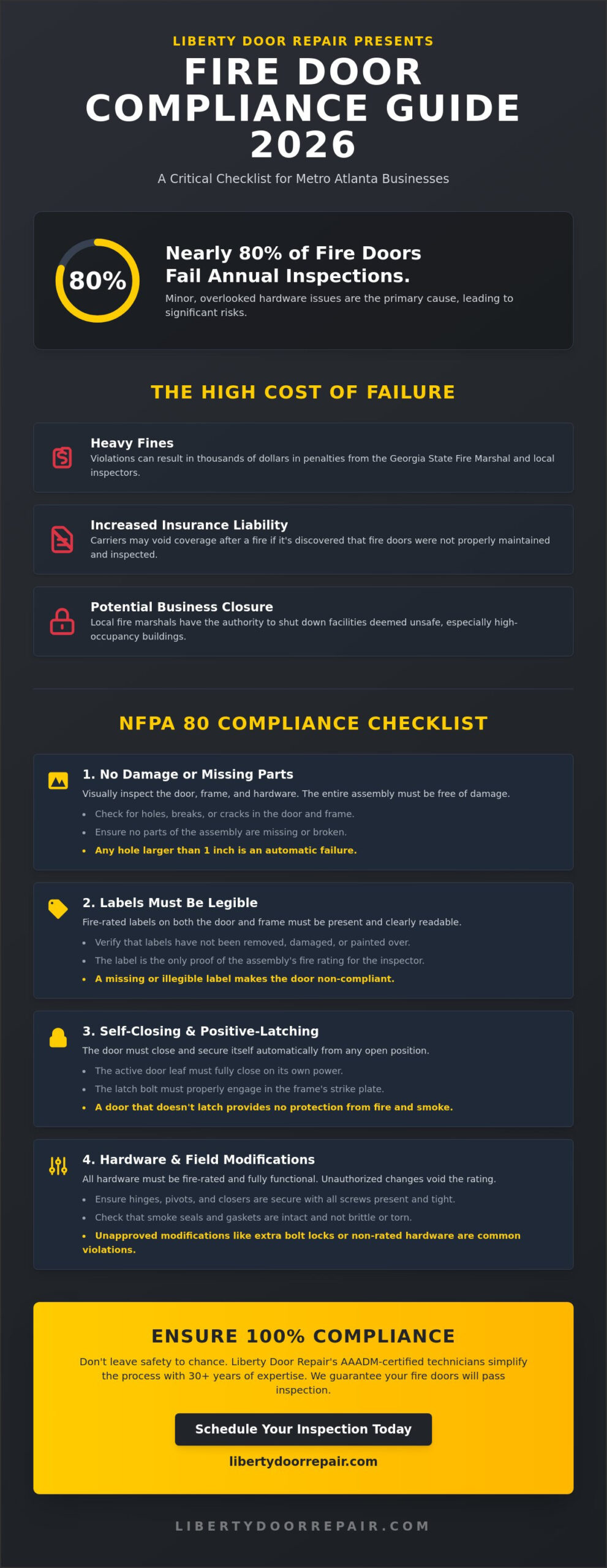
According to industry reports, nearly 80% of fire doors fail their annual inspections due to minor hardware issues that facility managers often overlook. In Metro Atlanta, these small errors can lead to heavy fines from local fire marshals and increased insurance liability. We know that trying to reconcile NFPA 80 standards with the International Building Code and specific Georgia amendments is confusing. You shouldn’t have to worry about whether your aging door hardware will hold up during a surprise walkthrough. As a trusted expert with 30+ years of experience, Liberty Door Repair is here to simplify the process for you.
This 2026 guide provides a professional fire door compliance checklist for business owners and managers. Our goal is to ensure you pass your next inspection without a single violation. We’ll cover everything from proper latching and closing speeds to the specific clearance requirements mandated by the state of Georgia. Follow this expert-led breakdown to protect your occupants and keep your facility running smoothly.
Key Takeaways
- Understand why meeting Georgia State Fire Marshal standards is a critical life-safety requirement for every Metro Atlanta facility in 2026.
- Utilize our comprehensive fire door compliance checklist for business to identify structural damage and verify essential fire-rated labels.
- Avoid the common misconception that a fire-rated label alone ensures compliance, especially when dealing with uncertified repairs.
- Prepare for your annual inspection by conducting a professional walkthrough and organizing all necessary maintenance and inspection records.
- Leverage the expertise of AAADM-certified technicians with 30+ years of experience to resolve complex fire-rated assembly issues quickly.
Why Fire Door Compliance is Non-Negotiable for Metro Atlanta Businesses
Fire doors are more than just heavy entryways. They are critical life-safety devices engineered to contain smoke and fire during an emergency. To understand the basics of these systems, you can explore What is a Fire Door? and how it functions as part of a passive fire protection strategy. For Metro Atlanta business owners in 2026, staying compliant isn’t a suggestion. It’s a legal requirement enforced by the Georgia State Fire Marshal and local municipal inspectors.
Failing an inspection carries heavy risks. You face immediate fines, potential business closure, and sharp increases in your insurance premiums. A single faulty latch or a painted-over label can lead to a failed inspection report. This is why a fire door compliance checklist for business is an essential tool for every facility manager. It ensures your “total assembly” is functional. This concept means the door, frame, hinges, and hardware must all work together perfectly. If one component fails, the entire door is considered non-compliant and dangerous.
- Fines can reach thousands of dollars per violation depending on the jurisdiction.
- Insurance carriers may void coverage after a fire if doors weren’t properly maintained.
- Local fire marshals have the authority to shut down high-occupancy buildings immediately.
Liberty Door Repair brings 30+ years of experience to every job. We understand that a broken door is an urgent problem. Our technicians are AAADM-certified and ready to ensure your facility meets every safety standard. Don’t wait for a surprise inspection to find out your hardware is failing.
The Legal Framework: NFPA 80 and the International Building Code
The National Fire Protection Association (NFPA) 80 is the primary standard for fire door maintenance and testing. It dictates how you must repair and inspect every opening. Meanwhile, the International Building Code (IBC) determines where these doors must be placed based on building type. To stay within the law, you must schedule your professional assessments properly. The required annual inspection window for fire-rated doors is strictly defined as 9 to 15 months between service dates.
Local Enforcement in Cities like Alpharetta, Marietta, and Roswell
Local enforcement varies across the Metro Atlanta area. In Alpharetta and Marietta, inspectors often focus on high-traffic commercial zones and new mixed-use developments. Roswell marshals are known for rigorous walkthroughs in historic districts where older buildings present unique fire risks. Common triggers for a surprise inspection include recent building permits, citizen complaints, or a change in business occupancy. Metro Atlanta businesses in high-occupancy zones face stricter enforcement because the life-safety stakes are much higher in crowded environments. Using a professional fire door compliance checklist for business helps you stay prepared for these unannounced visits.
The Essential NFPA 80 Fire Door Compliance Checklist for 2026
NFPA 80 standards aren’t suggestions; they’re legal requirements for every Metro Atlanta business. Every fire door must function as a life-safety system designed to compartmentalize smoke and flames. Start your fire door compliance checklist for business with a thorough visual sweep of the door surface. Look for holes, breaks, or warped sections in the door or frame. Any hole larger than 1 inch in diameter that isn’t filled with an approved fire-rated material is an automatic failure. You must also verify that fire-rated labels are present and legible on both the door and the frame. If these labels are painted over or removed, you can’t prove the assembly’s hourly rating during an inspection.
Field modifications are a common reason for non-compliance. Don’t drill extra holes for unapproved security hardware or add oversized kickplates. Any modification that isn’t specifically allowed by the door’s listing voids the fire rating immediately. For double-door sets, the door coordinator must function perfectly. This device ensures the inactive leaf closes before the active leaf, creating a tight seal against fire spread.
Hardware and Gasketing Requirements
Missing or broken hardware is a major liability. Check every hinge, pivot, and closer to ensure they’re securely attached and functional. Every screw must be present and tight. We often see failures caused by using non-rated screws or hardware, which can’t withstand the extreme heat of a fire. Evaluate smoke seals and intumescent strips for integrity. If they’re torn, brittle, or missing, the door won’t stop toxic gases from moving between rooms. Our trusted expert technicians have seen how 30+ years of wear can degrade these components, making professional replacement essential.
Clearance and Gap Measurements
Precision is mandatory for NFPA 80 compliance. You must measure the “under-door” clearance; the maximum allowed is 3/4 inch from the bottom of the door to the floor. For wood doors, the top and side gaps must stay within the 1/8 inch standard. Steel doors allow for slightly more at 1/8 inch plus or minus 1/16 inch. Excessive gaps allow lethal smoke transfer to bypass the door, which is the leading cause of death in commercial building fires.
The Self-Closing Mechanism Test
A fire door that stays open is a chimney for fire. Follow these steps for an accurate test:
- Open the door to its fully extended position and release it.
- Ensure the door closes completely without hitting any obstructions.
- Verify the latch fully engages the strike plate without manual assistance.
- Check for common violations like floor mats, propped-open wedges, or decorative items that block the swing path.
If the latch doesn’t click into place every single time, the door is non-compliant. These mechanisms must work reliably to protect your staff and property. If you find issues during your fire door compliance checklist for business, address them immediately to avoid heavy fines and safety risks.
Beyond the Label: Why ‘Fire Rated’ Doesn’t Always Mean Compliant
The biggest misconception among Metro Atlanta facility managers is the belief that a metal label guarantees a pass. A fire-rated door is only a compliant door if it functions perfectly as a system. If your door has the correct UL label but fails to latch, it’s a liability, not a safety feature. This oversight is a leading reason why companies fail their fire door compliance checklist for business during annual inspections. Local fire marshals in 2025 have reported that nearly 40% of fire door failures stem from poor maintenance rather than the door’s original construction.
Hiring a general handyman for these repairs is a dangerous shortcut. Uncertified contractors often use standard hardware instead of fire-rated components. They might use non-rated screws or fasteners that can’t withstand high temperatures. This compromises the entire assembly. We also see many instances where labels are painted over or removed during renovations. A door without a legible label is treated as a non-rated door by inspectors, regardless of its actual core material. In Atlanta warehouses, the most common violation is propping doors open with wedges or fire extinguishers. This simple act defeats the door’s purpose and allows smoke to bypass critical fire barriers in seconds.
Common Hardware Failures in High-Traffic Atlanta Stores
Busy retail storefronts in areas like Midtown or Buckhead put immense strain on door hardware. Heavy-duty closers are usually the first to fail. When these components leak hydraulic fluid, the door loses its ability to self-close. This is a direct violation of safety codes. Panic bars also present a unique challenge. These must allow for immediate egress while maintaining a secure fire seal. Natural wear and tear on hinges leads to “door sag.” If the gap between the door and the frame exceeds 1/8 inch, the door won’t stop the spread of smoke and heat effectively. Liberty Door Repair technicians identify these issues before they lead to fines.
The Risk of Uncertified Modifications
Adding security cameras, card readers, or secondary locks can inadvertently ruin your compliance status. Any hole drilled into the door that isn’t covered by a listed protection device pierces the fire-rated core. This creates a path for flames to travel through the assembly. Every component used in a repair, from the strike plate to the hinges, must be fire-certified. All door parts & replacements must be UL-listed to maintain the original integrity of the opening. Liberty Door Repair is a trusted expert with 30+ years of experience. We ensure that every replacement part we install meets the strict NFPA 80 requirements. Don’t risk your business’s safety on uncertified modifications that can’t handle the heat.
Preparing for Your Annual Fire Marshal Inspection in Metro Atlanta
Don’t wait for the Fire Marshal to knock. A failed inspection leads to costly fines or immediate business closures. You should use your fire door compliance checklist for business to perform a thorough pre-inspection walkthrough at least 30 days before your scheduled date. This window gives you enough time to address mechanical failures or hardware issues without the pressure of an active citation. It’s the most effective way to protect your bottom line and your occupants.
- Inspect all labels to ensure they’re legible and securely attached.
- Test self-closing devices to confirm the door latches fully from any position.
- Verify that no field modifications, like drilled holes, have compromised the door’s fire rating.
- Confirm that all gaskets and seals are intact and free of paint or damage.
Staff training is a critical part of this preparation. Employees often prop doors open with wedges or fire extinguishers to improve airflow. This practice violates NFPA 80 standards and puts lives at risk. You must ensure your team understands that fire-rated openings must remain clear and unobstructed at all times. If a marshal sees a single door propped open, it can trigger a deeper, more aggressive audit of your entire facility.
Documenting Your Fire Door Maintenance
In 2026, documentation is as important as the hardware itself. Your Fire Door Inspection Report (FDIR) must be comprehensive. It needs to include the date of inspection, the name of the inspector, and a detailed log of every door’s performance. Metro Atlanta marshals expect to see records covering at least the last 3 years of maintenance. Digital records are highly recommended for multi-location businesses. They allow you to pull up compliance data instantly on a tablet or smartphone during a walkthrough. This speed shows the marshal that you take safety seriously.
Working with AAADM-Certified Technicians
Compliance is complex, especially when integrated with modern security systems. Working with a commercial door repair atlanta specialist provides the technical expertise needed for high-traffic facilities. If your building utilizes automatic door services, certification isn’t just a preference; it’s a necessity.
AAADM-certified technicians have the training to calibrate closing speeds and sensor ranges to exact safety specifications. This professional oversight shields business owners from liability and ensures that every repair meets the 2026 Georgia State Fire Code. Liberty Door Repair brings 30+ years of experience to ensure your facility is ready for any inspection. We identify the gaps that general handymen miss.
Liberty Door Repair: Your Partner for Fire Door Compliance
Liberty Door Repair is the trusted expert for Metro Atlanta businesses. We’ve spent 30+ years ensuring commercial properties stay safe and operational. Our team consists of AAADM-certified technicians who specialize in fire-rated assembly repair and maintenance. We understand the local fire codes in 2026 and the specific demands of the Georgia fire marshal. Whether you manage a retail space in Alpharetta, a warehouse in Marietta, or an office complex in Sandy Springs, we provide the reliable solutions you need to stay compliant.
A broken fire door is a liability. It’s not just about passing an inspection; it’s about life safety. We offer comprehensive fire door services that take the guesswork out of facility management. Our technicians arrive with the tools and knowledge to address issues immediately. We value your time and prioritize fast response times to keep your business running without interruption.
Our Fire Door Inspection and Repair Process
Our process starts with a detailed multi-point inspection. We follow NFPA 80 guidelines to the letter. We check every component on your fire door compliance checklist for business to ensure 100% functionality. Our technicians verify door gaps, seal integrity, and the self-closing speed of every unit. We don’t just spot problems; we solve them.
- On-site repairs: We fix door closers, panic bars, and latching hardware during the initial visit whenever possible.
- Hardware replacement: We use high-grade, fire-rated components that meet or exceed local building codes.
- Formal reporting: You receive a professional report for your records. This documentation is essential for your fire marshal visits and insurance audits.
Protect Your Business and Your People
Proactive maintenance is a smart financial decision. The cost of a scheduled repair is significantly lower than the price of emergency violation fines or legal fees after an incident. Industry data suggests that regular inspections can reduce emergency repair costs by up to 35% over the life of the door. We help you stay ahead of the fire door compliance checklist for business so you never have to worry about a surprise inspection failure.
Sometimes, a door is too damaged to save. If your assembly is beyond repair, we provide clear options for a commercial door replacement. We help you choose the right fire-rated materials that fit your budget and your building’s aesthetic. Our goal is to provide a seamless transition from a failing door to a fully compliant entrance.
Don’t wait for a fire marshal to find a problem. Schedule your fire door compliance inspection today!
Secure Your Metro Atlanta Facility Before Your Next Inspection
Don’t let a failed inspection or a safety violation disrupt your operations. Staying current with the fire door compliance checklist for business is a year-round responsibility that requires technical precision. NFPA 80 standards for 2026 demand more than just a visible label; they require fully functional hardware, proper closing speeds, and gap-free seals. Liberty Door Repair brings 30+ years of Metro Atlanta experience to every job site. Our AAADM-certified technicians understand the specific codes enforced across 20+ cities including Alpharetta, Marietta, and Roswell. We handle the technical details so you can focus on your business with total peace of mind. Whether you’re preparing for an annual Fire Marshal visit or need immediate repairs to a damaged frame, we provide the reliable solutions you need. Protect your property and stay compliant with help from a trusted expert who gets the job done right. We’re ready to help you meet every safety standard today.
Get Expert Fire Door Compliance Help Now
Frequently Asked Questions
How often are fire doors required to be inspected for a business?
Fire doors must undergo a professional inspection at least once every 12 months according to NFPA 80 standards. This annual requirement ensures all components like hinges, gaskets, and closers function during a fire. Businesses in Metro Atlanta must maintain written records of these inspections for the Fire Marshal to review during their own 365-day check cycles. Don’t skip this yearly task or you’ll face heavy fines.
Who is authorized to perform a fire door inspection in Georgia?
A “qualified person” with specialized knowledge and training must perform the inspection as defined by NFPA 80 Section 3.3.95. Liberty Door Repair provides skilled technicians with 30+ years of experience to handle these critical safety checks. Our team understands the specific local codes enforced by the Georgia Office of Commissioner of Insurance and Safety Fire. We act as your trusted expert to ensure every door meets 2026 standards.
Can I repair a fire door myself if it fails inspection?
You shouldn’t attempt fire door repairs yourself because NFPA 80 requires repairs to be completed by a qualified person using labeled, fire-rated components. Using the wrong screw or sealant voids the door’s certification and creates a safety liability. Our AAADM-certified experts ensure every fix meets the strict fire door compliance checklist for business standards required in Georgia. We use only certified parts to maintain the door’s integrity.
What happens if the fire-rated label on my door is missing or painted over?
A missing or painted label results in an immediate inspection failure because the fire rating cannot be verified. NFPA 80 Section 4.2.1 states that labels must be legible for the life of the assembly. If your label is obscured, you’ll need a field labeling service or a door replacement to regain compliance with Metro Atlanta safety codes. Our technicians can help identify if a door is worth the cost of recertification.
Is a fire door the same as an exit door?
Fire doors and exit doors serve different primary functions, though one door often performs both roles. A fire door is designed to contain smoke and flames within a specific compartment for 20 to 180 minutes. An exit door provides a clear path for occupants to leave the building. Both must meet specific NFPA 101 Life Safety Code requirements to stay legal and functional during an emergency.
What is the maximum allowable gap under a fire door?
The maximum allowable clearance between the bottom of the door and the floor is 3/4 inch according to NFPA 80 Section 4.8.4.1. If the gap exceeds this 0.75-inch limit, the door won’t effectively block smoke or heat. We use precision tools to measure these gaps during every fire door compliance checklist for business assessment. If your gap is too large, our skilled technicians provide reliable solutions to bring it back into code.
Does a fire door have to be self-closing?
Yes, every fire door must be self-closing or automatic-closing to ensure it shuts completely during an emergency. NFPA 80 Section 6.1.4.2 requires the closing mechanism to overcome the resistance of the latch. Our technicians check the closing speed and latching force to confirm the door secures firmly into the frame every single time it’s opened. If your door stays propped open, it’s a major safety violation that requires immediate repair.
Are there specific fire door requirements for Atlanta high-rise buildings?
Atlanta high-rise buildings must comply with the 2018 International Building Code and specific Georgia safety amendments. These structures often require 90-minute or 120-minute fire-rated assemblies in stairwells and elevator lobbies to protect vertical exit paths. Our trusted experts have spent 30+ years navigating these complex urban requirements. We help Metro Atlanta commercial properties stay fully compliant with all local ordinances through fast, professional service.