

In 2026, a “heavy” front door isn’t just an inconvenience; it’s a direct violation of Georgia’s updated accessibility codes. With the state’s recent adoption of the 2024 International Building Code and specific local amendments, your business entrance must meet rigorous standards to avoid costly fines or litigation. You likely feel the pressure of keeping up with these changing regulations while trying to run your daily operations without disruption. It’s confusing to distinguish between low-energy and high-energy operators, and you shouldn’t have to guess which one keeps you compliant.
This guide explains everything you need to know about professional ada door opener installation atlanta to ensure your property passes every inspection. We will break down the latest technical requirements from the Georgia Safety Fire Commissioner and show you how to choose a durable system that improves customer experience. From understanding ANSI standards to finding reliable local maintenance, you’ll gain the clarity needed to secure your facility’s future and provide seamless access for every visitor.
Key Takeaways
- Identify how Georgia’s updated 2026 accessibility codes and Fire Commissioner regulations impact your specific building entrance requirements.
- Compare low-energy and high-energy operators to select the most efficient hardware for your specific door material and foot traffic volume.
- Master the technical clearance and opening force standards required for a successful ada door opener installation atlanta that passes every inspection.
- Follow a professional, step-by-step installation process to ensure structural integrity and power supply compatibility without disrupting your operations.
- Implement a seasonal maintenance strategy to protect electronic sensors and motor lubrication from Atlanta’s high humidity and extreme temperature fluctuations.
Why ADA Door Compliance is Critical for Atlanta Businesses
ADA-compliant door openers are automated systems designed to provide barrier-free access to buildings. These devices use motorized operators to swing or slide doors open without requiring physical force from the user. For a business in Metro Atlanta, this technology is no longer an optional upgrade. It’s a fundamental requirement for operating a public-facing facility. Professional ada door opener installation atlanta ensures that your entrance meets the specific height, weight, and force requirements set by federal law.
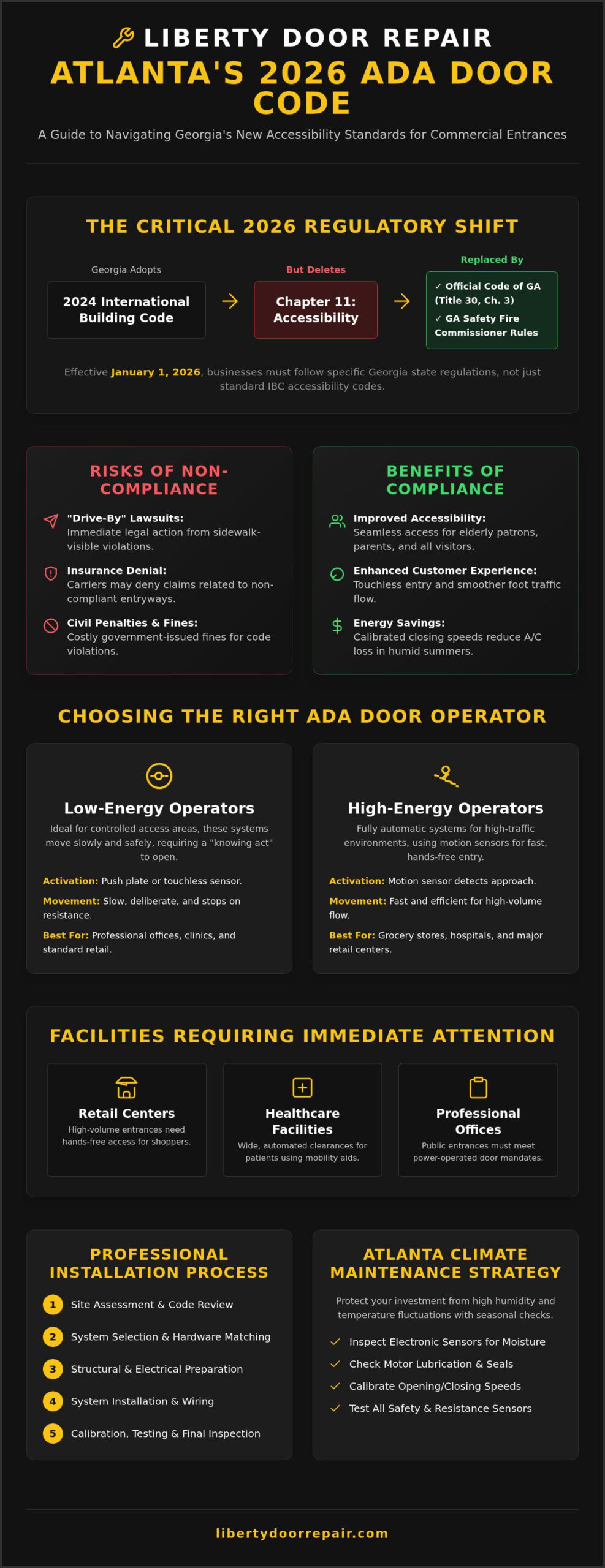
The legal landscape shifted significantly as of January 1, 2026. Georgia has adopted the 2024 International Building Code (IBC), but there’s a critical local twist. The state deleted Chapter 11 on Accessibility from its amendments. Instead, businesses must now comply with Title 30, Chapter 3 of the Official Code of Georgia Annotated and the Rules and Regulations of the Georgia Safety Fire Commissioner. This change means local expertise is vital. You can’t rely on generic national advice; you need a specialist who understands how Georgia’s Safety Fire Commissioner interprets these rules for public entrances.
The Consequences of Non-Compliance
Ignoring these standards carries heavy risks. “Drive-by” ADA lawsuits are a reality in Georgia, where plaintiffs identify visible compliance failures from the sidewalk and file suit immediately. These legal battles often cost far more than a high-quality installation. Beyond legal fees, your insurance carrier may deny claims related to entryway accidents if your hardware doesn’t meet current codes. ADA door compliance is a mandatory standard for public accommodations. Failing to meet it leaves your business vulnerable to civil penalties and reputational damage that can take years to repair.
Benefits of Automatic Entry for Modern Facilities
Modernizing your entrance does more than just stop lawsuits. It significantly improves foot traffic flow in busy storefronts from Buckhead to Decatur. Different Types of automatic door operators allow for touchless entry, which is a major draw for health-conscious customers. These systems aid elderly patrons, parents with strollers, and anyone with mobility devices, making your brand known for inclusivity.
There’s also a financial benefit to your utility bill. Professional ada door opener installation atlanta includes precise calibration of closing speeds. This ensures doors don’t stay open longer than necessary, which minimizes the loss of air-conditioned air during Georgia’s humid summers. High-traffic facilities like retail centers, healthcare clinics, and corporate offices see an immediate return on investment through improved accessibility and climate control.
Certain facility types in Atlanta require immediate attention to remain compliant:
- Retail Centers: High-volume entrances must support hands-free access for shoppers.
- Healthcare Facilities: Medical offices require wide, automated clearances for patients using wheelchairs or walkers.
- Professional Offices: Multi-tenant buildings must ensure that primary public entrances meet the 2024 IBC power-operated door mandates.
Choosing the Right ADA Door Opener System
Selecting the correct hardware for ada door opener installation atlanta depends on your building’s specific footprint and daily traffic volume. You must balance federal compliance with local durability needs. A high-traffic retail storefront in Alpharetta requires different hardware than a private medical office in Marietta. Choosing the wrong motor or arm type leads to premature system failure or, worse, a compliance violation during your next fire safety inspection. It’s vital to match the operator’s power to the weight of your door and the frequency of its use.
Low-Energy vs. High-Energy Operators
Low-energy operators are the standard for most Atlanta businesses. These systems require a “knowing act” to operate, such as pressing a wall switch or waving a hand near a touchless sensor. They move slowly and stop if they encounter resistance, making them safe for elderly patrons and those with limited mobility. High-energy operators are fully automatic. They use motion sensors to open as someone approaches. These are essential for high-volume grocery stores or department centers where shoppers have their hands full. Both types must adhere to the official ADA guidelines for doors regarding opening speed and force to remain legal.
Mounting Options: Surface Mounted vs. Overhead Concealed
Your door’s material determines the installation method and the long-term durability of the system. Consider these common configurations:
- Glass Storefronts: These often benefit from overhead concealed operators to maintain a clean, modern aesthetic.
- Hollow Metal Doors: Ideal for industrial settings, these provide the rigidity needed for heavy-duty operators.
- Wood Doors: Common in historic Atlanta properties, these may require specialized mounting plates to prevent the frame from splitting under torque.
Surface-mounted units are the most cost-effective choice for retrofitting existing buildings. They bolt directly to the header and are easily accessible for maintenance. We always evaluate your door frame strength before mounting hardware. If the frame is compromised, it must be reinforced to handle the constant stress of a commercial motor. Space constraints also dictate whether you need a swinging, sliding, or folding system. Sliding systems are superior for narrow entryways where a swinging door would block foot traffic.
For facilities requiring high security, these systems integrate seamlessly with modern access control solutions. This allows you to combine automated entry with keycard or biometric readers. The door will only automate once the electronic lock is successfully released. If you’re unsure which system fits your current layout, you should speak with a local technician to ensure your hardware selection matches your building’s needs and budget.
Key Requirements for ADA Door Opener Installation in Atlanta
A successful ada door opener installation atlanta starts with meeting strict dimensional requirements. Your entrance must provide a minimum clear opening width of 32 inches. This measurement is taken between the face of the door and the stop on the frame when the door is open at a 90-degree angle. If your existing frame is too narrow, simply adding an operator won’t make you compliant. You must ensure the entire pathway remains unobstructed for users with mobility devices.
Precision adjustment is the next critical step. Legal standards dictate exactly how much force is required to open a door and how quickly it must close. For low-energy systems, the door shouldn’t require more than 15 pounds of force to stop its motion. Closing speed must also be carefully timed; a door should take at least 5 seconds to move from an open position of 90 degrees to a point 12 degrees from the latch. Achieving these exact metrics requires professional automatic door services to calibrate the motor’s internal settings correctly.
Push Plate and Sensor Guidelines
Actuators and sensors must be placed where every visitor can reach them. Wall-mounted push plates should be installed between 34 and 48 inches above the finished floor. We often recommend wireless buttons for Atlanta renovations because they don’t require cutting into existing masonry or drywall. However, hardwired systems offer superior long-term reliability for high-traffic entrances. According to the U.S. Access Board ADA Standards, these controls must also be located in a position that allows a person to activate the door without being hit by it as it swings open. Safety sensors are mandatory to detect pedestrians in the door’s path and prevent contact accidents.
The Importance of AAADM Certification
You shouldn’t trust your liability to a general handyman or a standard locksmith. AAADM certification is the industry gold standard for safety. This certification ensures that the technician performing your installation or commercial door repair atlanta understands the complex interplay between ANSI standards and building codes. At Liberty Door Repair, our technicians bring over 30 years of experience to every project. We perform a comprehensive safety inspection after every installation to verify that your system operates within legal limits. This certified inspection provides a vital paper trail that protects your business from legal challenges and ensures a safe environment for all patrons.
The Installation Process: A Step-by-Step Guide
The success of an ada door opener installation atlanta depends on the preparation work done before the hardware even arrives. Our process begins with a rigorous site evaluation to check the structural integrity of your door frame and the availability of power. A weak header will fail under the constant torque of a commercial motor. We ensure the mounting surface is reinforced and the electrical supply is sufficient to prevent blown circuits or motor burnout during peak traffic hours.
Electrical and Structural Preparation
Commercial automatic openers typically require a dedicated 120V AC circuit to operate reliably. If you’re coordinating this with a full commercial door replacement, we work alongside your electrical contractors to ensure wiring is concealed and protected. For heavy-duty swing operators, reinforcing the header with steel plates is often necessary, especially in older Atlanta buildings where original frames weren’t designed for automation. This prep work prevents the operator from pulling away from the wall, which is a common cause of system failure in DIY or uncertified installations.
Once the structure is sound, we mount the operator box and connect the drive arm or slide track. This stage requires millimetre-precision to ensure the arm geometry allows the door to open fully to the required 90-degree angle. We then integrate the system with your building’s power and any existing access control panels. If you need a reliable team to handle this technical setup, contact Liberty Door Repair today for professional assistance.
Final Testing and AAADM Inspection
Fine-tuning is where we dial in the legal compliance metrics discussed earlier. We adjust the back-check, which prevents the door from slamming into the wall, and set the latching force to ensure the door closes securely without creating a hazard. Our AAADM-certified technicians verify every setting against ANSI A156.19 standards for low-energy doors or A156.10 for full-power systems. We don’t just walk away once the power is on; we perform a comprehensive handover that includes:
- Staff Training: We teach your team how to use manual override and emergency modes.
- Daily Safety Check: We provide a walkthrough of the simple daily tests you should perform to ensure the sensors are active.
- Compliance Documentation: You receive a record of the certified inspection to keep on file for your insurance and fire marshal.
This systematic approach ensures your entrance isn’t just functional, but also a durable asset that protects your business from liability. Don’t leave your compliance to chance; ensure your hardware is installed by experts who understand the local Atlanta codes inside and out.
Maintaining Your ADA Door System in the Atlanta Climate
Atlanta’s environmental conditions present unique challenges for electronic and hydraulic door hardware. High humidity levels during Georgia summers often lead to condensation on sensitive infrared sensors. This moisture causes “ghosting,” where the door opens and closes without a visitor present. Regular cleaning and moisture-wicking adjustments are essential to prevent this erratic behavior. Professional ada door opener installation atlanta includes weather-sealing these components, but ongoing maintenance is required to ensure the seal remains intact against the city’s heavy rainfall and heat.
Seasonal calibration is just as vital as the initial setup. Temperature swings in Metro Atlanta can cause hydraulic fluids within operators to change density. A door that closes perfectly in July might slam or fail to latch in January. We recommend biannual inspections to adjust the opening force and closing speed, keeping your facility within the strict legal limits discussed in previous sections. If your building uses an older or discontinued operator, sourcing reliable door parts & replacements becomes a priority to avoid a total system failure that leaves your entrance non-compliant.
Common Issues and Quick Fixes
Mechanical wear often manifests as loose drive arms or noisy motor cycles. If you hear grinding or clicking, the motor is likely straining against a misaligned door. Ignoring these sounds leads to a burnt-out operator and an expensive emergency repair. You should also pay close attention to doors that serve as fire exits. If your ADA opener is installed on a fire-rated entrance, any malfunction could compromise your building’s safety rating. In these cases, you need specialized fire door services to ensure the automation doesn’t interfere with the door’s ability to self-close and latch during an emergency.
Why Liberty Door Repair is Atlanta’s Choice
We’ve spent over 30 years serving the Metro Atlanta business community. Our team understands the specific stress that local weather puts on commercial hardware. We provide prompt, expert service across Marietta, Roswell, Decatur, and Alpharetta. Our technicians are AAADM-certified, which means every repair or ada door opener installation atlanta we perform meets the highest industry safety standards. We don’t just fix symptoms; we address the root cause of your door issues to ensure long-term reliability. Trust a local specialist who values your facility’s safety and accessibility as much as you do. Contact us to schedule your preventative maintenance before a small sensor glitch turns into a major liability.
Secure Your Entrance and Ensure Total Compliance
Meeting the 2026 Georgia accessibility standards isn’t just a legal chore; it’s a strategic move to protect your business and welcome every customer. You now understand that professional ada door opener installation atlanta requires more than just mounting hardware. It demands precise calibration, AAADM-certified expertise, and a proactive maintenance plan to handle the unique stress of our local climate. By prioritizing these standards, you transform your facility’s entrance from a potential liability into a seamless asset.
Don’t risk costly lawsuits or failed fire safety inspections with a non-compliant entryway. Our AAADM-certified technicians bring over 30 years of Metro Atlanta experience to every project, ensuring your doors meet every federal and local mandate. We offer free estimates for new installations to help you secure your facility with confidence and clarity. Request an ADA Door Compliance Assessment for Your Atlanta Business today to get started. Taking these professional steps now ensures your business remains a safe, accessible, and inclusive environment for every visitor who walks through your doors.
Frequently Asked Questions
Do all commercial doors in Atlanta need to be automatic to be ADA compliant?
Not every door must be automatic, but many high-traffic public entrances in Georgia now require them under the 2024 International Building Code. At least one public entrance must be power-operated in specific building types to meet accessibility mandates. Even when not strictly required, automation is the most reliable way to ensure your doors meet the legal opening force and maneuvering clearance standards required by the Georgia Safety Fire Commissioner.
How much does it cost to install an ADA door opener in a Metro Atlanta business?
The total investment for an ada door opener installation atlanta depends on the door material, the type of operator, and any necessary electrical or structural modifications. While basic surface-mounted units are more affordable, heavy-duty systems for high-traffic retail centers require more robust hardware. Factors like frame reinforcement and integration with access control systems also influence the final cost. We recommend getting a professional site assessment to determine your specific requirements.
What is the difference between a low-energy and high-energy door operator?
Low-energy operators require a “knowing act” like pressing a button or waving at a sensor to activate. They move slowly and stop if they hit an obstruction. High-energy operators open automatically via motion sensors and move at higher speeds. High-energy systems require more complex safety sensors and mats to prevent pedestrian accidents. Most Atlanta offices and small businesses choose low-energy operators because they are easier to maintain and highly effective for compliance.
Can an ADA-compliant opener be installed on an existing commercial door?
Yes, we can install ADA-compliant openers on most existing commercial doors in the Metro Atlanta area. Surface-mounted operators are designed for retrofitting storefronts, hollow metal doors, and even wood frames. Our technicians evaluate your existing frame’s strength and the door’s weight to ensure the motor can handle the load. This allows you to achieve full compliance and improve customer access without the high cost of a total door replacement.
How often should ADA automatic doors be inspected for safety?
You should schedule a professional AAADM safety inspection at least once a year to verify that all sensors and speeds meet current ANSI standards. Business owners in humid climates like Atlanta should also perform a simple daily safety check to look for “ghosting” or sensor delays. Regular maintenance prevents small mechanical issues from turning into major liabilities. It also ensures your entrance remains a durable asset that passes every fire marshal inspection.
What electrical power is required for a commercial automatic door opener?
Commercial automatic door openers generally require a dedicated 120V AC circuit. Using a dedicated line prevents power surges and ensures the motor operates consistently under heavy use. During the installation process, we verify that your building’s electrical infrastructure can support the operator. Proper wiring is essential for the long-term reliability of your ada door opener installation atlanta, especially when integrating the system with electronic locks or biometric readers.
Will an automatic door opener still work during a power outage in Atlanta?
If the power goes out, the automatic opening function will stop, but the door will still function as a manual entrance. ADA regulations require that the door can still be opened manually with a specific amount of force even without power. While some businesses choose to add battery backup systems for continued automation, the primary safety requirement is that the door never becomes a barrier to egress or entry during an Atlanta power failure.
Does ADA compliance require push buttons on both sides of the door?
Yes, if a low-energy operator is used to provide an accessible route, actuators are typically required on both sides of the door. This ensures that users can both enter and exit without physical struggle. The placement of these buttons is strictly regulated by the U.S. Access Board. They must be reachable for someone in a wheelchair and positioned so the swinging door doesn’t strike the user upon activation.