

A malfunctioning automatic door isn’t just a technical glitch; it’s a “Closed” sign for your business that invites liability risks and drives customers away. When your entrance fails, your bottom line suffers immediately. It’s frustrating to watch potential clients walk away because your doors won’t open, or worse, to worry about a pedestrian safety incident. Most automatic door sensor problems stem from environmental factors like sunlight or debris, but ignoring these signals can lead to costly security breaches or safety violations.
You need your facility to remain accessible and secure without the constant fear of a door staying stuck open at night. We’ll help you learn how to identify, troubleshoot, and resolve common automatic door sensor issues to keep your business safe and accessible. This guide explores everything from simple recalibration techniques to understanding when a major repair is necessary. You’ll gain the clarity needed to ensure your equipment meets current AAADM safety standards and functions reliably for every visitor who walks through your Metro Atlanta storefront.
Key Takeaways
- Learn how activation and presence sensors work together to keep your entrance moving safely.
- Identify the environmental factors that trigger common automatic door sensor problems and stall your customer traffic.
- Follow a professional troubleshooting checklist to see if a simple cleaning can fix your door immediately.
- Understand how AAADM safety standards protect your business from pedestrian accidents and legal risks.
- Discover when to contact a certified specialist for technical recalibration and hardware replacements.
Understanding Automatic Door Sensor Technology and Common Failures
Automatic doors rely on a sophisticated network of electronic components to provide seamless access. When these systems fail, the issue usually traces back to the sensors. These devices act as the eyes of the entrance, communicating directly with the motor to control movement. To understand modern systems, it’s helpful to look at the history of automatic door technology, which has evolved from simple floor mats to advanced microwave and infrared systems.
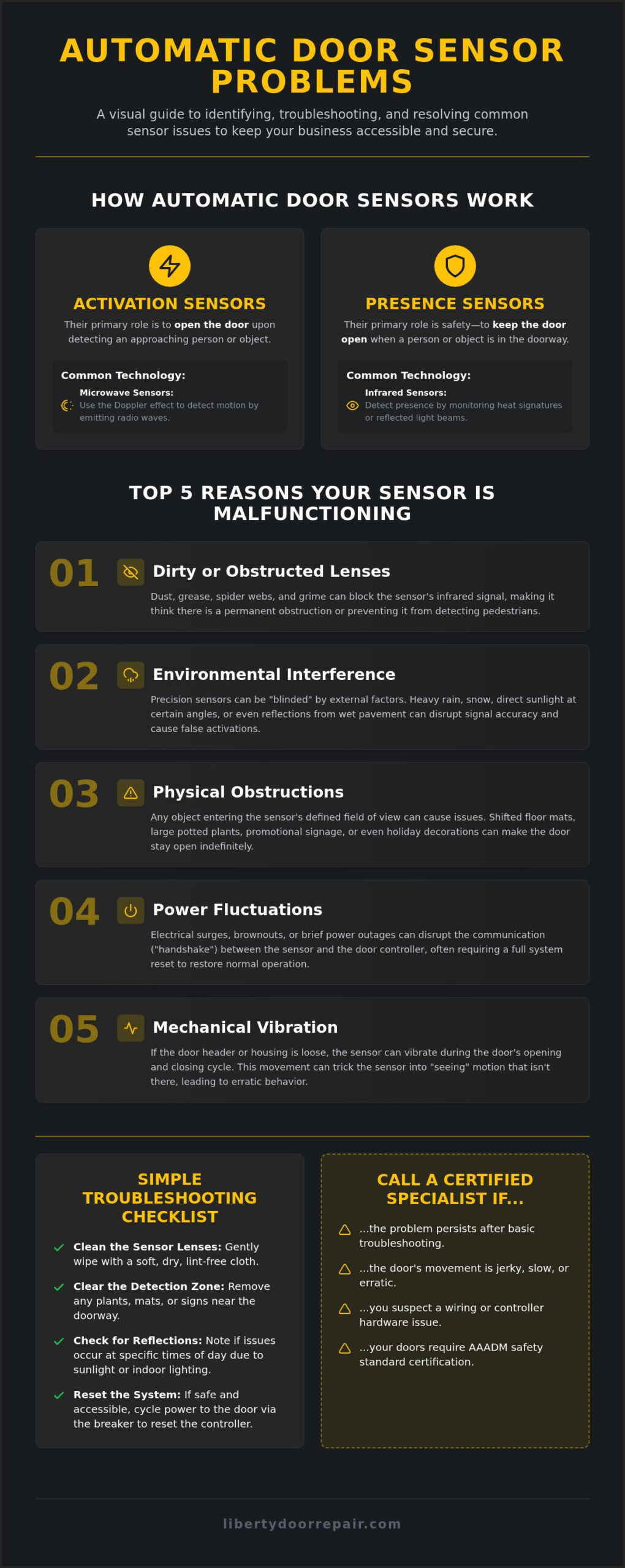
Sensors generally fall into two categories based on their primary role. Activation sensors focus on opening the door. They detect an approaching person and signal the controller to start the opening cycle. Presence sensors focus on safety. They ensure the door stays open while a person or object remains in the path of the panels. Most commercial systems feature header sensors mounted above the door to scan the approach area and threshold sensors positioned within the door frame to monitor the immediate closing zone. If either location is compromised, you’ll likely experience persistent automatic door sensor problems.
- Microwave Sensors: These use the Doppler effect to detect motion. They emit high-frequency radio waves that bounce off moving objects to trigger the door.
- Infrared Sensors: These detect presence by monitoring heat or light patterns. Active infrared sensors emit a beam and look for a reflection, while passive sensors monitor changes in the background thermal environment.
The Difference Between Motion and Presence Sensors
Motion sensors are highly effective for approach detection because they respond quickly to movement. They can occasionally be fooled by fast-moving objects like a bird or wind-blown debris. This is why presence sensors are vital for pedestrian safety. They prevent the door from closing on a stationary person, such as someone pausing in the doorway to adjust their bags. Modern commercial entrances typically utilize dual-technology sensors. These units combine microwave motion detection with infrared presence sensing to provide the most reliable operation possible.
Why Sensors Fail: An Overview of Electronic Components
The door controller acts as the central brain. It receives signals from the sensors and executes the opening and closing commands. If the controller fails to interpret these signals correctly, the door may freeze or behave erratically. Physical damage is another common culprit. Loose connections or frayed wires inside the header often cause intermittent signal loss. You might also encounter issues with environmental interference. Sensor ghosting is a phenomenon where environmental changes like moving shadows or sudden temperature shifts trigger false activations.
Top 5 Reasons Your Automatic Door Sensor Is Malfunctioning
Identifying why your entrance isn’t working is the first step toward a resolution. Most automatic door sensor problems aren’t caused by total component failure. Instead, they usually result from simple environmental changes or neglected maintenance that interferes with the device’s “line of sight.” Understanding these common triggers can help you determine if you need a quick cleaning or a professional technician.
- Dirty or Obstructed Lenses: Dust, grease, and spider webs are common culprits. These block the infrared signal, making the sensor think there’s a permanent obstruction or preventing it from seeing pedestrians at all.
- Environmental Interference: Sensors are precision instruments. Heavy rain, snow, or even direct sunlight at a specific angle can blind the receiver and disrupt signal accuracy.
- Physical Obstructions: Check your detection zone for shifted floor mats, seasonal plants, or promotional signage. If any object enters the sensor’s field of view, the door may stay open indefinitely.
- Power Fluctuations: Electrical surges and brownouts can desync the handshake between the sensor and the controller. This often requires a system reset to restore communication.
- Mechanical Vibration: If your door header is loose, the sensor may vibrate during the door’s operation. This movement tricks the sensor into “seeing” motion that isn’t there, leading to erratic behavior.
Environmental Factors in Metro Atlanta
In areas like Alpharetta and Marietta, high humidity and extreme pollen counts frequently cloud sensor covers. This buildup creates a sticky film that scatters infrared beams. Temperature extremes in Georgia also take a toll on battery-operated wireless components, causing them to fail prematurely. Additionally, reflections from rain-slicked pavement or highly polished lobby floors can cause false positives, keeping your doors open when no one is actually approaching. If your system struggles during heavy weather, it may be time to schedule professional automatic door services to adjust the sensitivity levels.
Ghosting and False Activations
Ghosting occurs when your door opens and closes repeatedly with no one in sight. This frustrating cycle is often caused by fluorescent lighting or radio frequency interference (RFI) from nearby electronics. In some cases, the sensor is simply misaligned. It begins to see the door panels themselves as they move, creating an endless loop of activation. You can often identify this by watching the sensor’s indicator light as the door cycles; if it triggers just as the panels move, the detection field is likely too wide or poorly angled.
Step-by-Step Troubleshooting for Commercial Door Sensors
Address automatic door sensor problems immediately to restore your facility’s accessibility and security. You don’t always need a technician for the initial diagnosis. Many issues result from simple setting errors or physical obstructions that you can resolve in minutes. Follow this systematic approach to identify the root cause of your door’s malfunction.
- Perform a Visual Inspection: Examine the sensor cover for hairline cracks, heavy dirt, or trapped moisture. Even a small amount of condensation inside the housing can refract infrared beams and cause erratic behavior.
- Check the Function Switch: Locate the main control switch, usually found on the door header or a nearby wall. Ensure it’s set to “Automatic.” It’s common for staff to accidentally leave the door on “Hold Open” or “Off” after cleaning or receiving deliveries.
- Clear the Threshold: Inspect the floor tracks and the area directly beneath the door. Remove pebbles, debris, or bunched-up floor mats. These items often enter the safety zone and prevent the door from completing its closing cycle.
- The Power Cycle Method: If the door is acting “confused,” perform a safe reboot. Turn the power switch off for at least 60 seconds before turning it back on. This allows the internal capacitors to discharge and clears minor software glitches in the door controller.
- Conduct a Walk-Test: Once you’ve cleared the area, walk toward the door to map the current detection zone. Note exactly where the door begins to open and ensure it provides enough time for a person to pass through safely.
The Daily Safety Check for Business Owners
Consistency is the key to preventing liability issues. Perform a walk-test every morning before opening to the public. Approach the door from different angles and speeds to ensure the activation sensor captures movement effectively. To test the safety zone, stand completely still in the threshold. The door should remain open as long as you are in the path. Document these checks in a dedicated safety log. This record serves as essential evidence of your commitment to pedestrian safety for insurance and compliance purposes.
Cleaning and Basic Maintenance
Use only safe cleaning agents on your sensor covers. A soft, lint-free cloth dampened with mild soap and water is usually sufficient. Avoid abrasive chemicals or glass cleaners containing ammonia, as these can cloud the plastic lens over time. While cleaning, check for loose mounting screws on the sensor housing. A wobbly sensor will vibrate during door operation, leading to false activations. If you find the housing is damaged beyond repair, consult our guide on door parts & replacements to find the correct hardware for your specific brand.
Safety Risks and AAADM Compliance Standards
Ignoring automatic door sensor problems creates more than just a convenience issue. It exposes your business to significant legal liability. The American Association of Automatic Door Manufacturers (AAADM) sets the industry benchmark for safety. These standards ensure that every power-operated door protects pedestrians from “door strike” accidents. If your sensors fail to meet these requirements, you risk costly litigation and insurance claims. Safety isn’t optional for high-traffic storefronts in Metro Atlanta.
Modern safety is governed by specific regulations. ANSI/BHMA A156.10-2024 covers power-operated pedestrian doors, while ANSI/BHMA A156.19-2026 applies to low-energy swinging doors. These standards dictate precise detection patterns and timing. Attempting DIY internal repairs on these systems is dangerous. It can void your manufacturer warranty and lead your insurance provider to deny coverage after an accident. Only certified technicians should handle electronic adjustments or internal wiring changes.
The Danger of “Blind Spots” in Sensor Zones
A sensor that detects an adult might completely miss a small child or a person in a wheelchair. This creates a “blind spot” where the door panels can close prematurely. Reliable systems require 100% threshold coverage. This is achieved by overlapping activation and presence sensors so no gaps exist in the detection field. When presence sensors fail, doors may close at high speeds. This creates a severe risk for those moving slowly through the entrance, particularly the elderly or disabled.
Professional Inspection vs. DIY Troubleshooting
A simple reboot can clear software glitches, but it won’t fix a failing motor or a degraded circuit board. Certified specialists use specialized testing equipment to measure sensor field strength and response times. AAADM recommends a professional inspection at least once a year to verify compliance. If you suspect your entrance is unsafe, don’t wait for an accident to happen. Contact Liberty Door Repair for automatic door services to secure your facility. Our team ensures your hardware meets every safety mandate and functions with precision.
Secure your business and protect your customers today. Schedule your AAADM safety inspection with Liberty Door Repair.
Expert Automatic Door Sensor Repair in Metro Atlanta
Liberty Door Repair stands as the premier choice for businesses across Metro Atlanta. Our AAADM-certified team brings over 30 years of industry experience to every service call. We understand that a broken entrance isn’t just a nuisance. It’s a threat to your security and customer flow. We specialize in resolving complex automatic door sensor problems for retail storefronts, office buildings, and healthcare facilities. Our technicians possess the specialized training required to work on all major brands, including Stanley, Horton, and Nabco hardware.
Our reach extends throughout the entire Metro Atlanta region. We provide rapid assistance to businesses in Marietta, Sandy Springs, and Decatur. We also serve clients in Roswell and Alpharetta. You won’t have to wait days for a technician to arrive from out of state. We are local experts who live and work in the communities we serve. This proximity allows us to deliver the fast, reliable fixes that high-traffic commercial environments demand. Our technicians diagnose automatic door sensor problems across all major hardware brands with precision and speed.
Our Commercial Door Repair Process
Efficiency defines our approach to service. We offer a rapid response for businesses in Atlanta and the surrounding suburbs. Our process begins with a thorough diagnostic of your entire entrance system. We provide transparent pricing before any work begins. If your sensors are outdated or damaged beyond repair, we offer expert recommendations for modern upgrades. For a deeper look at our full-service capabilities, visit our guide on commercial door repair atlanta. We don’t just patch the problem; we ensure your door is safe for every visitor.
Upgrading to Modern Sensor Technology
Older systems often rely on single-mode detection. These units are prone to the “ghosting” and false activations discussed earlier in this guide. Switching to newer microwave-infrared combo sensors provides superior precision. These dual-technology units distinguish between approaching traffic and passing pedestrians. This improves energy efficiency by reducing unnecessary door cycles. It also helps maintain your building’s climate control by keeping the doors closed when they aren’t needed. Contact Liberty Door Repair for an automatic door safety evaluation today. We’ll ensure your entrance remains a reliable asset for your business.
Secure Your Entrance with Professional Sensor Solutions
Maintaining a functional entrance is vital for business continuity and pedestrian safety. You’ve learned that most automatic door sensor problems result from simple environmental obstructions or neglected maintenance. However, persistent issues require more than just a quick reboot. Ensuring your hardware meets AAADM safety standards is the only way to protect your business from liability and keep your doors accessible for everyone.
Don’t let a malfunctioning sensor drive customers away or create unnecessary security risks. With over 30 years of experience, our AAADM-certified technicians provide the specialized expertise needed to keep your facility running smoothly. We proudly serve businesses throughout Atlanta, Marietta, Roswell, and beyond with dependable, high-quality repairs. Your entrance is your first impression; make sure it’s a safe and welcoming one.
Get Expert Automatic Door Sensor Repair in Metro Atlanta today and restore your peace of mind.
Frequently Asked Questions
Why does my automatic door keep opening and closing when no one is there?
This behavior is known as ghosting. It typically happens when the sensor’s detection field is too wide or improperly angled. The sensor begins to “see” the door panels as they move, creating a continuous loop of activation. External factors like fluorescent lighting or radio frequency interference can also trigger these false signals. If a sensitivity adjustment doesn’t work, you likely need a certified technician to recalibrate the microwave settings.
Can I clean my automatic door sensor with Windex?
Don’t use Windex or any cleaners containing ammonia to clean your sensor covers. These harsh chemicals can permanently cloud the plastic lens, which blocks the infrared signal and causes automatic door sensor problems. Instead, use a soft, lint-free cloth dampened with a mixture of mild soap and lukewarm water. Gently wipe the cover to remove dust and pollen, then dry it with a separate clean cloth to prevent spots.
How do I know if my automatic door sensor is broken or just dirty?
Start by cleaning the sensor cover and clearing the threshold of debris. If the door still malfunctions, observe the indicator lights on the sensor housing. A light that remains on when no one is present, or one that never illuminates during a walk-test, usually points to a hardware failure or a loose internal connection. If a power cycle doesn’t reset the logic, the component likely requires professional replacement to ensure safety.
What is the “safety zone” on an automatic sliding door?
The safety zone is the immediate area within the door’s path where presence sensors must detect stationary objects. According to ANSI standards, this zone ensures the door remains open as long as a person or object is in the threshold. If your presence sensors fail to cover this area, the door might close prematurely. This creates a significant liability risk for your business, especially for children or individuals using wheelchairs.
Are automatic door sensors affected by direct sunlight?
Direct sunlight can definitely interfere with your door’s operation. High-intensity light can “blind” infrared sensors, causing them to either stay open or fail to detect approaching customers. This is particularly common in Atlanta during sunrise or sunset when the sun is at a low angle. If you experience these issues seasonally, a technician can install a specialized sunshield or adjust the sensor’s sensitivity to account for the background light.
How often should I have my automatic door sensors professionally inspected?
You should schedule a professional inspection at least once every year. The American Association of Automatic Door Manufacturers (AAADM) recommends annual checks by a certified inspector to verify that all safety features meet current standards. In addition to these professional visits, business owners should perform daily safety checks. This combination of professional maintenance and daily monitoring is the best way to prevent unexpected automatic door sensor problems and ensure safety.
Is it legal to turn off my automatic door if the sensor is malfunctioning?
It’s legal to turn off the door, but you must ensure your building remains accessible. If a sensor is malfunctioning, you should switch the door to the “Off” or “Hold Open” position to prevent accidents. However, you must still meet ADA requirements. This might involve using a secondary accessible entrance or manually assisting customers. Leaving a known safety hazard in “Automatic” mode can lead to severe legal consequences if an injury occurs.
What should I do if my automatic door closes too fast on people?
Turn the door off immediately and switch it to a manual mode if possible. A door that closes too fast is a major safety hazard and usually indicates a failure in the presence sensor or the controller’s timing settings. This isn’t a problem you should attempt to fix yourself. Contact an AAADM-certified technician to recalibrate the closing speed and verify that the safety sensors are providing 100% threshold coverage before reopening the entrance to the public.