

Did you know that a single OSHA violation for a poorly maintained commercial door can cost your company up to $16,550 in 2026? It’s a staggering figure. You already know that a jammed storefront or a sluggish loading dock does more than just annoy people. It kills foot traffic, creates dangerous logistics bottlenecks, and exposes your business to massive liability. When the doors stop moving, your revenue stops too.
We’re here to help you take control of your facility’s safety and efficiency. You’ll learn how to identify mechanical failures before they halt your operations. We’ll show you how to avoid business downtime door repair emergencies by implementing a predictive maintenance strategy that protects your bottom line. This checklist covers everything from the new BS 8214:2026 fire door standards to ADA compliance. It’s the ultimate tool to ensure your facility stays safe and fully operational without the stress of unexpected repair bills or regulatory fines.
Key Takeaways
- Learn how a simple $200 adjustment can prevent a $2,000 emergency replacement and protect your daily revenue from sudden closures.
- Follow our comprehensive 2026 health checklist to avoid business downtime door repair issues and keep your storefront or warehouse accessible.
- Master the “50% Rule” to determine if it’s more cost-effective to repair your existing hardware or invest in a new installation.
- Discover why proactive maintenance from AAADM-certified technicians is the only way to ensure OSHA compliance and avoid massive liability fines.
- Understand the “Frequency Trap” and how to identify when recurring minor repairs are actually signaling a catastrophic system failure.
The High Cost of Neglect: How Door Failures Cause Business Downtime
Business downtime isn’t just a quiet storefront. It’s a direct leak in your revenue stream. When a door fails, it triggers a chain reaction of lost foot traffic, halted logistics, and potential safety shutdowns. To truly avoid business downtime door repair issues, you must view your entryways as critical infrastructure. A broken door is a physical barrier between your products and your customers. If they can’t get in, they’ll go elsewhere.
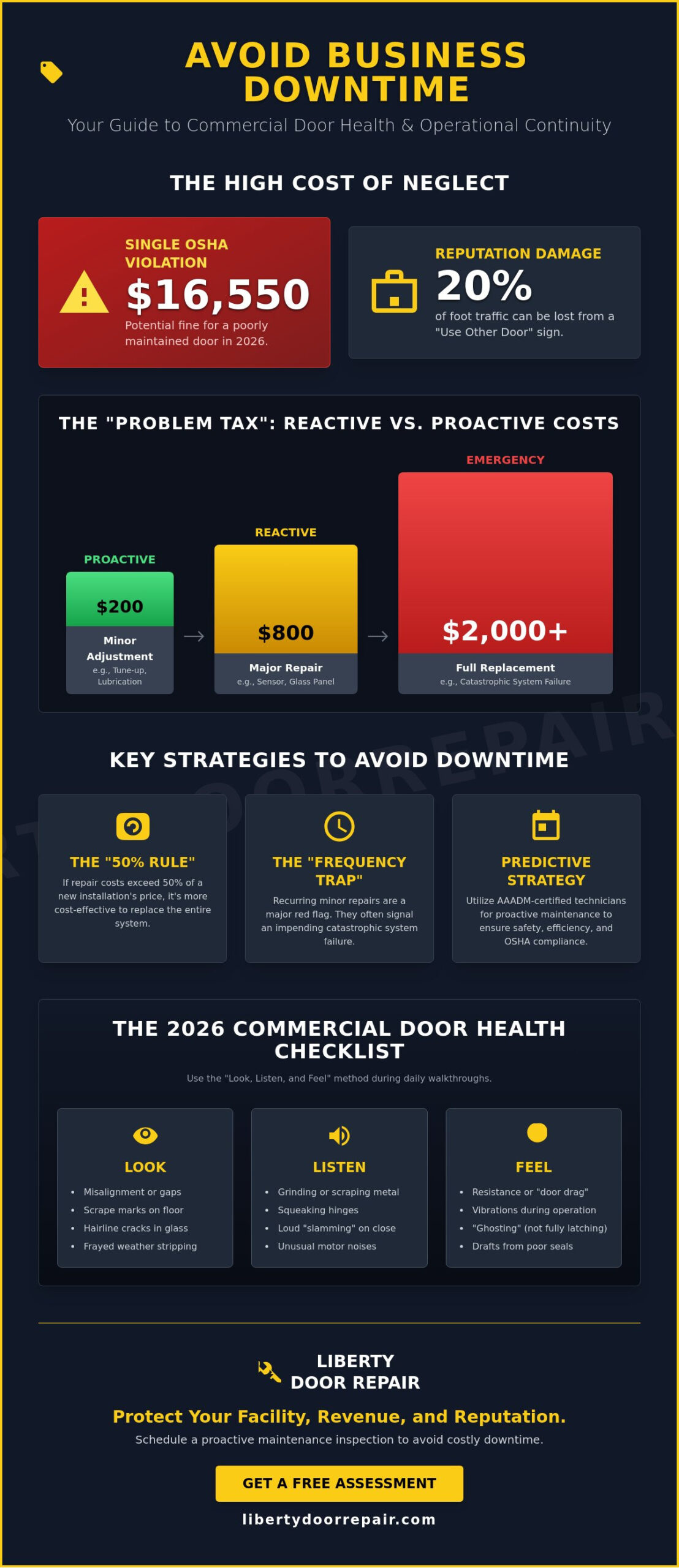
We call this the “Problem Tax.” It’s the financial penalty for waiting until something breaks. A technician might charge $200 for a basic tune-up or hinge adjustment today. If you ignore that squeak or slow close, you’re looking at a $2,000 emergency replacement tomorrow. Reactive maintenance is always the most expensive choice. In the humid Georgia climate, door neglect also hits your utility bills. Gaps in seals or doors that won’t close fully force your HVAC system to work overtime. This leads to spiked energy costs and premature equipment failure. Consider these common cost escalations:
- Minor adjustments: $150 to $350 for lubrication and sensor calibration.
- Major hardware failure: $400 to $1,200 for glass panels or automatic sensors.
- Full system failure: $2,000 to $10,000 for total door replacement.
Legal risks add another layer of expense. Non-functional ADA-compliant openers or fire-rated doors aren’t just inconveniences. They are code violations. As of 2026, fire safety standards like BS 8214:2026 require a “Complete System” approach. If your hardware fails, your entire assembly is non-compliant. This exposes you to litigation and heavy fines. Smart facility managers prioritize maintenance schedules to avoid business downtime door repair emergencies before they become legal liabilities.
The Operational Bottleneck: When Doors Stop Logistics
A malfunctioning warehouse dock door can stall an entire supply chain in minutes. When High-speed industrial doors fail, trucks sit idle and labor costs skyrocket. You’re paying employees to wait for a repair instead of moving inventory. Operational downtime is any period where a primary entry or exit point restricts standard business flow. This ripple effect can turn a minor mechanical glitch into a logistical nightmare that costs thousands in lost productivity.
Reputation and the “Closed for Business” Signal
First impressions are physical. A “Please Use Other Door” sign is a signal of neglect. Industry data shows these signs can drive away 20% of spontaneous foot traffic. Customers associate a broken entryway with poor service quality and a lack of professionalism. Investing in commercial door repair Atlanta ensures your storefront remains a welcoming gateway rather than a liability. Trust is built at the threshold. Don’t let a faulty hinge tell customers you’re too busy to care about your facility.
The 2026 Commercial Door Health Checklist
Unplanned equipment failure costs industrial manufacturers as much as $50 billion a year. While your facility might not be a massive factory, the principle remains the same. A single jammed entrance can halt your entire operation. To effectively avoid business downtime door repair emergencies, your team should adopt the “Look, Listen, and Feel” method during daily walkthroughs. Look for misalignment. Listen for grinding metal. Feel for resistance or “door drag” against the floor. These subtle signs are early warnings of catastrophic failure.
Energy efficiency is another critical factor in your 2026 inspection framework. Check your weather stripping and thresholds monthly. In the humid Atlanta climate, even a small gap in a storefront seal allows conditioned air to escape. This forces your HVAC system to work harder and drives up overhead costs. A well-maintained door is a sealed door. If you notice light peeking through the edges or feel a draft, it’s time for a professional adjustment.
Storefront and Glass Door Inspection
Start at the threshold. If you see scrape marks on the floor, your pivots or hinges are likely failing. This “door drag” puts immense stress on the frame. Next, test the door closer speed. It should close smoothly without “slamming” or “ghosting” (stopping before it’s fully latched). Finally, examine the glass for hairline cracks. Thermal stress from Georgia’s temperature swings can turn a tiny nick into a shattered pane during the next heatwave.
Automatic Door & Access Control Systems
Safety is the priority here. Verify that sensors detect traffic at the correct range to stay compliant with AAADM standards. You should also test the backup battery systems for your keyless entry systems. If the power fails, your doors must remain secure but accessible to authorized personnel. Don’t forget to test the emergency “break-out” function on sliding doors; it must engage with minimal force to ensure a safe exit route during a fire.
Industrial Dock and Overhead Doors
Industrial doors handle the heaviest workloads. Inspect the tension springs for any signs of rust or gaps between the coils. A snapped spring can cause a door to crash down, creating a severe safety hazard. Check the tracks for alignment and look for denting caused by forklift impacts. Ensure that all safety cables are intact and that photo-eyes are clean and unobstructed. If your hardware feels sluggish, you can request a professional inspection to prevent a total logistics standstill.
Repair vs. Replace: The Predictability Framework
Facility managers often struggle with the “repair or replace” dilemma. To effectively avoid business downtime door repair headaches, you need a clear financial framework. We recommend the “50% Rule.” If an estimated repair cost exceeds 50% of the price of a new door, replacement is usually the smarter investment. Pouring money into an aging asset that has reached the end of its service life is a recipe for recurring failure. You’ll end up paying more in the long run through multiple service calls and lost productivity.
Watch out for the “Frequency Trap.” If you’ve called for service three or more times in a single year for the same door, you aren’t fixing a problem; you’re managing a failure. These recurring costs quickly surpass the price of a modern, reliable system. Technological upgrades can also change the math. Switching to high-speed doors in high-traffic areas can drastically reduce cycle times and minimize the risk of forklift impacts. Modern systems are built for high-cycle environments and significantly lower the risk of unplanned outages.
When to Opt for Professional Repair
Many issues are solved with simple hardware swaps. We identify “wear items” like rollers, hinges, and closers that are designed for routine replacement. These parts bear the brunt of thousands of cycles. Before we commit to a fix, our technicians perform a structural “bone” check. This involves inspecting the integrity of the frame and the door leaf itself. We define an “economical repair” as a fix that restores a door to 95% of its original factory performance. If a repair can’t meet that standard, it’s just a temporary patch on a failing system.
When Replacement is the Only Strategic Choice
Replacement becomes necessary when hardware goes obsolete. If manufacturers stop making your specific parts, a minor break can lead to weeks of downtime while you hunt for a used component. You can’t fix what you can’t find. Structural damage is another dealbreaker. If your building has settled or a forklift has twisted the frame, no amount of adjustment will make that door hang straight. You’ll keep paying for service calls that don’t solve the root cause.
Investing in commercial door replacement offers a high ROI through improved security and superior thermal insulation. Newer doors feature advanced security sensors and better R-values that older models simply lack. This move protects your inventory and reduces your energy overhead simultaneously. When a door is too far gone, a new installation is the only way to ensure your facility stays secure and operational without the constant threat of a breakdown.
Preventative Maintenance: Avoiding the Emergency Call
Waiting for a door to break before calling for service is a high-risk gamble. In the Metro Atlanta business community, the “run-to-fail” model is consistently the most expensive maintenance strategy. It forces you into emergency situations where parts might not be in stock and labor rates are at their highest. To effectively avoid business downtime door repair disasters, you must transition to a proactive schedule. A planned service visit allows you to control the timing of repairs. This ensures they happen during off-hours rather than during a Saturday afternoon rush.
Local environmental factors play a massive role in door longevity. Atlanta’s humidity levels often exceed 70% in the summer, which accelerates rust on hinges and rollers. Even more critical is the spring pollen season. When pollen counts hit 6,000 or higher, the fine yellow dust settles on automatic door sensors and clogs the internal lubricants of overhead tracks. This leads to sensor malfunctions and motor strain. Regular cleaning and lubrication during these peak seasons can extend the life of your hardware by years.
Documentation is your best defense against liability. Keep a detailed maintenance log for every entryway. Insurance providers and fire marshals often require proof of service during inspections. If an accident occurs and you can’t produce a signed maintenance record, your business could face denied claims or massive legal penalties. Our trusted experts provide the documentation you need to stay compliant and protected.
The Role of AAADM-Certified Technicians
Certification matters. AAADM certification is the industry gold standard for automatic door services. A general handyman might get a door moving again, but they often overlook critical safety settings like entrapment protection or sensor timing. Our skilled technicians are trained to calibrate doors to exact safety specifications. This certified sign-off provides a layer of liability protection that uncertified labor simply cannot offer. We bring over 30 years of experience to every inspection. We ensure your doors are safe for both employees and customers.
Fire Door Compliance and Inspection
Fire doors are life-safety equipment. NFPA 80 requires these doors to be inspected and tested annually. A fire door that doesn’t latch properly is useless during an emergency. During your walkthrough, use this mini-checklist:
- Ensure the door closes fully from any open position.
- Verify the latching hardware engages securely without manual help.
- Check that the door is free of holes or physical damage.
- Confirm that no “homemade” wedges or kick-down holders are in use.
For a complete compliance review, visit our fire door services page. We help you stay ahead of the fire marshal and keep your building safe.
Liberty Door Repair: Your Partner in Operational Continuity
Operational success depends on a facility that stays open and accessible. For over 30 years, we’ve served as the trusted expert for Metro Atlanta’s commercial and residential door needs. We understand that a malfunctioning entryway is more than a mechanical glitch; it’s a threat to your bottom line. Our mission is to help you avoid business downtime door repair emergencies through rapid response and masterful technical skill. From the high-traffic storefronts in Alpharetta to the heavy-duty industrial docks in Marietta, we provide the reliable solutions you need to keep your business moving.
Our approach is built on dependable expertise. We don’t just patch problems; we solve them. We bring three decades of local experience to every job site. This ensures your facility remains compliant with the latest 2026 safety standards. Whether you’re dealing with a failed automatic sensor or a damaged fire door, our skilled technicians arrive ready to work. We value your time and prioritize effectiveness above all else. When you call us, you’re hiring a team that understands the urgency of your situation.
Why Atlanta Businesses Trust Liberty
Speed is critical when a door fails. We maintain a fast response rhythm for businesses in Sandy Springs, Decatur, and Roswell. Our service trucks are stocked with a wide inventory of specialized door parts & replacements. This allows us to complete most repairs on the first visit. We’re committed to “Getting it Fixed Right the First Time.” This philosophy eliminates the need for repeat service calls and helps you avoid business downtime door repair delays that frustrate your customers and staff.
Request Your Commercial Door Audit
Don’t wait for a total system failure to assess your facility’s health. A Liberty Door Repair professional evaluation provides a clear, no-nonsense service report on the state of your entryways. We’ll identify worn hinges, sluggish closers, and sensor misalignments before they lead to a shutdown. This audit gives you the data you need to plan your maintenance budget with precision. You’ll gain peace of mind knowing your building is secure and fully operational. Contact our AAADM-certified experts today to schedule your site assessment and protect your business from unexpected downtime.
Protect Your Revenue with Proactive Door Care
Your business threshold is too important to leave to chance. We’ve shown how the “Problem Tax” can turn a minor adjustment into a $2,000 emergency replacement. By following our 2026 health checklist and applying the Predictability Framework, you move from reactive panic to professional operational continuity. Don’t let Atlanta’s humidity or peak pollen counts compromise your security or your ADA compliance. Smart facility management is about making the right call before the failure occurs.
When you choose to avoid business downtime door repair emergencies with a scheduled maintenance plan, you protect your revenue and your reputation. Our AAADM-certified technicians bring 30+ years of local experience to every job site. We currently serve businesses in 20+ Metro Atlanta cities, providing the dependable expertise required to keep your doors moving and your customers coming through. Take the first step toward a more reliable facility today. Request Commercial Door Service in Metro Atlanta to get the professional audit your business deserves. It’s time to stop worrying about your entryways and focus on your growth.
Frequently Asked Questions
How can I avoid business downtime during a door repair?
You can avoid business downtime door repair delays by scheduling service during low-traffic windows or after-hours. Our technicians arrive with fully stocked vehicles containing specialized door parts and replacements to ensure most fixes are completed in a single visit. This proactive approach prevents the need for multiple service calls and keeps your storefront accessible for customers during your primary operating hours.
How often should commercial doors be inspected for safety?
High-traffic commercial doors require daily visual checks by your staff to identify obvious hazards like dragging or grinding. For regulatory compliance, fire doors must undergo professional inspection every 12 months as per NFPA 80 standards. Automatic doors should be serviced at least twice a year to ensure sensors remain calibrated and compliant with current safety codes and AAADM requirements.
Is it cheaper to repair or replace a commercial storefront door?
Repair is generally more cost-effective for minor hardware failures, but you should follow the “50% Rule” for major issues. If a repair quote exceeds 50% of the cost of a new door, replacement is the more economical long-term choice. Modern replacements offer superior energy efficiency and improved security, which helps offset the initial investment by reducing monthly utility and insurance costs.
What are the most common causes of automatic door failure in Georgia?
Humidity and pollen are the leading causes of door failure in the Metro Atlanta area. High moisture levels lead to rust on pivots and hinges, while pollen counts exceeding 6,000 often clog sensitive automatic sensors. These environmental factors cause motors to work harder, leading to premature burnout if regular cleaning and lubrication are neglected during peak Georgia seasons.
Do I really need an AAADM-certified technician for my business doors?
Yes, hiring an AAADM-certified technician is the only way to ensure your automatic doors meet national safety standards. Certification guarantees the expert understands complex sensor timing and entrapment protection requirements. Using uncertified labor for these repairs exposes your business to significant liability risks and potential OSHA penalties of up to $16,550 per serious violation as of 2026.
What happens if my business fails a fire door inspection?
Failing a fire door inspection can lead to immediate fines from the fire marshal and potential increases in insurance premiums. Non-compliance with BS 8214:2026 or NFPA 80 standards means your building is not legally safe for occupancy. You must complete the required repairs immediately to avoid a full operational shutdown and protect your facility from the 16,500 office fires reported annually by FEMA.
Can a broken door opener lead to higher energy bills?
A malfunctioning door closer or opener significantly increases your utility costs. If a door fails to latch or “ghosts” open, your HVAC system must work harder to combat Georgia’s 70% humidity levels. Maintaining tight seals and proper closing speeds is essential for protecting your building’s thermal envelope and reducing monthly overhead. Professional adjustments help you avoid business downtime door repair issues while lowering energy waste.
How long does a typical commercial door repair take?
Most standard commercial door repairs are completed within 1 to 3 hours. Basic tasks like hinge adjustments or sensor calibrations are fast, while glass replacement or motor repairs may take longer. Because our technicians arrive with 30+ years of experience and stocked vehicles, we prioritize getting your doors operational in a single service window to minimize any disruption to your daily operations.