

Your next industrial overhead door installation is now a race against new regulatory deadlines and rising operational costs. As of January 1, 2026, the Georgia Department of Community Affairs has adopted the 2024 International Building Code. This means every new permit in Atlanta must meet stricter safety and structural standards. If your facility isn’t prepared, you risk more than just a failed inspection; you risk significant downtime and security vulnerabilities.
You understand that a door is often the most frequent point of failure in a high-traffic warehouse. Constant repairs and skyrocketing energy bills from poor insulation shouldn’t be the norm for your business. We’re here to help you master the complexities of door selection to maximize your warehouse productivity and security.
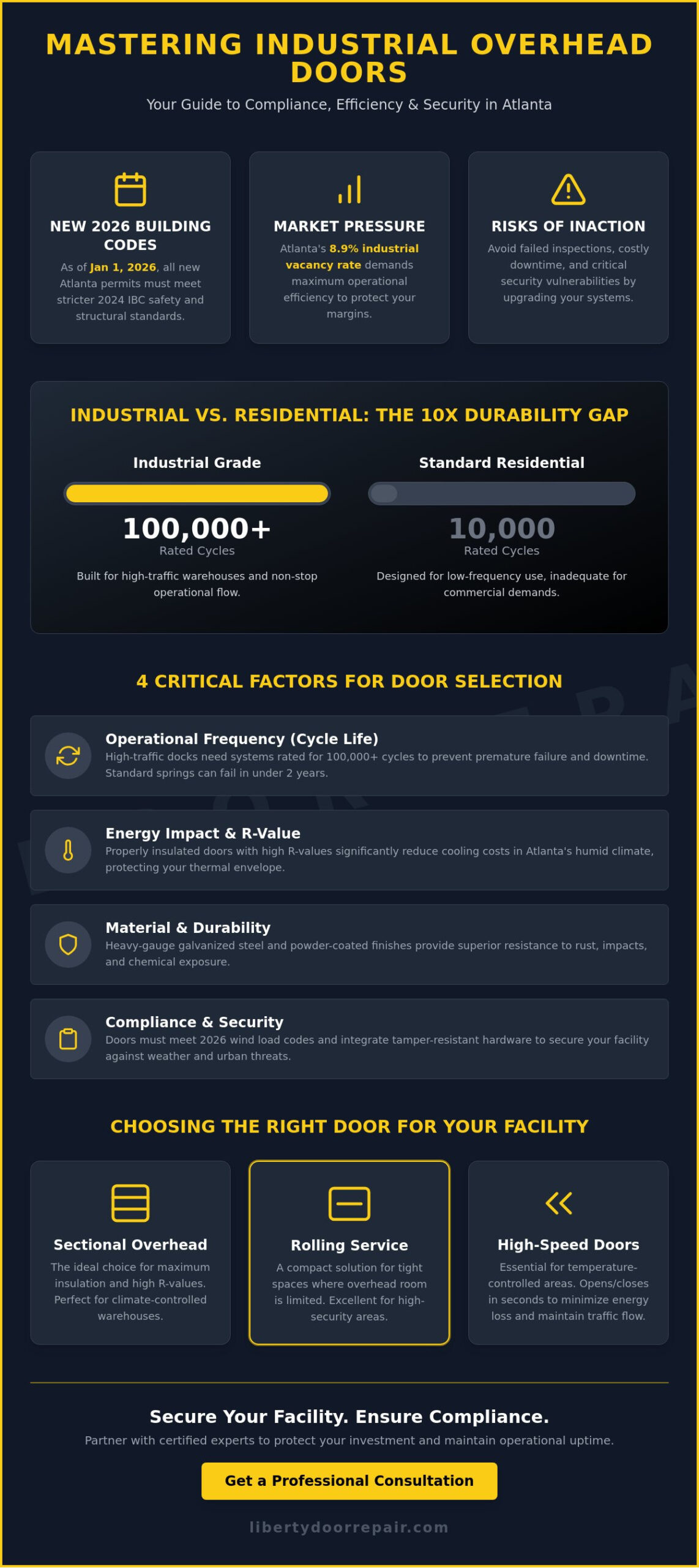
This guide covers everything from R-value optimization to compliance with the latest NFPA 101 Life Safety codes. You’ll learn how to navigate the current Atlanta industrial market, where vacancy rates sit at 8.9 percent and efficiency is the only way to protect your margins. We provide a clear path to a secure facility with zero operational friction.
Key Takeaways
- Understand why a professional industrial overhead door installation requires specialized system integration of high-cycle tracks and motors to handle heavy daily traffic.
- Learn to calculate R-values and energy impacts to significantly lower cooling costs in the humid Atlanta climate.
- Identify the critical pre-installation steps, including site audits and safety perimeter setups, that prevent operational friction during the build.
- Navigate the 2026 Georgia building code updates and urban security challenges to ensure your facility remains compliant and secure.
- Recognize the value of local, certified expertise in preventing hardware degradation and ensuring long-term reliability for your warehouse.
What is Industrial Overhead Door Installation?
Industrial overhead door installation is the professional fitting of heavy-duty, high-cycle barriers designed for extreme operational frequency. This process isn’t a simple hardware swap. It’s a comprehensive system integration where tracks, panels, and high-torque motors must work in perfect synchronization. In a busy Atlanta warehouse, these doors function as the primary valves of your supply chain. They control the flow of goods while maintaining the thermal envelope of your facility.
Industrial-grade systems differ significantly from standard commercial or residential options. While a residential door might be rated for 10,000 cycles, industrial installations often require components rated for 50,000 to 100,000 cycles. The hardware is heavier, the motors are more powerful, and the safety requirements are far more stringent. If a door fails in a distribution center, productivity stops instantly. This makes precision industrial overhead door installation a prerequisite for operational uptime.
Core Components of a High-Performance System
Every reliable system starts with the right track configuration. Standard lift tracks are common, but high-lift or vertical-lift tracks are often necessary to clear interior obstructions or maximize overhead storage. Panel materials also play a vital role. Heavy-gauge galvanized steel is the standard for durability, though reinforced composites are gaining ground for their corrosion resistance. The heart of the movement is the counterbalance system. High-cycle torsion springs are engineered to manage the immense weight of the panels, ensuring the motor doesn’t overwork and fail prematurely.
Primary Industrial Door Categories
Choosing the right category depends on your specific facility needs. A sectional overhead door is the preferred choice for facilities requiring maximum insulation and high R-values. These doors consist of large panels that slide up and along the ceiling. For tighter spaces where overhead room is limited, rolling service doors provide a compact solution by coiling into a drum above the header. These are excellent for high-security areas. Finally, high-speed doors are essential for temperature-controlled environments. They open and close in seconds, which drastically reduces energy loss and keeps traffic moving without delay.
Key Criteria for Selecting the Right Industrial Door
Selecting the correct door for your facility requires a data-driven approach. You must balance initial capital expenditure against long-term maintenance costs. A common mistake is choosing a door based solely on price without considering the “Repair vs. Replace” lifecycle. If your current door requires monthly service calls or has visible structural fatigue in the tracks, a new industrial overhead door installation is often more cost-effective than continued maintenance. The decision to replace hinges on four factors: frequency of failure, safety risks, energy loss, and compliance with industry safety standards.
Georgia’s climate also dictates specific hardware needs. High humidity in the Metro Atlanta area can lead to rapid track degradation and rust. Beyond climate, your door must meet 2026 structural codes for wind load resilience. These standards ensure your facility remains secure during severe weather events common in the Southeast. Integrating access control and tamper-resistant hardware further strengthens your perimeter against urban security threats.
Analyzing Operational Frequency (Cycle Life)
Cycle life is the most critical metric for durability. Standard springs are often rated for only 10,000 cycles. For a busy loading dock operating 20 times a day, these springs will likely snap within two years. High-cycle systems rated for 100,000 cycles or more are essential for high-traffic environments. A precision industrial overhead door installation using these components ensures you avoid emergency repair fees and operational downtime. Estimate your annual cycles by multiplying daily traffic by operating days to find your ideal hardware grade.
Material and Finish Options
Durability starts with the right material choice. Galvanized steel provides excellent protection against the elements, but powder-coated finishes offer superior corrosion resistance for facilities exposed to chemicals or extreme moisture. Investing in high-quality commercial steel doors ensures your facility can withstand the daily rigors of forklift impacts and heavy use. You should also consider perforated slats if your warehouse requires airflow without sacrificing security. If you need assistance determining which material fits your operational demands, consulting with experts in professional door services can prevent costly selection errors.
The Industrial Door Installation Process
A successful industrial overhead door installation is a precision engineering project that demands strict adherence to a timeline. It begins long before the first panel is lifted. Our process starts with a rigorous pre-installation site audit. We verify all structural clearances and inspect the integrity of the headers to ensure they can support heavy-duty hardware. We also confirm that the electrical supply matches the requirements of high-torque industrial operators. Skipping these checks leads to mid-project delays and increased costs.
Workplace safety is our immediate priority during the build. We establish a secure safety perimeter around the loading dock to protect your employees from falling debris or moving machinery. This minimizes operational friction while maintaining a hazardous-free zone. Precision track and spring alignment follows this setup. This phase is the most critical for long-term reliability. Even a minor misalignment causes premature wear on rollers and puts unnecessary strain on the motor.
Step-by-Step Installation Workflow
The workflow follows a logical, efficient sequence to get your facility back to full capacity. First, we prepare the headers and jambs for heavy-duty anchoring. Without a solid foundation, the door system will vibrate and loosen over time. Next, we assemble the sections and place the rollers to ensure smooth travel along the tracks. Spring tensioning is the most dangerous part of the process. It requires AAADM-certified professional handling to manage the immense energy stored in high-cycle torsion springs. Finally, we integrate the operator and access control systems to provide your team with seamless entry and exit points.
Safety Standards and Compliance
Compliance isn’t optional; it’s a legal requirement that protects your business from liability. Every installation must meet OSHA workplace safety standards under the General Duty Clause. This includes the installation of safety sensors and reversing edges that stop the door immediately if an obstruction is detected. For facilities with specific zoning requirements, we also ensure the system meets fire door services standards. These specialized barriers are essential for containing hazards within industrial partitions. We finish every job with a full system calibration and a safety sensor test to ensure your facility remains ADA and OSHA compliant from day one.
Metro Atlanta Factors: Climate, Security, and Local Codes
Atlanta’s industrial landscape presents unique challenges that generic national guides often overlook. From the heavy humidity of the Piedmont region to the specific security needs of the urban core, your industrial overhead door installation must be tailored to the local environment. In areas like Alpharetta and Marietta, moisture is a constant threat to track longevity. High humidity levels accelerate oxidation on standard steel components. Without specialized galvanized coatings or powder-coated finishes, rust can seize a track system in just a few seasons, leading to expensive emergency repairs.
Urban facilities in downtown Atlanta face different pressures. High-security rolling doors are often a necessity rather than an upgrade to protect against unauthorized access and tampering. These systems feature interlock slats and reinforced bottom bars that standard doors lack. Meanwhile, if you’re planning an industrial expansion in Canton or Woodstock, you must navigate the 2026 Georgia building code updates. These local permitting requirements ensure your facility meets new storm resilience and fire safety standards. Our experience serving North Georgia businesses since 2015 in Metro Atlanta allows us to troubleshoot local environmental wear patterns faster than national competitors.
Climate Control and Energy Efficiency in GA
Georgia summers are notoriously unforgiving on your facility’s cooling budget. High R-value doors are essential for maintaining a consistent internal temperature and reducing energy bills during peak heat months. In warehouses across Cumming, we emphasize the importance of heavy-duty weather stripping and perimeter seals. These components do more than just block heat; they keep out the pests and humidity that can damage sensitive inventory or electronic equipment. When selecting door panels, you must balance the need for natural light with your privacy requirements. Vision lites provide essential visibility for safety in high-traffic docks but should be positioned strategically to maintain facility security.
Local Service and Maintenance Response
When a door fails, proximity is the only thing that matters. Reducing downtime in Duluth, Lawrenceville, and Roswell requires a partner who’s already in your neighborhood. Waiting for a technician from another region isn’t an option when your loading dock is paralyzed and shipments are backing up. You need a local specialist for commercial door repair Atlanta to restore your operations immediately. Developing a preventative maintenance schedule tailored to local traffic patterns is the best way to avoid these emergencies. Regular inspections catch track degradation and spring fatigue before they lead to a total system failure. If your current system is showing signs of struggle, schedule a professional site evaluation to ensure your facility remains secure and efficient.
Why Liberty Door Repair is the Right Choice for Your Installation
Your facility’s uptime depends on hardware that works every single time. Liberty Door Repair has served North Georgia businesses since 2015. We don’t just install doors; we engineer solutions that survive the rigors of high-volume logistics. Our team understands that an industrial overhead door installation is a capital investment that must pay off through years of reliable service. We’ve spent since 2015 mastering the specific environmental and operational demands of Georgia’s industrial corridors. This localized knowledge ensures your installation isn’t just a generic fit but a precision-tuned entry point for your business.
Technical mastery is the foundation of our service. Our AAADM-certified technicians ensure every component meets the highest safety and performance standards. This certification isn’t just a badge. It represents a deep understanding of the complex mechanics involved in heavy-duty door systems. Whether your project involves a standard dock door or a complex commercial door replacement, we bring the same level of professional intensity to the job. We prioritize speed and effectiveness because we know that every hour your dock is down is an hour of lost revenue.
The Liberty Advantage: Expert-Led Installation
When you call Liberty Door Repair, you get direct access to experienced technicians. You won’t have to deal with sales representatives who have never stepped onto a loading dock. We provide customized hardware solutions based on your facility’s specific throughput and traffic patterns. We analyze your cycle needs and environmental exposure to select the right materials before the first track is bolted. Once the industrial overhead door installation is complete, we provide full documentation for your safety records. This post-installation support ensures you remain compliant with local codes and ready for any inspection.
Get Your Industrial Installation Quote Today
Don’t wait for a hardware failure to address your facility’s security and efficiency. We make the consultation process straightforward and professional. You can schedule a comprehensive site audit in Alpharetta, Kennesaw, or Sandy Springs to get an accurate assessment of your needs. To make the most of your consultation, have your rough door dimensions and daily cycle estimates ready. We’ll use this data to provide a no-nonsense quote that reflects the true requirements of your facility. Schedule your industrial overhead door installation audit with Liberty Door Repair today.
Optimize Your Facility’s Performance and Security Today
Your warehouse is only as efficient as its primary entry points. Success in the 2026 Atlanta industrial market requires a proactive approach to facility maintenance and regulatory compliance. By prioritizing high-cycle hardware and adhering to the latest Georgia building codes, you eliminate the risk of unexpected downtime and costly safety violations. A professional industrial overhead door installation is more than just a basic facility upgrade. It’s a strategic investment that lowers energy bills and hardens your security perimeter against evolving urban threats.
Liberty Door Repair has served North Georgia businesses since 2015, working with your job site. Our AAADM-certified technicians possess deep expertise in ADA and fire-rated compliance, ensuring your facility meets every regulatory requirement from day one. We provide the dependable, no-nonsense expertise you need to keep your supply chain moving without friction or failure. We understand the urgency of your operations and deliver results that last.
Don’t let an aging or inefficient door compromise your daily operations. Request a Professional Industrial Installation Quote from our team of specialists today. We’re ready to help you build a more secure and efficient future for your business.
Frequently Asked Questions
How long does a typical industrial overhead door installation take?
A standard industrial overhead door installation typically takes between four and eight hours per door. Complex configurations involving high-lift tracks or integrated access control systems might extend the timeline to a full business day. We prioritize efficiency to minimize your operational downtime. Our technicians arrive with all necessary components to ensure the loading dock is back in service as quickly as possible.
Can I upgrade my current door to a high-speed model without replacing the tracks?
No, you cannot safely upgrade to a high-speed model without replacing the existing track system. High-speed doors operate at significantly higher velocities and generate intense kinetic energy that standard tracks can’t support. These systems require specialized, reinforced tracks and high-torque motors designed for rapid cycles. Attempting to reuse old hardware leads to immediate mechanical failure and creates severe safety risks for your employees.
What is the difference between R-value and U-factor in industrial door insulation?
R-value measures the thermal resistance of the door’s internal insulation material. In contrast, the U-factor measures the heat transfer rate through the entire door assembly, including the panels, seals, and hardware. While a high R-value is important, a low U-factor is a more accurate predictor of energy efficiency for Atlanta warehouses. It accounts for the air leakage that often occurs at the joints and perimeter seals.
Are rolling steel doors more secure than sectional doors for Atlanta warehouses?
Rolling steel doors generally offer superior security for high-risk urban environments. They consist of interlocking metal slats that are difficult to pry apart or penetrate. Sectional doors are excellent for thermal insulation but have more visible points of entry at the panel hinges. For facilities in downtown Atlanta, we often recommend rolling steel doors to provide a hardened perimeter against unauthorized access and tampering.
How often should industrial overhead doors be professionally inspected?
You should schedule professional inspections at least twice per year to maintain safety and compliance. High-traffic distribution centers operating 24/7 often require quarterly maintenance to manage the wear on high-cycle springs and rollers. Regular inspections catch minor track misalignments and cable fraying before they turn into expensive emergency repairs. This proactive approach is the best way to extend the lifespan of your hardware.
Do I need a permit for a new industrial door installation in Metro Atlanta?
Yes, most municipalities in Metro Atlanta require a permit for a new industrial overhead door installation, especially during facility expansions. Local building departments in areas like Marietta and Alpharetta enforce specific wind load and fire safety codes. We assist with the necessary technical documentation to ensure your project meets the 2024 International Building Code standards adopted by Georgia in 2026.
What happens if our industrial door fails after-hours?
If a door fails after-hours, your priority is to secure the perimeter and prevent unauthorized entry. While we don’t provide 24/7 emergency services, we recommend that facility managers keep manual override keys accessible to close the door safely. You should then contact us to schedule a priority repair for the next business morning. Rapid response during business hours ensures your supply chain remains moving with minimal disruption.
Can Liberty Door Repair integrate access control with my new overhead door?
We can absolutely integrate advanced access control solutions with your door system. Our technicians sync your industrial operators with card readers, biometric scanners, or vehicle sensing loops to streamline your facility’s traffic flow. This integration allows you to monitor every entry and exit point in real-time. It provides a seamless balance between high-speed operational efficiency and rigorous warehouse security.