

Did you know that a single malfunctioning sensor or a door that closes too fast can expose your Atlanta business to massive legal liability and ADA fines? It’s a risk most owners don’t realize they’re taking until an activation fails or a pedestrian is injured. When your storefront entrance breaks down, it isn’t just an inconvenience; it’s lost revenue and a potential lawsuit waiting to happen. Securing a professional automatic door service is the only way to ensure your facility stays compliant with the latest ANSI A156.10 and A156.19 standards.
We understand that navigating the 2010 ADA Standards for Accessible Design and the updated 2026 safety requirements feels overwhelming. You want your doors to work perfectly every time without worrying about 32-inch clear width requirements or specific closing speeds. This article will show you how AAADM-certified expertise protects your bottom line. We’ll cover the benefits of preventative maintenance, how to achieve full compliance with accessibility laws, and the best ways to extend the lifespan of your expensive automatic hardware.
Key Takeaways
- Learn why professional automatic door service is essential for aligning your facility’s sensors and controllers with current ANSI/BHMA safety standards.
- Identify the critical differences between servicing high-traffic sliding doors and low-energy swinging operators in commercial environments.
- Discover how a structured preventative maintenance plan reduces long-term costs and prevents unexpected entrance failures.
- Master the daily safety check procedures necessary to keep your business fully compliant with ADA and ANSI regulations.
- Explore the benefits of partnering with AAADM-certified technicians who bring over 30 years of experience to the Metro Atlanta area.
The Importance of Professional Automatic Door Service for Atlanta Businesses
Professional automatic door service is a technical discipline that goes far beyond simple mechanical repair. It involves the precise calibration of sensors, motors, and electronic controllers to ensure every component meets rigorous ANSI/BHMA safety standards. While the history of automatic doors began with a focus on basic convenience, today’s systems are sophisticated safety barriers. For Metro Atlanta businesses, entrance reliability is a non-negotiable priority. High-traffic retail hubs and busy healthcare facilities in cities like Marietta and Decatur depend on these systems to manage the flow of people efficiently. You can’t afford a breakdown when your doors are the primary gateway for your customers.
Entrance failures create immediate operational crises. In Georgia’s intense climate, a door that fails to close properly leads to skyrocketing energy costs. Your HVAC system shouldn’t have to compete with the outdoor heat because of a faulty door seal or a misconfigured sensor. Beyond the utility bill, a “stuck door” scenario is a customer service disaster. If a patron encounters a broken entrance, they often perceive the entire business as poorly managed. They don’t want to struggle with a heavy manual door; they want a seamless experience. If you don’t provide it, they’ll likely head to a competitor who does. Regular automatic door service prevents these avoidable friction points.
Liability and Safety: Beyond Simple Convenience
Malfunctioning sensors represent a significant legal risk. If a door fails to detect a pedestrian or closes with excessive force, the resulting injuries can lead to costly litigation. Regular service provides the documented maintenance history you need to protect your business during insurance audits. Our technicians focus on the specialized hardware that prevents pedestrian contact. We ensure every safety zone is active and complies with current standards. This proactive approach stops accidents before they occur.
First Impressions and Building Accessibility
Your entrance is the first handshake you have with a customer. In competitive markets like Buckhead or Alpharetta, brand perception starts the moment a visitor approaches your building. A jerky, noisy, or slow-moving door creates an immediate negative impression. We help you maintain a barrier-free environment that welcomes everyone. Providing a reliable, accessible entrance isn’t just about meeting a legal requirement. It’s about ensuring every visitor feels valued from the second they arrive at your facility.
Comprehensive Solutions: Sliding, Swinging, and ICU Door Systems
Expert automatic door service requires a technician who understands the nuances of every major hardware brand. Unlike manufacturers who only service their own proprietary models, we provide comprehensive repairs for all systems. Central to this expertise is our AAADM certification. This credential from the American Association of Automatic Door Manufacturers ensures our team is specifically trained to inspect and certify doors according to ANSI safety standards. It provides you with peace of mind that your entrances are safe, legal, and efficient.
Automatic Sliding Door Maintenance
Retail and grocery stores across Atlanta rely on automatic sliding doors for high-volume foot traffic. Constant use leads to inevitable wear on tracks and rollers. When these components fail, the door may jump its track or strain the motor. We focus on precision sensor calibration to ensure motion detectors and safety beams are perfectly synced. This prevents the door from closing on pedestrians. Additionally, we prioritize high-quality weather stripping. In Atlanta’s humid summers, effective seals are critical for maintaining indoor climate control and reducing energy waste.
Swinging Door Operators and ADA Openers
Office buildings and healthcare facilities often utilize automatic swinging doors to improve flow and accessibility. We specialize in optimizing low-energy operators for ADA-compliant door openers. Our technicians adjust closing speeds and opening force to meet strict 2026 accessibility guidelines. If your building currently relies on manual doors, we can retrofit them with automatic swing capabilities. This upgrade immediately improves the user experience for everyone entering your facility.
In Atlanta’s medical corridor, specialized environments like ICUs and cleanrooms require even greater precision. These systems must maintain specific pressure differentials and operate with absolute reliability. We provide dedicated maintenance for these sensitive areas, ensuring the hardware performs exactly as required. To further enhance security, we facilitate the integration of access control solutions with your automatic operators. This allows for seamless, secure entry that works in tandem with your building’s safety protocols. If your system is showing signs of wear, contact us for a professional automatic door service assessment.
Preventative Maintenance vs. Emergency Automatic Door Repair
Relying on a reactive maintenance strategy is a gamble that most Atlanta business owners eventually lose. If you only call for help when a door is completely stuck, you’ve already lost money. Emergency downtime creates immediate bottlenecks that frustrate customers and disrupt your operations. Professional automatic door service isn’t just about fixing what’s broken; it’s about identifying small mechanical stresses before they turn into total system failures. Our team uses over 30 years of experience to help businesses in Marietta, Decatur, and Sandy Springs avoid these costly surprises.
You don’t need to be a technician to spot trouble early. Keep an eye out for these warning signs that your system needs professional attention:
- Grinding or squealing noises during the opening or closing cycle.
- Jerky, uneven movements that suggest rollers are flat or the track is obstructed.
- Delayed sensing where the door hesitates to open as a person approaches.
- Closing speeds that feel too fast or too slow compared to standard operation.
The True Cost of Entrapment and Downtime
When your main entrance is out of commission, your revenue takes a direct hit. Customers often assume a business is closed if the automatic doors don’t respond. Beyond lost sales, a malfunctioning door is a liability. If a sensor fails to detect a visitor, you risk a pedestrian injury and a subsequent lawsuit. Preventative checks extend the life of your expensive control boards by ensuring they aren’t working overtime to compensate for mechanical friction. A standard commercial operator’s cycle life refers to the total number of times the door can open and close before the mechanical components reach their expected point of failure.
AAADM-Certified Inspections: The Gold Standard
Working with an American Association of Automatic Door Manufacturers certified technician ensures your facility stays compliant with ANSI A156.10 and A156.19 standards. This certification is the industry benchmark for safety and technical skill. During a professional visit, we perform a rigorous 14-point safety check. This includes testing sensor zones, measuring opening force, and verifying that closing speeds meet 2026 requirements. We also ensure your fire door services are fully integrated with your automatic closers. This holistic approach protects your building’s occupants and your bottom line. Don’t wait for a breakdown to realize the value of a reliable entrance.
Ensuring ADA Compliance and ANSI Safety Standards
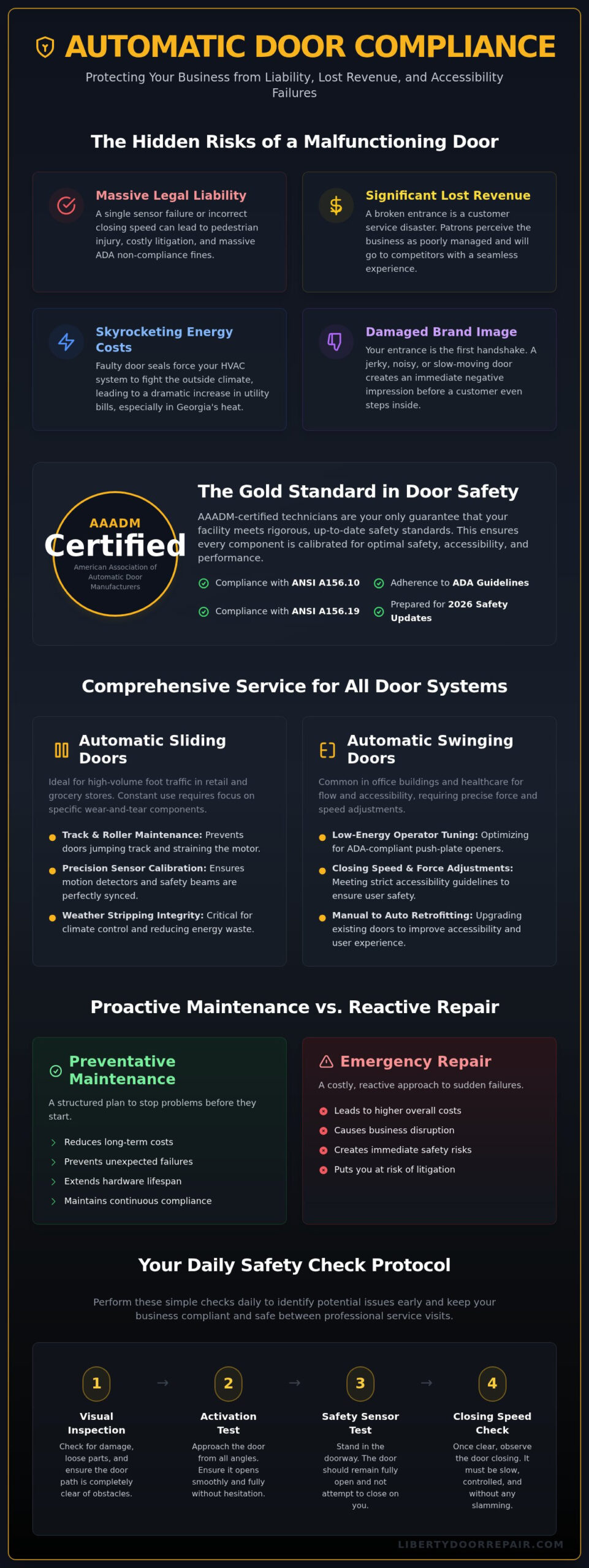
Compliance isn’t a one-time event; it’s a continuous obligation for every business owner. Navigating the complexities of ANSI A156.10 for full-power doors and ANSI A156.19 for low-energy systems requires technical precision. The primary differentiator between these standards is the trigger mechanism. A low-energy door requires a “knowing act,” such as pressing a wall switch or a push plate, to initiate the opening cycle. In contrast, full-power systems rely on sophisticated motion sensors and safety mats to detect pedestrians automatically. Professional automatic door service ensures these triggers are calibrated to current 2026 safety requirements, protecting your business from liability and fines.
Signage is another critical, yet often overlooked, component of compliance. Legally mandated decals like “Caution” and “Automatic Door” must be visible and correctly positioned at eye level. These aren’t just helpful suggestions; they are required indicators that prevent pedestrian confusion and accidents. If your decals are peeling, faded, or missing, your facility is technically non-compliant. Regular inspections verify that all required safety messaging is in place and meets the latest ANSI visibility standards.
Daily Safety Check Checklist for Facility Managers
Facility managers should perform a basic safety check every morning to catch obvious failures before they cause an injury. This routine only takes a few minutes but provides an essential layer of protection. Use the following steps to verify your system’s health:
- Walk-through test: Walk toward the entrance at a normal pace. The door should begin to open when you are several feet away and open smoothly without hesitation.
- Detection zone check: Stand motionless in the door’s path. The door should remain open as long as you are within the detection zone or on the safety mat.
- Re-open function: Observe the door as it begins to close. If an obstruction is detected, it must reverse immediately.
- Force test: Ensure the door doesn’t close with excessive force. For full-power doors, the force should not exceed 15 lbs.
ADA Standards for Pedestrian Entrances
The Americans with Disabilities Act mandates specific physical dimensions for all public entrances. Every automatic door must provide a clear opening width of at least 32 inches to accommodate wheelchairs and mobility aids. Thresholds are another common failure point; they must be managed carefully to prevent tripping hazards. Generally, thresholds should not exceed 1/2 inch in height. Furthermore, interior doors on accessible routes are required to operate with no more than 5 lbs of opening force. If your current entrances are struggling to meet these benchmarks, it may be time for a commercial door replacement to ensure full facility accessibility. To protect your investment and remain compliant, schedule an automatic door service consultation today to verify your system’s performance.
Choosing Liberty Door Repair for Your Metro Atlanta Facility
Liberty Door Repair brings over 30 years of specialized experience to the Metro Atlanta business community. We aren’t just general contractors; we’re dedicated specialists focused on high-performance entrance systems. Every technician on our team maintains current AAADM certification. This means the person servicing your facility is trained to the highest industry standards for safety and technical precision. We understand the urgency of a broken entrance. Our team provides fast, professional automatic door services designed to restore your operations without unnecessary delays.
We’ve built our reputation on being the dependable local specialist that property managers can count on. Our deep roots in the Georgia market allow us to provide a level of service that national providers simply can’t match. We know the local building codes and the specific environmental demands that Atlanta’s humidity puts on your hardware. Choosing a local expert ensures you receive a solution tailored to your specific facility and traffic volume.
Our Metro Atlanta Service Area
We provide comprehensive coverage across more than 19 cities in the Metro Atlanta area. Whether you manage a retail hub in Alpharetta, a medical clinic in Johns Creek, or a warehouse in Duluth, we’re your nearby partner for entrance reliability. Proximity is a major advantage when your doors fail. Our technicians arrive in fully equipped vehicles stocked with high-quality door parts & replacements. This allows us to complete most repairs on the spot, saving you from extended downtime. We also serve commercial hubs in:
- Marietta and Roswell
- Decatur and Sandy Springs
- Smyrna and Brookhaven
- Lawrenceville and Norcross
The Liberty Door Repair Guarantee
Reliability is the core of our business model. We’re committed to getting the job done right the first time to minimize disruption to your staff and customers. Property managers trust our no-nonsense approach because we prioritize effectiveness over everything else. We don’t just patch problems; we provide the professional maintenance needed to extend the lifespan of your expensive automatic hardware. Don’t leave your building’s accessibility and security to an uncertified generalist. Contact us today for a comprehensive automatic door safety audit to ensure your business remains compliant and secure.
Secure Your Business with Certified Entrance Solutions
Maintaining a safe and accessible entrance is a critical responsibility for any Metro Atlanta property manager. From ensuring ADA compliance to performing daily safety checks, the technical details of your hardware matter. You’ve learned that proactive care isn’t just about convenience; it’s a strategic move to protect your business from liability and reduce long-term repair costs. Whether you operate a high-traffic retail storefront in Buckhead or a specialized medical facility in Alpharetta, your doors require precision care.
Liberty Door Repair stands ready to deliver the expert automatic door service your facility deserves. As A+ rated commercial door specialists with over 30 years of Atlanta experience, we provide the specialized knowledge needed to keep your systems running flawlessly. Our AAADM-certified technicians handle everything from sensor calibration to full operator repairs with absolute professionalism. Don’t wait for a mechanical failure to compromise your building’s security or accessibility.
Schedule Your AAADM-Certified Automatic Door Service Today. We look forward to helping your business remain secure, compliant, and welcoming to every visitor.
Frequently Asked Questions
How often should my commercial automatic doors be serviced?
Your commercial doors should receive professional service at least once per year. For high-traffic retail or healthcare environments in Metro Atlanta, we recommend inspections every six months. Regular maintenance identifies worn rollers or misaligned sensors before they cause a total system failure. This proactive approach extends the lifespan of your expensive hardware and ensures you don’t violate safety standards. Frequent cycles put immense strain on motors, making consistent check-ups essential for entrance reliability.
What is an AAADM-certified technician, and why do I need one?
An AAADM-certified technician is a professional specifically trained by the American Association of Automatic Door Manufacturers to inspect and certify doors according to ANSI standards. You need one because it’s the only way to guarantee your entrances are safe and legal. General contractors often lack the specialized knowledge to calibrate high-power sensors or verify closing force requirements. These technicians provide the documented proof of safety that protects your business from liability during insurance audits.
Do automatic doors need to be ADA compliant in Georgia?
Yes, automatic doors must be ADA compliant in Georgia because federal accessibility laws apply to all public facilities. This includes providing a minimum clear opening width of 32 inches and ensuring thresholds don’t exceed 1/2 inch in height. Interior doors on accessible routes must also operate with no more than 5 lbs of opening force. Failing to meet these standards creates barriers for your customers. Our automatic door service includes a full compliance audit.
What are the most common causes of automatic door failure?
The most common causes of failure include sensor misalignment, worn-out rollers, and debris in the tracks. Sensors often become blocked or lose calibration, causing the door to stay open or fail to detect pedestrians. Mechanical parts like rollers and belts wear down over thousands of cycles, leading to jerky movements or motor strain. Environmental factors in Georgia, like extreme humidity, can also degrade electronic components, necessitating specialized automatic door service to maintain peak performance.
Can a regular locksmith repair my automatic sliding door?
The primary safety standards are ANSI/BHMA A156.10 for full-power automatic doors and ANSI/BHMA A156.19 for low-energy, power-operated doors. These regulations dictate everything from how fast a door can close to where safety sensors must be positioned. Compliance with these standards is verified during our professional inspections. Staying current with these codes is the best way to prevent pedestrian accidents and ensure your business remains in good standing with insurance providers and local inspectors.
How do I perform a daily safety check on my automatic entrance?
You can perform a daily safety check by walking toward the door at a normal pace to verify it opens smoothly. Stand motionless in the path of the door to ensure it remains open while you’re in the detection zone. Observe the door as it closes; it must reverse immediately if it senses an obstruction. Finally, verify that the area around the door is free of tripping hazards and that all required “Caution” and “Automatic Door” signage is clearly visible.
Does Liberty Door Repair service all brands of automatic door operators?
Yes, Liberty Door Repair services all major brands of automatic door operators. We’re not limited to a single manufacturer, allowing us to maintain sliding, swinging, and ICU door systems regardless of who installed them. Our technicians carry a wide range of parts to handle repairs for various models on the first visit. This brand-agnostic approach ensures that Atlanta property managers receive the most effective and efficient service possible for their specific entrance hardware.